



Ritter Sport wins packaging trademark battle over square snack bars

Key takeaways
- Ritter Sport has won a trademark dispute against Wacker over its square snack bar packaging.
- A German court ruled that Wacker’s packaging creates a likelihood of consumer confusion with Ritter Sport’s protected design and that it must stop using the disputed packaging.
- Ritter Sport can pursue damages, product recalls, and legal costs, while Wacker can challenge the court’s refusal to allow an appeal.
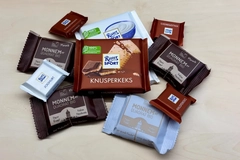 (Image credit: Ritter Sport).
Ritter Sport has won a trademark dispute over its square chocolate bar packaging featuring two serrated edges and a back closure.
Last week, the Higher Regional Court of Stuttgart, Germany, ruled that organic food manufacturer Wacker has infringed trademark rights due to the likeness of its Monnemer Quadrat Bio — Kakao Haselnuss and Monnemer Quadrat Bio — Kokos Mandel oat bar packaging.
The judgment is not yet legally final. Moving forward, Wacker can challenge the court’s refusal to allow an appeal by filing a complaint with Germany’s Federal Court of Justice within one month.
“The shape of the Mannheim Square packaging clearly resembles that of a Ritter Sport chocolate bar,” states the German chocolate and confectionery manufacturer.

“People in Germany associate this square packaging shape with the Ritter Sport brand. And the products are very similar and have a similar intended use.”
Ritter Sport registered a packaging trademark in 2001, which protects a “three-dimensional packaging structure with a square base, to which two flat closure flaps with finely serrated edges and transverse embossing are attached on the left and right sides.”
Last year, it alleged that Wacker’s oat bar packaging infringed its rights of the registered trademark on two grounds: a “likelihood of confusion” between the two packaging designs, and exploitation that “violates the protection” of Ritter Sport's reputation.
Initially, Stuttgart’s Regional Court dismissed the lawsuit on the grounds that it did not see a risk of similarity or confusion.
However, after Ritter Sport appealed the decision, the Higher Court reversed the judgment of the regional court, stating that: “Trademark infringement exists simply because the defendant, by using its two types of packaging without the plaintiff’s consent, has created a likelihood of confusion.”
Public interest in packaging design
The case has been reported by several media outlets in Germany and garnered a lot of public interest, prompting Wacker, a family-owned brand from Mannheim, to state they are “trying to remain calm and continue focusing on our work producing good food.”
“We didn’t expect that a packaging issue would turn into a public matter.”
Now that they have lost the case, Wacker has been ordered to stop using the packaging. Ritter Sport was granted the right to claim additional information, damages, recall, and reimbursement of legal fees.
The court states that Wacker benefits from a “pull effect” from the similar looking Ritter Sport’s packaging that “attracts consumer attention that its products would not otherwise receive.”
Packaging identity protection
Aside from packaging similarities, the court also examined the similarity of slogans on each of the companies’ snack packaging, although these fell outside the scope of the registered trademark, which only protects the packaging design.
Ritter Sport’s slogan reads “Square. Practical. Good.” while Wacker’s states “Square. Coconut. Clear.” The Higher Court found that Wacker’s wording “clearly draws” on Ritter Sport’s “extensively used” slogan.
“There is no doubt that the defendant’s aim is to use the third party’s expenditures on the trademark at issue to increase its own sales,” concludes the Higher Court’s decision.
In a similar case, Mondelēz International sued supermarket chain Aldi last year for allegedly imitating its packaging design for cookie and cracker snack products.
These cases underscore the importance of distinctive packaging design in establishing brand identity, strengthening consumer recognition, and protecting intellectual property in an increasingly competitive snack market.
Previous research found that distinctive visual elements, including shapes, colors, and typography, help consumers identify products in crowded retail environments.