


Self-healing smart film combines spoilage detection with food protection


Key takeaways
- Kyushu University researchers developed a self-healing hydrogel film that changes color as food spoils, providing a visible freshness indicator without opening the pack.
- The film combines purple sweet potato anthocyanins with a MOF to stabilize the natural pigment while maintaining its sensitivity to spoilage.
- Tests with pork found the material recovered 99% of its tensile strength after cutting and extended shelf life by around 12 hours compared with untreated samples.
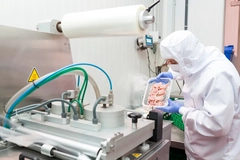
A flexible film featuring a natural plant pigment that changes color as food spoils can give consumers a food freshness signal without opening the packaging.
Researchers at Kyushu University, Japan, incorporated anthocyanin-loaded metal-organic framework (MOF) into a hydrogel to produce the film. It can further repair its own cuts, keeping bacteria out during transportation, according to the research team. They further found that the material extended the shelf life of pork by about 12 hours compared to untreated samples.
Fumihiko Tanaka, professor at Kyushu University’s Faculty of Agriculture, explains that when the film is cut and pressed back together, the tear becomes close to invisible in a few minutes, while tensile strength reaches a 99% recovery within two hours.

“In conventional packaging, any crack is permanent and becomes an entry point for bacteria. This material bonds back together on its own. The wound heals, and so does its ability to protect what’s inside, which makes it more durable and reliable in practical use,” Tanaka adds.
The study, published in Chemical Engineering Journal, looks at food freshness as a “chemical signature.” Meat, for example, is mildly acidic when fresh, but as bacteria multiply, they break down proteins and release alkaline compounds, causing the meat pH to steadily increase before visible spoilage appears, the scientists detail.
The anthocyanins in the newly developed film are the pigments of purple sweet potatoes and red cabbage, which can track that shift in pH. In particular, as pH rises, anthocyanins change from a purple-red to yellow-green color. This change is visible to the naked eye, the researchers point out.
Anthocyanins from purple sweet potato
The researchers sourced the anthocyanins for the film from purple sweet potatoes, which were freeze-dried and ground into a powder. They highlight that the crop is affordable and widely available, while anthocyanins sourced from it are natural in origin and safe for food contact.
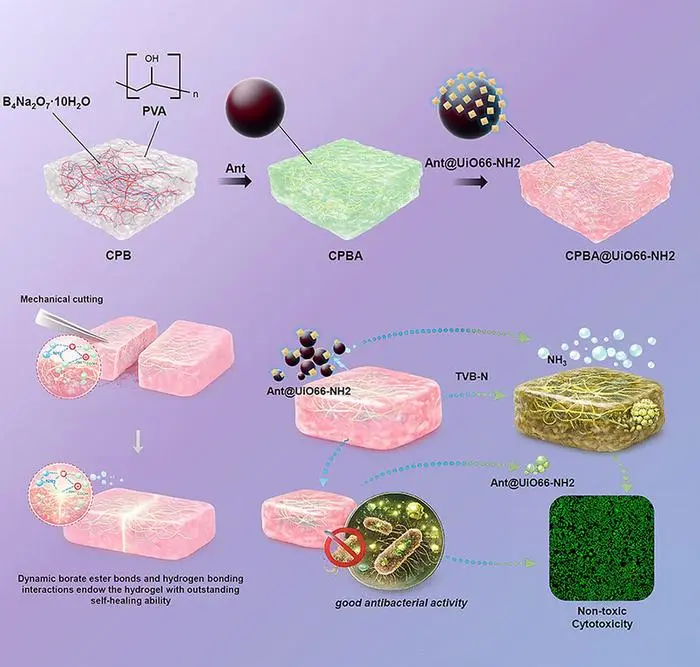 Conceptual illustration of a self-healing smart hydrogel (Image credit: Kyushu University).One potential issue that the research team foresaw is that light and heat can easily disrupt anthocyanins’ color response, resulting in false readings and making them unreliable as a long-term indicator.
For stabilization, the scientists used UiO66-NH2, a type of MOF known for its thermal and chemical stability.
Xirui Yan, corresponding author of the study, researcher at Kyushu University’s Faculty of Agriculture, and member of the Japan Society for the Promotion of Science (JSPS), comments: “MOFs have attracted enormous attention because of their unique porous structures and versatile functions, and I became curious whether they could be used for something closer to everyday life, like food preservation.”
“At the Hope Meetings with Nobel Laureates [organized by JSPS], I attended professor Susumu Kitagawa’s lecture on the sustainable use of functional porous materials. His perspective inspired me to think more broadly about how MOFs could create value in food systems.”
Anthocyanin molecules adsorb onto the MOF’s surface through multiple chemical interactions, anchoring it in place, the research team explains. When fixed and less mobile, the molecules are protected from the oxygen, light, and heat that cause degradation and rotting while remaining sensitive to pH.
During tests with pork, the protected pigment was shown to be “consistently responsive.” As the meat spoiled and alkaline gases accumulated, the material shifted continuously from purple-red to yellow-green, giving a readable signal during each spoilage stage.
Future developments and applications
The team is now looking into a companion smartphone application that would allow manufacturers, logistics companies, and shoppers a reliable, objective way to assess food quality in real time.
Fumina Tanaka, associate professor at the same faculty, notes that the applications of the anthocyanin film “don’t have to stop at food packaging.”
“Smart materials built from natural ingredients and nanotechnology may have uses we haven’t imagined yet. If anyone sees a place where this could work, we’d love to hear about it.”
Recently, Kyushu University’s Fumihiko and Fumina Tanaka also used pumpkin peel as a raw material to synthesize a nanomaterial for produce packaging to slow down rotting while reducing transport damage.
Meanwhile, researchers in Denmark found that chemically modified montmorillonite clay can absorb and retain ethylene inside fresh produce packaging to slow ripening and spoilage.