


Pumpkin peel-based packaging can extend fruit freshness, study finds


Key takeaways
- Researchers at Kyushu University, Japan, have developed a biodegradable food packaging material using pumpkin peel.
- The solution aims to improve strength, reduce moisture loss, and slow down the deterioration of the produce.
- In tests with cherry tomatoes, the material suppressed microbial growth and preserved freshness better than unpackaged and conventional plastic-wrapped controls.
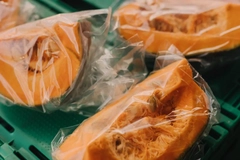
Researchers at Kyushu University, Japan, have used pumpkin peel as a raw material to synthesize a nanomaterial for food packaging that slows the deterioration of fruit and other produce while reducing transport damage.
The study, published in Food Research International, investigated pumpkin peel, an agricultural by-product that accounts for roughly 10% of the fruit’s weight, as a raw material for developing biodegradable functional food packaging designed to preserve fruit quality.
Fumihiko Tanaka, study author and professor at Kyushu University’s Faculty of Agriculture, says: “Our lab has long focused on extending the shelf life of agricultural produce while reducing reliance on petroleum-based plastics.”
“This project began with an idea from a student of ours from Southeast Asia. Cold-chain logistics across much of Asia are still underdeveloped, so we hope our technology, which preserves food at ambient temperature, could help in places where that infrastructure is lacking.”
Enhanced mechanical properties
The scientists heated the peel under high pressure, then cooled and freeze-dried it to produce carbon quantum dots (CQDs), a fine black powder with particles about 10 nanometers in diameter. Researchers share that the particles feature antimicrobial and UV-blocking properties, and can protect food surfaces from browning and degradation caused by excessive light exposure.
The team combined the CQDs with carboxymethyl cellulose and gelatin to form a composite film. Researchers discovered that adding 3% CQDs increased the film’s tensile strength by 147% and reduced water vapor permeability.
This enables the packaging to be more resistant to vibration and impact during transport, while also preventing spoilage from moisture loss.
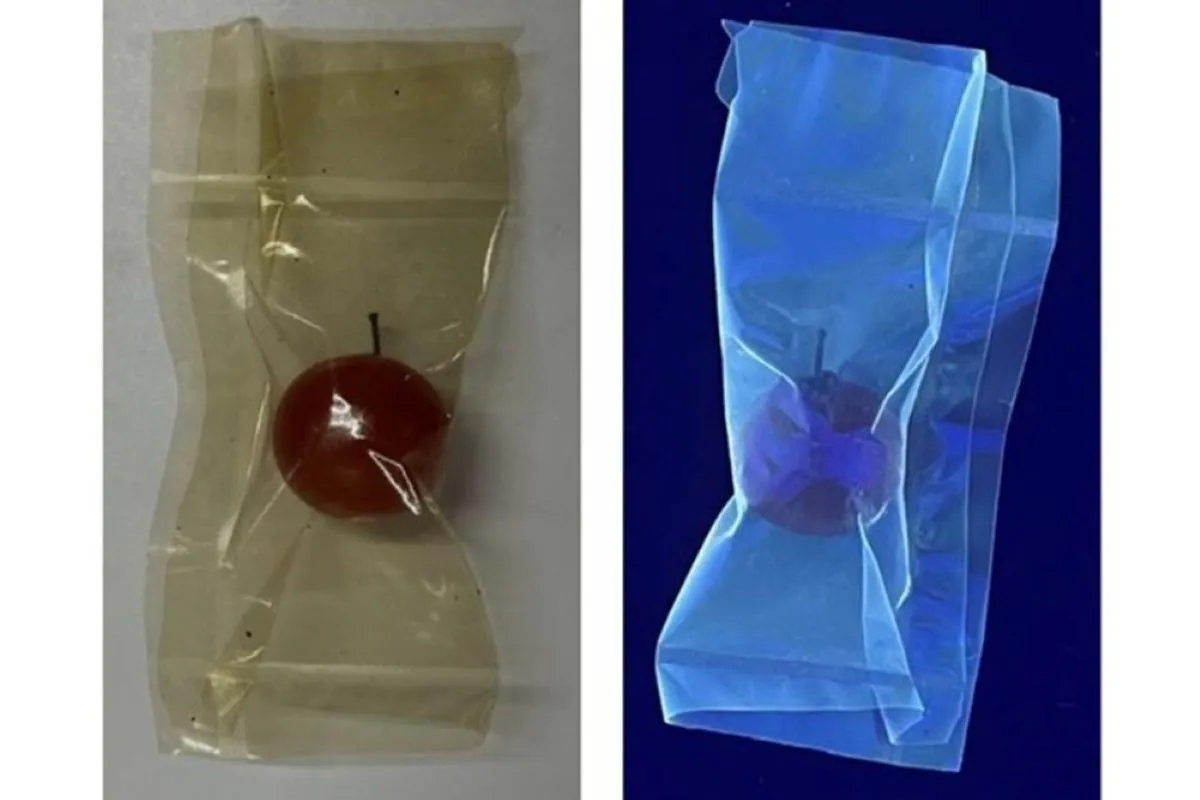 Biodegradable film with carbon quantum dots fluoresces under UV light (Image credit: Kyushu University).Fumina Tanaka, associate professor at Kyushu University’s Faculty of Agriculture, says: “Conventional antimicrobial packaging typically relies on metal nanoparticles like zinc oxide or silver, which carry a larger environmental footprint than CQDs. Ours are derived from organic matter and show good biocompatibility at effective concentrations, something critical for any food contact material.”
Extending shelf life
For a real-world test, the scientists packaged cherry tomatoes and compared the results against unpackaged and conventional plastic-wrapped controls.
The team found that films containing CQDs suppressed microbial growth and slowed weight loss and softening, preserving freshness significantly better than the alternatives.
The study’s first author, Reshaka Kavindi at Kyushu University’s Graduate School of Bioresource and Bioenvironmental Sciences, says: “We understand safety is a key concern. Cell viability tests confirmed the material is non-toxic below 2 mg/mL, and the coating itself uses only a fraction of that amount, at roughly 0.01 millimeters thick. Consumers can further reduce exposure simply by washing or peeling.”
The material can be applied as a packaging film or sprayed directly onto produce, according to the researchers. This enables partial coating only of vulnerable spots, removing excess packaging, and cutting costs.
“Beyond the environmental benefits, I’d also love for this material to bring a bit of fun to food packaging. Under UV light, the carbon dots fluoresce, and the color shifts with particle size. If we could eventually find a way to render text or illustrations with it, that would be pretty exciting too,” shares Fumina Tanaka.
For future development, the team is looking into the possibility of incorporating natural antifungal agents, like essential oils, to increase the material’s defense against more aggressive mold strains.
Recently, researchers in Denmark found that chemically modified clay can absorb ethylene inside fresh produce packaging to control ripening and rotting.