



Stoelzle restarts pharma glass production with 80% recycled content capacity

Key takeaways
- Stoelzle has restarted pharmaceutical glass production at its Hermanova Hut facility in Czechia following a major furnace and equipment modernization.
- The upgraded furnace can process up to 80% recycled glass (cullet), while improvements are designed to increase capacity, efficiency, and production flexibility.
- The investment included doubling electrical boosting capacity and upgrading forming, inspection, and packaging equipment to strengthen European supply capabilities.
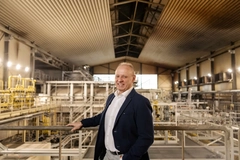 Libor Kraft at the upgraded Hermanova Hut (All image credits: Stoelzle).
Stoelzle Glass Group has resumed manufacturing at its pharmaceutical glass packaging production facility in Hermanova Hut, Czechia, following the modernization of its amber glass furnace and production technology.
“The modernization included an expanded melting area, doubled electrical boosting capacity, and upgrades to forming, inspection, and packaging equipment,” Libor Kraft, plant manager at Stoelzle Hermanova Hut, tells Packaging Insights.
“These improvements are designed to increase production capacity, improve process stability, and enable us to respond more flexibly to changing production volumes while maintaining consistent product quality.”
“The new furnace can process up to 80% recycled glass (cullet),” the spokesperson continues. “Increasing cullet content requires careful control of raw material quality and melting conditions to maintain consistent glass properties, particularly for pharmaceutical applications.”

The Austrian glass packaging company, which provides solutions for the healthcare, spirits, F&B, and beauty sectors, further highlights that higher recycled content can reduce the use of virgin raw materials, energy consumption, and associated emissions. “The actual environmental benefits depend on the recycled content used in production.”
Optimizing production
Stoelzle explains that the project included the complete rebuilding of Hermanova Hut’s end-port amber furnace. The forehearths, connecting the glass melting furnace to the forming area, and the regenerators for thermal energy storage and heat recovery have undergone an upgrade, according to the company.
.webp) Hermanova Hut’s upgrade included its end-port amber furnace, forehearths, and the regenerators.The renewal project expanded the facility’s melting area and doubled its electrical boosting capacity. The company further invested in glass distribution, forming, inspection, and packaging equipment capabilities at the plant.
“The modernization is designed to increase production capacity while improving efficiency and process stability,” Kraft explains. “For our pharmaceutical and healthcare customers, the priority is to maintain the high-quality standards they expect while responding more flexibly to changing order volumes.”
In addition to glass packaging for the pharmaceutical sector, Hermanova Hut also provides solutions for the F&B and spirit alcohol sectors.
“The investment strengthens our ability to manufacture our existing portfolio efficiently and ensure reliable long-term supply.”
The glass producer says that Hermanova Hut’s convenient location facilitates shorter transport routes to its customers and more resilient supply chains.
“Efficient European manufacturing helps us remain competitive while keeping production close to our customers, reducing transport distances, and potentially lowering associated emissions,” Kraft adds.
“The strength of our European network was demonstrated during the rebuild: critical products were manufactured in advance, while some standard products were produced at our Köflach plant in Austria to support continuity of supply.”
A long-term investment
Stoelzle says that the facility revamp is its most significant recent investment, with the furnace rebuild taking place between August and October 2026.
.webp) With the modernization, Soelzle aims to increase its production capacity while improving efficiency and process stability.Kraft comments: “Bringing a glass furnace back into operation safely is a demanding process that requires precision, experience, and close teamwork. We are now focused on delivering the quality our customers expect.”
Glass production restarted on October 8, as planned, and all six production lines began operating again two weeks later, according to the company. Glass container production for customers has also recommenced, Stoelzle outlines.
Dr. August Grupp, CEO of Stoelzle, highlights: “The modernization of Hermanova Hut strengthens our manufacturing network. With more efficient production, competitive costs and reliable European supply, we are confirming our long-term commitment to pharmaceutical customers and their evolving needs.”
Kraft adds: “After 16 years of reliable operation, the furnace rebuild provided an opportunity to make a significant long-term investment in the site’s manufacturing capabilities.”
“Beyond replacing the existing furnace, our objective was to improve production efficiency, strengthen cost competitiveness, and increase operational flexibility. The modernization also reinforces Hermanova Hut’s long-term role as a key European production site for pharmaceutical and healthcare glass packaging.”
In a recent interview with Packaging Insights, the Federal Association of the German Glass Industry (BV Glas) said that Europe’s container glass sector is adjusting its production capacity to weaker demand and changing consumer behaviors. BV Glas urged German and other European policymakers to support competitive prices and to invest in the glass packaging sector.