



Biffa highlights economic benefits of domestic recycling in the UK


Key takeaways
- Ending exports of unprocessed plastic waste by 2030 could create 9,000 jobs, add £900 million (US$1.20 billion) annually to the UK economy, and attract £800 million (US$1.06 billion) in private investment.
- To meet projected 2030 waste volumes, the UK would need 15 new recycling plants capable of processing 927 kilotons of plastic, each delivering significant GVA and supply-chain economic activity.
- Biffa warns that exporting waste shifts environmental and ethical risks abroad; domestic processing would strengthen accountability and align with rising global restrictions on waste imports.

The UK could open 15 recycling facilities, create 9,000 jobs, and add £900 (US$1.20 billion) million to the economy annually, if it stopped exporting unprocessed plastic packaging waste by 2030, according to a new report commissioned by Biffa.
James McLeary, managing director at Biffa Polymers, says that the recycler commissioned the new research conducted by Hybrid Economics to celebrate its 10 billion high-density PE (HDPE) plastic bottles recycled mark and “to understand the challenges and the opportunities ahead.”
“Simply put, it is not enough. What Biffa, our customers and partners across supply chains have achieved with a closed-loop solution for HDPE milk bottles — where standardized materials applied in homogenized packaging are collected, processed and recycled into new bottles — is an anomaly. It needs to become the norm.”

The report findings further show that if the UK halted its exports of unprocessed plastic packaging waste by 2030, it could spark £800 million (US$1.06 billion) in private investment without requiring public funding.
Currently, around half of all the UK’s plastic packaging waste is recycled, of which half is processed in the UK, according to data cited by Hybrid Economics.
In addition to missing out on economic opportunities, the consultancy argues that by exporting its plastic waste, the UK is evading responsibility and risking unpreparedness as a growing number of countries refuse to import unprocessed waste.
Ending exports
Hybrid Economics says that it estimated the economic impact of ending exports of plastic waste for recycling using the “methodology, data, and assumptions.”
 James McLeary, managing director at Biffa Polymers (Image credit: Biffa).The UK’s recycling rate is shown to be on an upward trajectory based on data from Defra from 2013 to 2024. The consultancy suggests that it is plausible to expect this trend to be sustained for the rest of the decade, pointing to the introduction of DRS and the Simpler Recycling Schemes in 2027.
“We project that in 2030 the plastic recycling rate will be 60%, and consequently, there will be 1,512 kilotons of plastic waste available to be recycled.”
A conditioning assumption of the analysis is that no plastic waste will be exported for recycling and considers the possibilities that all recycled plastic will be processed in UK facilities by 2030.
Taking into consideration that 585 kilotons of plastic waste were processed domestically in 2024, according to the Environment Agency, the UK requires additional plastic waste recycling facilities capable of processing a further 927 kilotons of waste plastic.
Economic potential
Using the outlined methodology and an analysis of Biffa’s plastic waste recycling operations, Hybrid Economics finds that a single economically viable plastic waste recycling facility capable of recycling 100 kilotons would employ 300 full-time workers.
The additional facility would require £87.5 million (US$116.3 million) investment to build and become operational, but would then generate a profit of around £5 million (US$6.5 million).
The consultancy calculates the direct Gross Value Added (GVA) from building up the UK’s plastic recycling capacity by summing up staff costs, depreciation, financial costs, and profits before tax.
The research team uses operating information from Biffa to estimate average labor costs. It assumes the initial investment is depreciated over a 10-year period and that financing costs are 7.5% annually.
“That leads us to estimate that a stylized facility capable of processing 100K of waste plastic would directly generate a GVA of £32 million (US$42.6 million), so the required increase in plastic waste recycling capacity would directly lead to an annual GVA of £300 million (US$399 million).”
Taking impact ownership
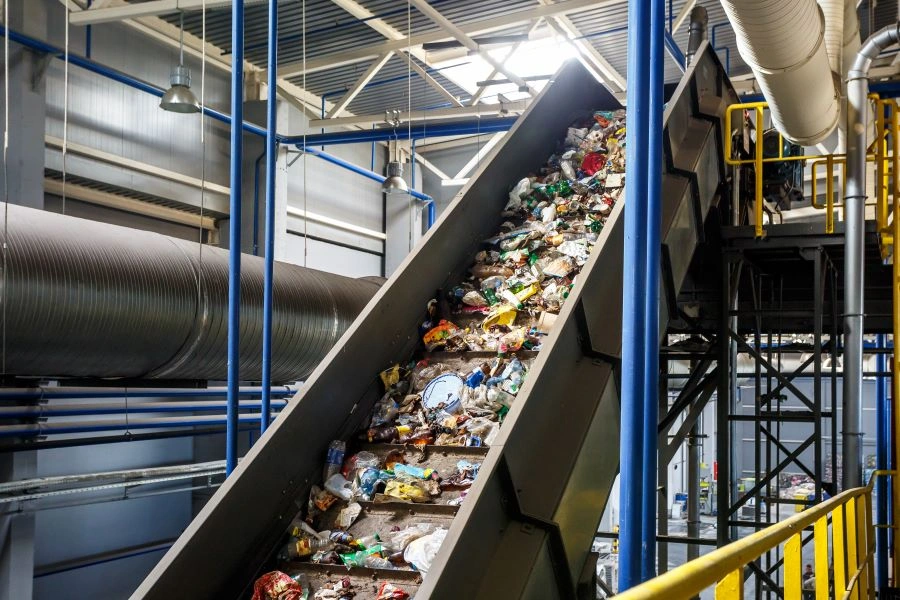 Hybrid Economics finds that a single UK plastic waste facility recycles 100 kilotons of waste and employs 300 workers.According to Hybrid Economics’ research, boosting the UK’s domestic plastic recycling would have a broader impact on economic activity and employment.
In addition to the direct GVA and employment the new facilities could generate, they are said to indirectly contribute to greater economic activity and employment in their supply chains, such as logistics, cleaning companies, and consultants, and in their local area, including local shops and services.
These effects are also captured in Type 2 economic multipliers produced by the Scottish government, the consultancy adds.
“We apply the specific multipliers associated with the Waste Management and Remediation sector to the GVA estimate in order to calculate the full impact of increased plastic waste recycling capacity on GDP and employment.”
Biffa’s McLeary says: “Beyond economics, we have a responsibility to manage the waste we produce locally. When we export unprocessed plastic waste, we risk being complicit in damaging outcomes. While much of the valuable plastic might be captured, waste that is deemed of no value can be burned or dumped into the environment.”
He warns that the labor standards in some countries where the UK is exporting its waste can be “far lower” and “involve the exploitation of workers, including children,” in collecting and sorting material.
“Managing our plastic onshore means taking ownership of our impact.”