




Fresh Inset sticker extends table grape shelf life, reducing food waste

Key takeaways
- Fresh Inset’s Vidre+ stickers extended table grape marketable life by an average of 4.95 days, according to the company’s analysis.
- The technology helps delay stem browning, berry damage, and decay across multiple grape varieties, storage conditions, and packaging formats.
- Fresh Inset says the findings could support longer export journeys and give growers and packers greater logistics flexibility.
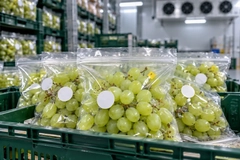 (Image credit: Fresh Inset).
Fresh Inset highlights that its Vidre+ technology helps improve stem appearance, berry integrity, and decay-related quality of table grapes.
The company’s analysis of nine post-harvest trials across Europe reveals that Vidre+ stickers extended the marketable life of grapes by an average of 4.95 days. Fresh Inset’s Vidre+ is a freshness protection technology that expands the possibilities for 1-methylcyclopropene application.
The results suggest potential benefits for the international fresh produce supply chain, providing additional time for transportation, distribution, and retail sales.
“For the international table grape industry, maintaining freshness from vineyard to supermarket shelf remains one of the most persistent post-harvest challenges. Grapes often travel thousands of kilometers, spending weeks in cold storage, refrigerated transport, and distribution before reaching consumers,” says Fresh Inset.

“Even under carefully managed conditions, quality deterioration can reduce commercial value. Browning stems, berry damage, fruit detachment, and fungal decay can all affect consumer acceptance, resulting in rejected shipments, retail markdowns, and food waste.”
Post-harvest trials
The findings from the Fresh Inset analysis are based on trials conducted in Italy, Greece, Spain, and the UK, involving 38 Vidre+ sticker variants and 354 paired quality comparisons. The research program covered several table grape varieties, including Italia, Soultanina, Aledo, Dominga, and Sweet Celebration.
Trials were performed under different post-harvest conditions, including variations in storage periods, temperatures, and packaging formats. Researchers assessed grapes packed in standard boxes, intact and perforated films, and retail flow-wrapped punnets.
The company says the findings could be relevant to other grape-producing and exporting regions outside of Europe.
“Major exporting countries such as Peru, Chile, South Africa, and India face similar challenges in delivering attractive, high-quality grapes to distant markets. For these industries, technologies capable of extending the commercial quality window could potentially offer greater flexibility in export logistics,” says Fresh Inset.
According to the company, enhanced berry integrity and delayed stem browning could support quality preservation for packing houses during handling, storage, and distribution. The technology aims to maintain commercial quality for longer without fundamentally changing the product’s presentation.
Previously, Packaging Insights spoke to Fresh Inset about how packaging technology can play a role in minimizing food waste.