

Interpack 2026: WPO tackles food waste, packaging waste trade off and “wishcycling”


Key takeaways
- WPO warns the packaging industry is not yet ready to honestly confront the food waste versus packaging waste trade-off.
- EPR regulations are now shaping packaging decisions in every region, not just Europe.
- Kelton calls for global design consistency on recyclability standards as her top priority ahead of Interpack 2029.
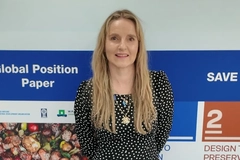
The global packaging industry is making progress on recyclability and monomaterial design, but is still failing to grapple with the harder trade-off between packaging waste and food waste, according to Nerida Kelton, the VP of sustainability and safe food at the World Packaging Organisation (WPO).
At Interpack 2026, Packaging Insights sits down with Kelton, who reveals that EPR regulations are now shaping packaging decisions in every region of the world — not just in the EU, where the Packaging and Packaging Waste Regulation (PPWR) enters force in August this year.
“Not only with PPWR — EPR regulations are everywhere, in every corner of the world,” Kelton says.
A material-agnostic position
Kelton was clear that WPO does not advocate for any specific substrate, a position the organization can hold credibly because it represents no commercial interest in any one packaging material. But she challenged the assumption — increasingly common in consumer discourse — that plastic is automatically the wrong answer.
“You can’t react in that time to consumers without making sure that your packaging is fit for purpose and functional first,” Kelton explains. “Even though we’re material agnostic, it’s important to understand that some polymers are, at this moment in time, the best solution for food safety, human health, protecting, containing, preserving, and extending shelf life.”
She adds that this framing matters because it lets the WPO offer something brand owners and converters rarely hear from suppliers — a candid assessment that polymers remain the best technical solution for many F&B applications, even as consumer pressure pushes the industry toward fiber and reusable alternatives.
“We need to educate consumers as well as the industry on the value of each material,” Kelton underscores. “Every material has a purpose.”
Design to recycle
Kelton said the industry-wide shift toward designing for end-of-life rather than for performance alone is the most significant change of the current regulatory cycle. She framed monomaterial adoption and recycled-content integration as the two clearest manifestations of that shift.
“We’re starting to prioritize and be a little bit more consistent in how we design our waste from the start, and looking at prioritizing the way we design our packaging through reducing the materials that we use and reducing the amount of packaging that we use,” Kelton adds.
“Also look at the volumization of packaging — and minimize the amount of packaging and materials being used.”
Recycled-content integration is the parallel shift, with food-grade recycled materials gaining ground in markets that had not previously permitted them. “Some countries have not had food-grade recycled content. We are seeing a bigger shift into that,” Kelton notes.
The discipline the regulations demand, in her view, is end-of-life literacy at the design stage — and an end to aspirational recycling claims.
“You have to make sure that the packaging that you are putting on the market is actually truly recyclable in the country that you’re selling it,” Kelton says. “So you can no longer guess — you can no longer wishcycle.”
She said brand owners must understand the full downstream pathway of every package they put on the market.
“You have to really understand at the end of the supply chain, when it goes in a rubbish bin, where is it going to go, is it going to go into landfill, is it going to be recycled, is it going to be recycled back into packaging materials, or is it going to be reprocessed into some other solution?” Kelton emphasizes. “You have to start thinking about that at the start.”
The aspiration, Kelton said, is full circularity by design.
“The ultimate goal is that you want it to be circular by design. The ideal scenario would be to take materials and put them back into packaging as many times as possible. It can’t happen all of the time — it’s impossible — but that has to be one of the goals.”
The fiber question
Kelton offered a measured counterpoint to the paperization narrative dominating Interpack 2026, urging the industry to ground every fiber substitution decision in life-cycle data rather than consumer sentiment.
“Consumers have driven a lot of changes from looking at plastic alternatives — predominantly people seeing plastic floating in the ocean, a lot of single-use plastic in waterways and in the environment, images of animals that have died unfortunately, in oceans,” Kelton explains. “Good or bad, the consumers have driven this.”
She adds that the challenge is that consumer pressure has run ahead of the technical evidence.
“We have seen a significant shift away from plastic to fiber alternatives, but the question always is — have they undertaken a life-cycle assessment?” Kelton asks. “Have they looked at the research to ensure it still maintains the flavor, the integrity, the safety aspect, and the extension of shelf life?”
She used fresh produce as a working example. A punnet of tomatoes or strawberries can be packaged in a paper alternative. However, the decision depends on whether the product is for export or domestic sale, the length of the supply chain, and the climate it must traverse.
“Australia is a really good example,” Kelton reveals. “We’re a very large geographical country, and if someone is shipping tomatoes or cucumbers from Brisbane to Perth through a value chain, through the logistics and transport, through humid climates, they need to make sure they have the right packaging to do that.”
“A consumer does not want soggy cucumbers. A consumer doesn’t want avocados that have been damaged and spoiled. It’s about finding the right packaging to suit your product, and it sometimes isn’t necessarily about moving to an alternate material. Rather, it’s about ensuring that this is the best material for your product.”
The food-waste paradox
The central argument Kelton brought to Interpack 2026 was that the industry is not yet ready to confront the food-waste-versus-packaging-waste trade-off honestly. WPO’s Safe Food Packaging Design Guidelines, originally developed by Kelton’s association in Australia in partnership with university research, are structured around that paradox.
“The whole point is trade-offs,” Kelton underscores. “That paradox between packaging waste and food waste, and how we balance and the optimum packaging design where we’re not wasting food but we’re also not wasting packaging materials?”
Kelton frames the technologist’s dilemma directly.
“For a packaging designer or technologist, it’s hard at the moment,” Kelton says. “Consumers are driving that they want no plastic or limited plastic, and they want everything to be moving to fiber-based solutions, but we’re also saying that we have to pick the right material for the products first, so we’re not wasting food, because the environmental impact is far greater for food waste.”
She explains that the full environmental cost of food waste must include the upstream resource, including investment in growing, harvesting, and transporting the product.
“Every brand has to determine what its accepted trade-offs are,” Kelton asserts. “They need to understand that the amount of money, water, energy efficiencies, and the costs that growing produce has environmental impacts.”
“You could get to the middle of your value chain and have poor-quality packaging that has caused leakage or spoilage or damage, and you’ve wasted all of the work.”
She also frames the challenge as one of measurement and traceability across the totality of the value chain. Kelton states that there are ways, such as through guidelines, through measurement, tracking, tracing, and reporting, that companies can determine how their packaging is performing across the change and where food and product are being lost.
“The household end of the value chain matters too,” she says. “The safe-food packaging design principles also examine whether consumer-facing issues are driving waste.”
“Are the issues with packaging in the household because they can’t open them, they can’t close them, they can’t reseal them, or are they too big a portion? Are they not freezing them properly, or are they unsure how to store them?”
These are things Kelton says may require better education, and allow companies to consider if a redesign is necessary.
The secondary blind spot
Kelton also flags secondary and tertiary packaging as an under-examined source of waste and cost across the industry.
“People prioritize primary packaging these days, but there are so many opportunities for cost efficiencies and optimizations in supply chain and logistics areas, such as in warehouses and in facilities,” she states. “Looking at the secondary and tertiary packaging — everything from pallet packing, the cardboard, the corrugates, and the way they palletize — all of those things can affect losses and damage and waste.”
The point, Kelton says, is that brand-owner conversations about packaging sustainability are too often siloed at the primary-packaging level, missing measurable losses upstream. Cold-chain placement can compound the problem.
“If you don’t stack, pack, and wrap a pallet efficiently, and you don’t put it in the right area of a cold-chain truck, you can have damage and spoilage. It’s an area where I think we need more training and more education in the industry.”
Looking to 2029
By the next Interpack in 2029, Kelton names global design consistency as her top priority of what she would like to see resolved.
“I’d like for the industry as a whole to be more consistent globally on regulations and standards for design,” she stresses. “I would hope that we could come back and see more consistent design standards for recyclability, so that people are starting at the same point with their design to be more recyclable, to have a lower environmental impact.”
Her second wish is for the industry to elevate safety, climate, and food waste as packaging conversations in their own right.
“I would also like that to be a bigger dialogue in 2029, where more of the exhibitors are showcasing what they’re doing to invest in minimizing food waste through machinery, through their packaging, through their design processes,” Kelton concludes. “For me, that would be more of a milestone, because it’s taking a while to elevate that discussion in the industry.”
“People are slowly getting it, but we’re not there yet.”