

- Industry news
Industry news
- Category news
Category news
- Reports
- Key trends
- Multimedia
- Journal
- Events
- Suppliers
- Home
- Industry news
Industry news
- Category news
Category news
- Reports
- Key trends
- Multimedia
- Events
- Suppliers
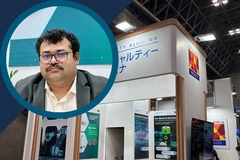
Cirkla exhibited its molded fiber overwrap and MAP trays for meat, replacing conventional plastic applications. Ankur Gupta, Cirkla’s co-founder, tells us about the trays’ recyclability. We also speak about Cirkla’s meal and dairy packaging ranges.
This is Natalie Sch Wertheim for Packaging Insights.
I'm at Farpak 2024 and now at the Circla booth with Circla's co-founder Anko Gupta.
Hello Anchor.
Hey, hi Natalie.
Pleasure, pleasure to be talking to you.
Anchor.
What can you tell us about molded fiber technology?
Hey, that's a great question.
So molded fiber has been around for the last 1015 years, but the focus always has been very easy applications like clamshells, food service products.
What Circular is doing is pushing the boundaries of what can be achieved with the same technology.
And then make complex applications possible so that we can replace plastics across a variety of use cases.
Perfect.
And what about molded fibers development?
How has it changed?
Right?
So over the last 4 to 5 years, a lot of innovation has happened in terms of.
Pushing the technology, making complex applications possible with low draft angles, complicated designs for brands that can use them like a plug and play solution, optimized for transportation, designed for recyclability, all of that, and Circle has been playing a forefront role in.
Making all of that innovation possible, we have an in-house team of folks who design products to make them a very easy replacement of plastics, and we optimize for cost, we optimize for logistics, we design for recyclability, and then we just ensure that these products can be made and supplied at scale.
Perfect.
Nice.
Now what can you share with us regarding surplus tray solutions?
Yeah, so we've been seeing phenomenal response on some of our tray solutions from the meat and the food industry.
So the meat industry uses a lot of plastics in their packaging, primarily two kinds of trays.
One is an over wrapped tray which is used for grocer and processor application, and the other one is an MAP tray or a modified.
Packaging tray which has a very high requirement for barrier.
So over the last 6 months, we've been working with a lot of top meat companies and retailers to help them replace plastics in their packaging.
So this tray that I have in my hand, it's, it's, there's a lot of design work that has gone in designing the tray, which is very strong.
We do multiple finite element analysis to ensure that.
These ribs are at the right places operators can actually load the meat on it and hold it with one hand without the tray cracking.
Simple things like these lift up lugs for ensuring that the tray bottoms don't get stained while they're kept on the tray on the on the shelf.
Yeah, we've.
Done multiple trials with large meat companies and the operators love it because it's like a plug and play replacement of existing plastic trays.
So this is the overlap tray that we've introduced and the second one, and we are super excited about this one is an MAP tray where wherever you require a.
Atmosphere packaging to extend the shelf life of the meat.
We've created probably the world's first MP tray made from plant fibers such as sugarcane bags, and we've designed it to be very strong, so we've achieved both score test results of 20 plus versus an industry benchmark of around 15.
And it is designed to be seamlessly replacing plastic trays across standard packet processor machines.
So we are super excited about this category.
The great thing is that we, we have an easy peel liner, so.
The consumers can actually peel the liner very easily.
There is a notch here.
The consumers can easily peel off the liner after use, so the liner can go in the plastic bin and the molded fiber tray can go in the paper stream for a fully recyclable solution.
All right, perfect.
Now you're also exhibiting your meal packaging solutions.
What can you share about these?
Right?
So for frozen and ready meal.
Applications we build these meal trays with coatings that are recyclable and food safe, and we've designed them in a way that they can be sealed on top.
So a lot of ready meal frozen as as chilled applications.
These trays are a perfect replacement for plastics, and we are super excited about this category as.
Cool.
OK, and now the third category you're showcasing is dairy.
Yes, so.
So we're actually working with some of the largest dairy companies in the world.
This is a dairy tub that we are helping replace for a large brand by weight of plastic, it is less than 5%, which is great because then it will be recyclable in most of the geographies.
It is designed to be completely plug and play again as most of our solutions and super super excited about dairy tubs and a lot of other applications such as.
Our coffee capsules and scoops, so essentially what we want to say is that molded fiber is a very versatile technology so there is manufacturing that exists at scale we've pushed the boundaries to make complex applications possible.
All right, very nice.
Now moving on to recyclability and European legislation.
What can you tell us from your experience regarding US legislation?
Yes, so that's, that's actually where we have seen a lot of progress and good results because we've been working with some of the paper mills in the US and the way that we've designed our liner to easily separate, even if consumers do not peel off the.
Use the liner still gets very easily separated in the paper recycling stream.
So the paper mills, they're actually super happy with the recyclability of the trays, even with the liner intact, and that is very encouraging, and we are sure that we'll see similar results in the European markets as.
The difference is in the European markets, the PPWR regulations for design for recyclability are not yet defined, so we're eagerly waiting for that.
But when we work with brands, all of them tell us that we need to keep the weight of plastic to be less than 10%.
That's what we've been doing in all our solutions in dairy tub, it is as low as 5%, but in all the other solutions where we have some kind of liner in place or a coating in place, the weight of plastic is less than 10%.
So we are hoping that the solutions will be widely recyclable.
Perfect.
Thank you very much for speaking with Packaging Insights today.
Thank you.