
- Industry news
Industry news
- Category news
Category news
- Reports
- Key trends
- Multimedia
- Journal
- Events
- Suppliers
- Home
- Industry news
Industry news
- Category news
Category news
- Reports
- Key trends
- Multimedia
- Events
- Suppliers
Top Packaging Trends 2022: Discover how consumer choices are shaping the industry
09 Sep 2022 | Packaging Insights
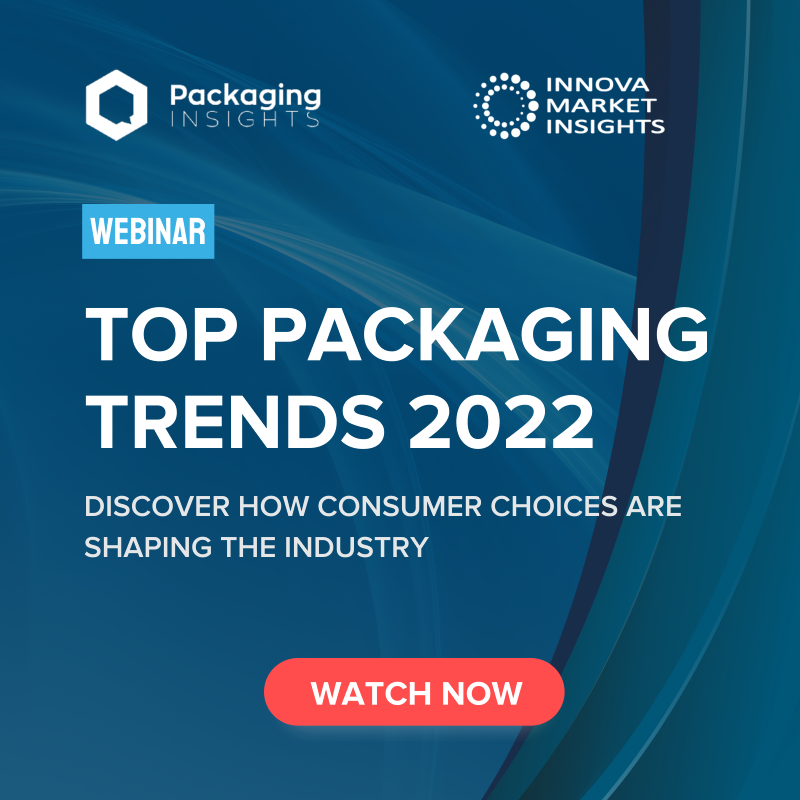
Watch this highly anticipated webinar hosted by PackagingInsights in which we unraveled Innova Market Insights’ top packaging trends for 2022. Topics ranged from food waste-fighting packaging and plastic pollution solutions to bio-based innovation and connective engagement technologies.
Hello and welcome to today's webinar entitled Top Packaging Trends 2022, Discover how Consumer Choices are shaping the Industry.
This webinar is hosted by Pack Insights with exclusive insights provided by Enova Market Insights.
My name is Joshua Paul and I'm the editor of PackInsights.com, and I'll be your moderator today.
I'm delighted to welcome our experts, firstly, Akhil Ayer, senior market analyst and projects leader at Anova.
Welcome, Akhil.
Thanks, Josh.
Thanks for having me.
Great to have you here.
Also joining us today is Neil Farmer, a UK, a leading UK pattern expert and consultant with over 40 years of industry experience.
Welcome to you, Neil.
My pleasure to be here, Josh.
Thank you for having me.
Thanks for being here.
I will now pass over to Akhil for an exclusive presentation on Nova's top packaging trends for this year.
This will be followed by a Q&A session.
Thank you for the introduction, Josh.
Hello everyone and welcome to the webinar.
My name is Akhilil and today I will be presenting the top packaging trends for 2022.
Now, before I start, here is a quick glance at the top trends that we've identified for the year 2022.
The number one trend for 2022 is food waste fighters, followed by monomaterial mastery, bioplastic boosters, labels unleashed, and finally caps uncovered.
Now, without further ado, let's dive deeper into each of the trends.
Food Waste Fighters has been identified as the top packaging trend for 2022.
The climate crisis, the COVID-19 pandemic, and political upheavals have elevated food waste concerns, spotlighting the importance of shelf life extending packaging to preserve perishable foods across complex international supply chains.
If food waste were a country, it would be the world's 3rd biggest greenhouse emitter behind China and the US.
Now, according to a recent consumer survey conducted by Innova Market Insights, we found that 2 in 5 consumers globally indicated that shelf life has a strong influence on their purchasing decisions.
Now, as a consequence of the pandemic, we observed a resurgence in plastics application, with suppliers taking this as an opportunity to abate plastic aversion by addressing the added value of these materials in terms of their shelf life and product protection.
This has led to a renewed appreciation for plastic, with Stepak launching a range of films that extend shelf life and co-expand launching antimicrobial monomaterial traits from materials such as PET and PP.
Now capitalizing on the hygiene concerns among consumers, suppliers took this as an opportunity to reform consumer opinions around plastic.
Now the introduction of the EU ban on the EU ban on single-use disposable plastic has sparked a debate with proponents for plastics highlighting the potential food waste implications along the supply chain, while detractors are arguing for more stringent measures.
Nearly a quarter of European consumers indicated that they had already stopped using single-use plastics more than 12 months ago in comparison to 11% of consumers from the rest of the world.
There has been a strong shift in consumer perception towards plastic packaging for perishables such as fruits and vegetables among European consumers, with only 29% of consumers indicating that they prefer a protective plastic layer for their fruits and vegetables compared to 46% of consumers globally.
Now, as consumers.
As consumers grow very weary of the plastic pollution crisis, we have seen a lot of paper-based solutions being touted as more sustainable alternatives to plastic-based solutions.
Now, while some of these solutions allow for replacement of plastic with paper, there's usually a sustainability trade-off when it comes to the material choice and its subsequent impact on the shelf life of the product being packaged.
The solutions on the left from covers are very good examples of fit for purpose packaging.
Now, based on the requirements for different markets, they develop different sandwich skillets for the European market and for the UK market due to conflicting shelf life demands.
The recycler paper monomaterial skillet illustrated on this slide is an entirely paper-based recyclable solution which is designed for shorter shelf life requirements.
Now, while paper may be suitable for packaging certain product categories, in order to ensure food safety and hygiene along the supply chain, plastic remains vital for certain packaging technologies.
And furthermore, what is really important for consumers to understand is that the potential food waste impact on the environment is far greater than that of the packaging if we do not use plastic for packaging certain foods.
Now there are also other avenues that have emerged to tackle this issue of food waste.
Over the past 2 years, suppliers have launched packaging with antimicrobial technology to tackle the issue of cross-contamination, especially at point of sale, and put consumers at ease.
Another another approach that we're observing across food retail chains is to ditch the use of use-by dates, especially within the dairy category, with Morrison's and Co op scrapping these labels for selected dairy products such as fluid milk and yogurts.
Now, according to a survey conducted by Cornell, they found that fluid milk is responsible for around 65% of the dairy product food base.
And according to, within the same study, what they also found was that consumers that they surveyed are ready to embrace food waste fighting QR codes on milk cartons.
The biggest challenge that we see, when it comes to, the waste, the food waste issue when it comes to dairy within supermarkets is with the dates often printed on cartons, consumers typically buy the most distant dated milk, but in, these situations, what, what often.
Happens is that it leaves drinkable milk on the store shelves where retailers throw it out later.
So by substituting these printed dates with QR codes, we could potentially help consumers discard less food by providing more accurate best by dates and information until when food products could be consumed.
Furthermore, there is a potential for interlacing this with existing smart refrigerator technologies, and this could enable you to.
Basically engage with your refrigerator to make sure you get recipes that allow you to use that product or tells you that you need to, that you are running low on a particular product and then you need to do a supermarket run.
Now, the next trend that we will be looking at is monomaterial mastery.
We have observed an industry-wide transition away from multi-layer packaging as brands adopt monomaterial solutions to improve recyclability within the existing infrastructure.
Throughout the through the years we have tracked how this trend has evolved over the past few years.
Recyclable by design solutions that are easily recycled by consumers in their respective recycling streams kickstarted this movement towards monomaterials.
The plastics full circle trend addressed the need for increasing recycled content in existing packaging.
While the fiber-based frenzy trend focused on brands finding alternative fiber-based solutions to appease the eco-conscious consumer, all of these trends together have been driving the industry towards monomaterial mastery.
Now while some packaging solutions enjoy relatively high recycling rates like glass bottles, PET bottles, aluminum cans and steel cans, these sort of solutions that are recyclable by design are technically more challenging in the flexible packaging industry.
We've seen a lot of developments recently within this space.
One of the prominent, solutions being from Doo, where they commercialized an aluminum-free toothpaste tube that uses PE-based technology to enhance the recyclability of toothpaste tubes.
Now, the move towards monomaterials has been observed across a range of different packaging formats such as stand-up pouches and retor pouches, meat trays, and also packets with solutions from companies such as Bob'st, Mondi, and Waddington aiming to take us one step closer to improving the circularity of plastic materials.
Now one example that I would like to highlight from this slide is that from Waddington's, the Piranha.
Monomaterial tray eliminates the need for a polyethylene layer or adhesive coating.
The packaging is sealed using a series of raised flanges, raised teeth that run through the sealing flange.
The raised, the raised teeth help in maintaining the seal's integrity even if the flange becomes contaminated with animal fat, and the tray is capable, capable of being fully recycled back into food grade artpit.
So, this is one of the solutions that is already compliant with the upcoming plastic tax in the UK.
Now, other developments that we see when it comes to, recyclable by design, solutions that are moving towards monomaterial mastery is within aseptic cartons.
So within aseptic cartons, traditionally they have been made of multiple materials, so it contains plastic, paper, and aluminum in most cases.
What a lot of the, major players within the aseptic carton industry are currently working on is removing the amount, removing the aluminum, from, these multilayer packages.
Now, although it accounts for a very small percentage of the packaging weight, it does offer significant barriers to ensure the shelf life for sensitive food and beverage products.
But at the same time, it also has a significant contribution towards the overall carbon footprint of a carton.
And finally, when it comes from a recyclability standpoint, it becomes challenging to separate the aluminum and polymer components, which are often recovered as polyal, which is then downcycled and reused in other industries.
So I see this as a move towards a more efficient recovery of the packaging material components and seeing this being reincorporated within the circular economy for food as opposed to being downcycled into other industries.
Now, when we look at fiber-based barriers, we've also seen a lot of developments in barrier technologies and particularly when we look at monomaterial solutions that are predominantly fiber-based, Reducing the reliance on plastic liners and coming up with alternatives, using biodegradable, biodegradable or, washable, sorry, biodegradable or, processable liners that can be processed during, The end of life cycle would be the way forward.
One other thing that we observed is most recently Kraft Heinz announced, announced a partnership with Pulpex to develop a paper-based renewable recyclable bottle that is made entirely from responsibly sourced wood pulp.
Now, the next trend is bioplastic boosters.
So we've observed, there has been a rapid expansion in production of bioplastics, and this is generating a more serious challenge.
This is generating a more serious challenge to fossil-based plastics with increasing global bioproduction, global production capacities for bioplastics.
Now, according to the European bioplastics, we have, they say that global production for bioplastics is expected to more than triple over the next 5 years, so between 2021 and 2026, and it is expected that by 2026, Asia will be accounting for more than 70% of the market share.
Now when it comes to the different applications where bioplastics find favor, packaging remains the largest field for the application of bioplastics, with 48% of the total bioplastics, accounting for nearly 48% of the total bioplastics market in 2021.
Moreover, we've also seen an increase in production, capacity from existing facilities and the greater capital investment, in bioplastics such as PEF and PLA, bodes for the future of this industry.
Now, we've also observed a steady, switch towards bio-based materials, especially in e-commerce, where they're being used to replace, other traditionally not so easily recycled materials such as polystyrene.
And there's also been quite a lot of developments when it comes to coating technologies and film solutions using these materials.
Now, towards the end of last year, we observed, Sun S Santori basically unveiled a new plant-based bottle.
Plant-based PET bottle prototype after a decade-long development cycle.
Now, this move takes Santori one step closer towards its goal of eliminating, it's, petroleum-based virgin plastic from its PET supply.
Now in this case, there is no competition with food stock, so all the raw materials are produced from non-food sources and it avoids competition with the food chain, and it's estimated to have a lower carbon footprint compared to virgin plastic bottles.
When it comes to flexible packaging, TIA also unveiled around the same time, home compostable laminate that can be converted into pre-made bags and pouches.
Now, this laminate is TUVOK certified to degrade in in home and community compost.
Now, while there have been quite a lot of positive developments in this space, the high costs of these materials compared to fossil-based polymers, recent regulations, and the scarcity of dedicated recycling infrastructure for these emerging materials remains a challenge.
Now, while it may be more expensive than their counterparts, certain legislations like the EU single use plastic Directive fails to distinguish them from conventional plastics.
Now this has led to a lot of countries and governments coming up with certain exceptions to these rules.
So for example, Italy has exempted biodegradable and composable plastics from its SUPD transposition.
Another thing that we see that is really, that really bodes for the overall industry is the US Compost Act, which is said to boost, composting infrastructure in the US, which is a really important move that has to go hand in hand with the developments within the industry to ensure that we have sufficient infrastructure to eventually properly dispose of, of these materials.
And finally, when it comes to consumer education, when we look at how consumers perceive these materials compared to other materials such as paper, glass, metal, and cardboard, when we evaluate, consumer perception of different packaging parameters, bioplastics perform only slightly, slightly better, better than plastic, but it falls behind most other materials.
So another important aspect would be consumer education, together with ensuring that there is clear end of life disposal information.
So this is quite important to clear the air with regards to the differences between bio-based materials, biodegradable materials, compostable materials, and also to make sure that we avoid contamination of existing recycling streams.
Now, the next trend that we're going to be looking at is labels unleashed.
So while labeling is quite integral to consumer packaging, it provides many different functions.
So it provides consumers with product information.
In certain cases it can be a tool for tamper evidence and brand differentiation.
Labels are also often notorious for hindering the efficiency of the packaging recyclability process.
So as circular economy targets loom on the horizon, we've seen that there have been several developments in innovative labeling materials and technologies that facilitate enhanced recycling.
There are different avenues that companies are taking to tackle this issue.
So one is to launch label-free bottles.
So for example, Coca-Cola launched a label-free bottle in South Korea.
Again, this is really restricted to box sales of Coca-Cola.
So according to, one of the company spokespersons, the goal with this was to see whether or not the launch of label-free products, would reinforce the brand loyalty that certain, that the consumers have.
And at the same time, they wanted to understand how this, like what they could learn from this launch in terms of individual bottle sales, which.
Is obviously a challenge currently because , this label-free packaging is currently only allowed for box sales.
Another solution is one that Avery Dennison came up with, which uses wash-off adhesive labels.
And alternatively, certain companies are getting rid of, labels on the bottles itself and adopting paper, paper neck labels, while avoiding conventional inks and adhesives.
One of the most interesting innovations that we've come across, over the past few months to tackle this issue of material separation is from grinder packaging.
So, the example on the slide, the K300 on the top right of the slide, the K3R00 cup, which is what the solution is called, can be easily separated by consumers and disposed of in the relevant recycling stream at home.
However, it also takes into account the fact that there might be certain consumers who might still not, separated into the, relevant streams.
In the off chance that this does happen, the packaging can be separated into its individual material components, through the application of pressure during the recycling process.
Now What else is happening within labels?
So another really important, technology that, we've seen a lot of development in over the past few years is, invisible watermarks and digital ecosystems.
So these IoT technologies are being explored for large scale rollouts.
So one of the angles obviously is to have heightened consumer engagement through transparency and, traceability, but at the same time, these technologies also enable easier sorting and recycling of the packaging material.
Now, a third of consumers globally indicated that disposability or end of life cycle information positively influences their product choice.
And that is also one of the goals of the digital, watermark technology.
So, we've seen a lot of development in this technology over the past 3 years.
It was spearheaded by the Ellen MacArthur Foundation in phase one of the project, following which a lot of different, manufacturers and suppliers have come together to.
Move towards a large scale rollout of this technology.
So in 2020, PepsiCo piloted the invisible barcode.
Last autumn, it hit another initiative as Copenhagen prepared for citywide recycling trials.
And finally, most recently, Sonuco, revealed that following the most recent trials in Denmark, the company can demonstrate a very high compatibility of its rigid, rigid paper, containers.
Using this technology to separate packages across different sizes and material specifications.
Finally, there's also other developments that we see within, labeling technology.
So one comes in the form of inclusive designs.
So PNG recently unveiled an inclusive by design packaging solution.
They're marketing this as a more universal alternative to Braille in order to be more inclusive of consumers who face the issue of visual impairment at a later stage in life and for whom developing the necessary sensitivity to read Braille at a later stage may be more of a challenge.
Other prominent advances that we've seen within this.
This part of the industry includes laser marking technology for branding fruits and vegetables, Avery Dennison's animal-free adhesive labels, which are taken veganism much beyond just diet.
And another really prominent development that we've seen when it comes to achieving greater circularity for polypropylene is Nextex Next loop project that uses a tracer-based technology to achieve mechanical recycling of post-consumer PP back into food grade packaging.
Now, finally, we have caps uncovered as the final trend.
Now we've seen that innovations and tethered caps are flooding the market as suppliers are concentrating their efforts on improving cap circularity in anticipation of upcoming legislative changes, especially in the EU.
In the EU, in an attempt to improve plastic circularity and reduce the environmental impact, as part of the SUPD directive, beverage containers, including composite beverage packaging with a capacity of up to 3 L, may only be placed on the market if the caps and lids remain attached.
So while one of the goals of this is to reduce the contribution of caps and lids to littering and landfill waste, a survey by Sedel revealed that only 26% of survey participants from Europe believe that.
The tethered cap solutions will actually reduce plastic littering.
Plastic littering.
Now, already in anticipation of this directive last year in Q2 of 2021, leading cotton manufacturers such as Tetrapak, SIG, and Eloak unveiled their tethered cap solutions, while other suppliers such as Alpla have also followed suit and unveiled their own solutions.
Now, according to a recent consumer survey that we conducted, nearly 60% of consumers agree or strongly agree to the statement that if a familiar brand changes their packaging design, it captures their attention.
Now, with the tethered, cap regulation, on the horizon, an excellent example of one such brand would be Coca-Cola.
Now, what Coca-Cola has done with the latest innovation is besides introducing tethered caps, they have also achieved lightweighting around the neck of the packaging, which is a very complex and technical challenge.
So, Coca-Cola Euro-Pacific Partners, basically achieved this new lightweighting and this will enable close to 7000, a reduction in plastic of close to 7000 tons by 2025.
See, Coca-Cola, Euro-Pacific partners have also collaborated with Coca-Cola Great Britain, when it comes to this transition to attach caps, and this is going to include their entire portfolio of brands, so including Coca-Cola, Coca-Cola Zero, Diet Coke, Fanta, Sprite, Dr.
Pepper, everything, and the most notable, aspect of this innovation is that.
They plan to make this lightweight design and open source industry standard, making it available for any manufacturer to use, to really support industry-wide carbon reduction.
Now, going beyond tethered caps, we have witnessed a lot of innovation and connective closures and also recycled or recyclable caps.
Now Amcor's connective closures are basically aimed at empowering online experiences that benefit brands and consumers directly.
Now, we know that these technologies have been there for a while, but they were really cost prohibitive outside of limited edition and seasonal offerings due to certain challenges, in terms of the production.
Now, by incorporating this technology within the closures, it has really opened doors for greater adoption of this technology and commercialization on a much larger scale, for these sort of, closures.
Now there has also been a lot of significant developments in improving cap recyclability and increased use of recycled plastics in the manufacturing of closures.
Following an investment of, close to a million dollars, and 8 years of investment in developing this, Heinz recently revealed its first recyclable bottle cap.
Tetrapac also recently collaborated with Elvir Elvir to launch certified recycled polymers in an industry first for cotton closures.
And finally, ahead of the UK plastic packaging tax, Packcor has unveiled caps with a minimum of 30%, recycled HDP for packaging dairy products.
Now finally, uncertainty and volatility and sustainable future are two of the main macro trends that we expect to shape the trends in the packaging industry moving forward.
We've seen that pandemic induced supply chain disruption and inflationary pressures pose risk to certain material industries, while energy supply is creating a lot of friction between the EU and Russia.
We do anticipate that energy could prove to be an ongoing source of geopolitical tension as we transition towards renewable materials.
There's also a great urgency to take actions that affect the, that limit the effects of climate change and also an increased focus on creating a circular economy that is resource efficient, use that uses renewable materials, and at the same time minimizes waste.
So where do we see the industry going forward looking ahead, we expect that the continuous volatility in the price of oil and gas and also fossil-based virgin plastics are likely to provide a boost to bioplastic production and uptake.
There's also a drop in magnesium production, which has been a consequence of the Chinese government tried to reduce its energy consumption.
However, this threatens to derail the European packaging industry since it is an essential material in the production of steel and glass.
And finally, the rushed enforcement and certain lack of clarity in terms of the guidelines outlined in the SUPD signals a missed opportunity for, environmentally sustainable innovation according to European bioplastics and certain suppliers like TIA.
To conclude, I would say it's quite an interesting time for the industry, but the challenges that lie ahead and the industry's response to tackle these will really shape the future of the packaging industry moving forward for the coming decades.
With that, I would like to bring my presentation to a close and hand the stage back over to Josh.
Thank you.
Yes, thanks Akhil for that brilliant presentation.
There's much for us to unpack there, no pun intended.
So Neil, do you have any, any thoughts or any questions for Akhil based on his presentation?
I thought it was absolute first class, Josh, and I think he covered so many areas of importance.
I have two quite very, very important points that, I think everybody will be concerned about, and, this is where we are at the moment.
We're going through a global period of economic contraction.
In my opinion, we should be concerned about the likelihood of the demanding targets that have been set by the EU and by others for sustainability.
Including all plastics packaging in Europe to be recycled by 2030 or recyclable by 2030.
How likely are these targets to be missed?
And indeed, what would the consequences be for the future of the global industry and indeed the world, because the environmental policy as we stand is in danger of being downgraded in importance in terms of the cost of living crisis versus the importance of the environmental aspects of packaging.
So I would say to me the most all embracing issue, and Akhil has covered everything in such great detail, but at the end of it he's highlighted this really very important point.
That we all have to face up to and what solutions are there?
Where can we go from here?
It's a challenge we're all facing, it's one that, I'd be more than happy to discuss further with Akhil and with yourself.
Yeah, I think you bring about a very important point, Neil.
I think.
There have been quite a lot of measures that the industry as a whole has taken, and there has been quite a lot of investments and developments in terms of innovations that can enable, These like enable the road towards these ambitious sustainability targets.
However, I feel the pandemic and most recently, the Russia-Ukraine war has really created certain additional bottlenecks to what were already quite lofty ambitions, when we look at the timeline.
One of the biggest challenges currently, especially when it comes to also the circular economy targets is really the availability of enough recycled resin to cater to the current demand.
So the amount of recyclate going around is not enough to cater to the high, like the high demand, is met with a disproportionate supply, when it comes to these recycled materials.
And also we see that, you know, this, it's getting diversified into a lot of different categories.
So taking the example of PET.
It's mainly beverage manufacturers that are contributing towards the recycling, but then it gets diverted into other categories as.
So there's a lot of competition when it comes to these materials.
I think also, as I mentioned, the enforce, like the rush enforcement of the SUPD and there's a lack of clarity in terms of guidelines, what is exempt, what is not.
It is a, it is considered as a missed opportunity by a lot of, by a lot of suppliers.
And furthermore, like unilateral decisions that are being taken by certain governments, in terms of certain exemptions.
So in France, when it comes to like the fruit and vegetable ban, there were certain exemptions.
So, it's all being done.
Very, yeah, it's a bit rushed.
I think we need to think.
It obviously required a lot more time, I feel, and some of these unilateral decisions, such as Italy's decision to exempt single-use plastics that are biodegradable, they have the potential to threaten the integrity of the single market as.
So I think there's definitely challenging times, and I, I personally foresee a situation where some of these targets might be reached, but some of these other, other targets will just have to be revisited and adopted.
Also based on.
Some of the talk that we see around the industry, ahead of the UK plastic pack, for example, several manufacturers are contemplating of contemplating to pay the tax since demand is far higher than supply.
So, yeah, at this point, I feel some of the targets might be reached, at least in terms of achieving recyclability as we move towards more more material solutions, but the amount of recycled material, I'm not so sure if you're going to be able to reach that across the board for all different packaging materials.
Yeah, you know, it, it came home to me today when I saw the latest figures for the UK recycling rates at 44% in England, which is pretty much a lot of that will be PET, and the future rate needed is 72%.
And as you know and I know, the amounts of low grade materials, the flimsy plastic film, the numbers are probably single digits, if 10 or 11% maximum.
So we've got a huge gap between those numbers and indeed the targets.
And unless we get something right in the infrastructure and start more infrastructure investment, we're gonna be way off.
So there is work to be done I think and there is progress made but it's certainly struggling at the moment because of the COVID situation and the cost of living crisis.
And Neil, what impacts do you think the, the UK plastic packaging tax could have on driving up the availability of recycled?
Is, is it an effective regulation?
It's, it's a great question, Josh.
My, my gut feeling is that.
Some people might be paying lip service to it as, as Akcur has said and almost paying the tax, rather than actually doing anything material about it.
My big concern with the UK is that we have an environmental bill, which is still to go through parliament and obviously with a new government about to be installed, whether that's going to happen as it stands is a very moot point.
We've got the extended producer responsibility which might or might not go ahead.
We've got DRS, deposit return system, which again happens in Scotland, but it might or might not happen in the rest of the UK.
There are big issues and, plastics tax, if I'm perfectly brutally honest with you, perhaps it's a revenue generator, perhaps it's just that and maybe not much more, but I'd like it to be more and I'd like it to work.
But the people I talked to in the industry, there's an element of skepticism as about exactly how effective it's going to be.
And are there guarantees that the funds generated will go back into recycling infrastructure yet?
Yes, that's, that's a very good question.
I would say at the moment that there's not many guarantees at all, to be perfectly honest, and we we might get a new Environmental minister in a few weeks' time, who knows, it'll be one of many over the last few years and we'll see what he or she thinks about it, but it, it's certainly the people I talked to the industry are are quite quite concerned about where this is all going to go, if anywhere at all.
Yeah.
OK, thanks, Neil, and you have a second question for Akhil, I believe.
Yes, I do, and Akhil, again, you really highlighted the importance of bioplastics, and , I, I like you have championed the belief in bioplastic materials to improve the performance of plastics off a barrier oxygen, moisture, good qualities that bioplastics have got.
But my question is this, with sustainability and the environment, high on the agenda for many companies, is the cost of bioplastics in packaging now going to be, even more, important?
Is it going to be more competitive or not?
We are going to scale up with materials like PEF and more PLA coming on stream, or is the global economic downturn gonna have a negative impact on wider usage of bioplastics?
Despite the excellent, really excellent performance qualities of some of these materials.
So I like your view on how we go from here and is the volume going to increase or are we facing this cost of living element which could reduce the increase in volume activity.
Yeah, I think this is, this is the time for the bioplastics industry, and I think it's a very important question, especially when we look at all the developments that have been happening, when it comes to joint ventures, the amount of investments, in production facilities across different regions.
Recently, I think it was Corbion, that had another, plant opened up in France.
So, because traditionally, Asia has really been the front runner when it comes to bioplastic production, but we're seeing a lot more investment within increasing, Europe, like, increasing independence and reducing the reliance on the Asian.
Bioplastics industry to feed the demand of the European market, let's say.
So within Europe itself, we've seen over the past couple of years, there's been quite a lot of investments.
Total Corbion, launched a plan that should be operational by 2024.
So there is quite a lot of, investments going on in this, case.
Now, again, with the current geopolitical landscape, led to a lot of companies withdrawing from Ukraine and Russia.
This had a significant impact, especially on the PET industry.
It really upended the industry.
In terms of the cost competitiveness, I think there's still some way to go before they become cost competitive.
So probably in a few years.
But I think, one thing that obviously plays a part that could expedite this is the increasing gas prices.
So obviously, The raw material prices for all the different polymers that are fossil fuel based are going to increase, so it's not a matter of bioplastic prices coming down.
It's more of the current situation increasing the prices of, virgin, fossil based materials.
So this should bode for getting more companies on board and really investing a bit more into bio-based alternatives.
Now while production is continuing to ramp up, I feel like one thing that we need to be wary of is obviously making sure that recycling infrastructure and consumer education takes place at a commensurate rate so that we don't end up in a similar situation where we are now moving towards a renewable source, but ultimately that plastic still ends up contributing to the existing plastic pollution crisis that we have.
So I think that is one thing that is really important.
So, cost wise, for example, I can think of one material, I think it's tarophen.
So it's not really.
Alternative to, fossil fuel-based polymers, but it's basically using graphene in combination with, other natural polymers to provide an alternative to, fossil fuel-based polymers.
So there's a lot of interest.
So beyond these materials there's also other materials that companies are investigating, outside of, outside of food and beverage, let's say, which we really keep an eye on when you look at cosmetics.
A lot of companies like Sulapak, for example, they're one of the companies that uses, wood chips to make packaging, so companies are trying to, you know, come up with these alternatives while at the same time making sure that the product protection and, the sort of.
Quality of the product remains at a certain level all along the supply chain, that the shift in terms of moving towards a more sustainable material doesn't come at the cost of protecting your product.
I saw this week again that there's some more investment in PLA in the US that's been announced, which is very encouraging because there could be two more startup plants in the US and, PLA is one of those materials that, again has great potential and, we'll have to see what happens with it, but, certainly there are encouraging signs in the bioplastic market because let's be honest, the consumption is probably about 6% of the total plastics in packaging.
It's got a way to go, and if we can see these numbers ratcheting up, it could be a very positive move with the oil and gas, gas crisis we're facing with Russia at the moment.
They will become more competitive, I think, and this could be a good time for them to achieve that competitiveness.
And Neil, you mentioned a few different types of biopolymers.
Which ones do you see as most promising in terms of functionality and, and, market growth potential?
Yes, yes, you know, Josh, I'm a great believer in PEF, and I have championed its rise over a number of years.
I, I still believe PEF has got great qualities in terms of barrier performance and oxygen performance, , brilliant qualities that rival PET.
Indeed they could be better than PET, but of course like all bios, it's all about startup costs and it's all about getting that production underway, and there is a plant in the Netherlands which is I believe due on stream in 2023.
There are several companies showing very much interest in using PEF in various applications, some major consumer goods brands.
So I can see, again, PEF subject to cost competitiveness, economies of scale, becoming a material which could look at a potential replacement indeed for PET.
We're not there yet and we've got some time to go, but certainly the performance qualities, my understanding, make it very, very competitive.
Once we get the costings right.
OK, thanks, Neil.
So let's now move on to some, some, audience questions.
Thank you to those who have submitted them to us.
So this first question is coming from, Tita Lami, who is project manager at store at Eso in Finland.
Which packaging types of materials have an increasing trend for providing fresh food shelf life?
So Neil, perhaps you can kick us off with that one.
Yes, certainly, thank you.
The, the questions are really excellent.
This, this is a great one, you know.
Extending fresh food shelf life, this is what our industry is all about at the moment because we have to face the issue about food waste and we have to face the issue about if we're not producing enough recycled and we're not producing the materials, what are we going to do?
The answer is extend fresh shelf life.
There's a company called Steak, an Israeli company, they've got MAP condensation control technology.
It extends shelf life, it's a recyclable, easy peel top seal.
Now you're gonna say to me, Josh, map, MAP, it's not new.
It's been around for quite a while, but it's an important technology to protect and preserve fresh products.
It preserves fresh products longest and replaces the air in a package with another gas mixture to prevent oxidation.
It's got great qualities.
But I sense now things are moving more with MAP.
There is an added incentive to enhance the technology and to make the technology perform even better than it has before.
So I'd certainly put Steepak as one of the companies who are doing great things in that area.
Another company, and again, it's quite interesting that this company is making good noises at the moment is Appeal.
Appeal is a US company.
It's essentially keeping fruit fresh for longer by putting a coating on the product.
And I know there are several retailers looking at their technology at the moment.
It's brilliant to have the technology that keeps product fresh on the shelf longer without using another packaging material.
So I would say Appeal with its coating on the product has got great potential.
A company we talk about and I know quite is Sure Plastics, and they've introduced a bacterial antibacterial coating, which they claim reduces bacteria on packaging by 95%.
Again, that's a very, very, very big claim, and it looks to me as though the antibacterial coating could do a good job.
We're talking about antibacterials in the sense of extending shelf life and sure have done quite a lot of work in this area, so I would hope that will achieve success.
Josh, we talk about older technologies.
Vacuum packaging has been around for quite a few years, many, many years.
Cryovac, from sealed air is a great example of vacuum packaging to remove as much of the air as possible from a package and then seal it in the minimal air while it remains in the package.
Cryovac is not new, but what Corda are doing is they're offering now a solution that adds a digital technology aspect to all of this.
They call the technology Prismic.
And essentially you can see inside the package.
The technology is such using a mobile phone that you can look at the package.
You can help eliminate waste, you can enhance customer engagement.
You can do all sorts of fairly techie things with it, and I really applaud Sealed Air doing this because it's all to me now, the future about digital enhancement, working with the technology, and younger generation very comfortable with the technology that's available, state of the art kit.
Game changing value for customers, touch less automation both in the facilities of sealed air and the customers' operations.
Making sustainable packaging a real deal.
So to me, I applaud the use of digital technology, I applaud it linked to existing technologies like vacuum packing and map, and I say this could be the future because we all know are about instant access, connectivity and making sure we see what we need and act and do things in a quicker way than ever before.
Yes, thanks Neil, and Akhil, anything to add to that?
Yeah, I think that was pretty comprehensive and Neil already mentioned a couple of examples that I was, I was thinking of as.
So the stepback solution, obviously, but also one of the, examples that I highlighted in my presentation, which is, which is the type of technology we're seeing a lot more of, and I think it also got a bit of a push as a consequence of the pandemic.
Like these antimicrobial, antibacterial solutions, especially, some of them obviously have an impact on the product, the packaging as , but in a lot of cases, we've also seen, these sort of solutions, for basically, so preventing like surface contamination.
So, Ada, for example, recently, collaborated with BioMaster to have antimicrobial cling films, that you could use at home.
And also based on some of the research that we did, we did find that food wastes quite often like the biggest contribution of food, food waste is coming from household.
So in order to have solutions that consumers could use at home as to, extend the shelf life of food once they've purchased it, not just until the point of purchase.
That is also something that, is interesting to keep an eye out for.
OK, thanks, Phil.
We have time for a couple more questions.
So this next one is coming from Joyce Komu, who is director for purchasing and NPD at New Earth Beauty in the United States.
Compostible material is available, but contract manufacturers are hesitant to run it.
What efforts are being made by packaging industry to bridge the gap between material developers and contract manufacturers?
So, Neil, perhaps you can tackle that one for us.
Yeah, yeah, it's a great, again, brilliant questions.
Contract manufacturing is an industry that I have some knowledge of and I've colleagues who work with me in that industry.
Contract manufacturing is one of the industries that I feel has got so much more to offer.
We know how it works with conjure manufacturing.
New product launches, test marketing, shorter runs, those types of issues are basically the sort of things that contract manufacturing does very.
But you know something, it's got to improve in the areas and the question is great because the sustainable materials that we now have on the market and are more widely used still have to becoming more widely available for contract manufacturers.
And we talked about companies like Sulaak who are doing a great job in compostable packaging for the health, beauty and cosmetics industry.
They've just put out a product launched this week that says to me in the sustainable markets, contract manufacturers, beauty and cosmetics, Sulipak could really score very heavily.
Working with partners, Quat Pack being one, Swan, the company today who have announced this deal with them as.
So there are exciting challenges, but I'm never gonna duck the issue about this and companies I'm aware of, major, major groups are working with contract manufacturers.
But they need to start innovating in cosmetics particularly, startups and new businesses demand short runs.
They demand products which are not going to be mass produced in high volume, but they need to be produced in materials that are in the sense of compostibility and biodegradability, the materials to be used in the future.
So in my experience, the contract sector has got a great many benefits to it.
But it's still got a lot of work to do, but I can throw up examples of Enovia of.
Companies who I've worked with over the years who've got great, great, great materials, Fujimura is another one, CCL Group.
These are big groups, they've got good technologies.
Perhaps they should be doing more to work with the contract manufacturing sector because certainly companies like Sulipak are starting to engage, connect and make great progress in contract manufacturing markets.
Great, Neil, thanks for the answer.
Let's move on to our next question.
This one is coming from, Laurent Chantram, who is Business Development Manager at Jindal Films in the UK.
The question is, what impact will monomaterials have on improving recyclability for flexible packaging across Europe?
So Akhil, perhaps you could, get us started on that one.
Yeah, so I think it's a pretty relevant question, and Rightfully so, since it's one of our trends.
So, as I mentioned, this is, this is a movement that we've observed over the past few years, and it was sort of kicked off by the whole movement of designing recyclable by design solutions.
So a lot of major players in Europe like Mondi, Amcor, Pro Impact, covers, among other, companies that are involved in making films and other solutions, flexible packaging solutions in Europe.
We've seen them develop a lot of different monomaterial polymer solutions to replace the current, multi-laminate structures that are notoriously difficult to recycle, but we're also seeing a lot of developments in high high barrier paper-based solutions.
So particularly for products that have a low water activity and are not as sensitive to oxidative, damage.
Over the course of their shelf life.
We're seeing companies make a switch to this, also in order to obviously appease to the eco-conscious consumer, but at the same time, this is a good example of fit for purpose packaging.
So you can't always just move to paper for everything.
There are certain applications where it might be useful.
So, for example, when we look at, Nestle's move last year, when they rolled out, paper-based packaging for the entire Smarties portfolio.
Probably there was something done also from a product standpoint to aid, the switch towards the packaging, but similarly, we're seeing a lot of different confectionery companies, which is really, one of the, I would say like confectionery and snacks.
These are the two, categories, especially when we look at it within food that use the most flexible packaging as.
And this is really, something that has been a roadblock in terms of moving towards greater recyclability as.
So, to achieve the same barrier properties using a monomaterial, would obviously have a very strong impact on the eventual recycling of these materials and also achieving the circular economy goals that we have.
So, yeah, I feel.
That this is going to have a big impact, especially within flexible materials.
It is something that was long overdue and it's great that the industry is making stride to move towards, mastering monomaterials when it comes to certain solutions.
And Neil, do we, do we feel like, monomaterial plastic packaging is enough to drive up recycling rates, or do we need to see greater investment in the recycling infrastructure as?
Yeah, undoubtedly, Josh, undoubtedly more investment in infrastructure.
We, we really are.
I always felt the COVID period was gonna be an issue where the numbers of recycling investment and the volume of of product invested in recycling would go down.
And so it happened.
And we're now coming out of that period and I know for a fact that many recycling plants did not survive the COVID period.
The European Recyclers Association were very honest about this and they made it clear that some of their people in their group were going to struggle and they wouldn't be able to survive.
We're now out of COVID, we're facing another crisis, but there is still need for massive investment in infrastructure.
There was a big European recovery COVID fund.
And I'd always question how much of that went actually into the areas of the environment, sustainability and packaging.
I suspect national governments didn't put as much into it as they want or should have done.
So now we go forward and we've got to have that investment.
It's absolutely vital.
I can't see any targets as we've discussed before being hit in many areas unless this happens.
So monomaterials are very important, because we've got the bottlenecks in the recycling stream.
We've got the inability to separate what I call good plastics from bad plastics in the recycling system.
We've got to find ways of investing, separating good from bad, but.
So making ourselves, producing more and more monomaterials.
And Ineos just recently announced, a big investment, which I reckon could, prevent a million tons of waste per year by this new investment in blown film technology in Belgium.
It's going to basically design, develop, and produce, flexible packaging using fewer polymers, new multi-layer technology, and I say to that hallelujah because that's exactly what we need.
It is the multi-layer technology, the improved barrier performance, but the fewer materials being used.
We can use those technologies to make sure we're doing more once the investment in recycling technology comes.
But it's still a good way off, and this is.
Investment technology announcement.
It's not gonna happen overnight, but we still have a lot of work to do.
I'd certainly itemize digital watermarks in all of this as.
That's very important.
I think digital watermarks again in the recycling stream, could be quite an important technology investment and decisions are being made in that.
Put that together with what's going on, and I think there are hopes for the future, but we still have an awful long way to go and monomaterials are undoubtedly part of the solution going forward.
OK, thanks, that was very interesting.
Unfortunately it's all we have time for today.
I'd like to extend my gratitude to Akhil and to Neil for sharing their insights for us today, so thank you both.
Thank you.
Thanks.
Thanks for having me.
Cheers girl.
And yeah, so stay up to date with these packaging trends and other big developments in our industry.
Visit passion and slice.com for daily news, multimedia content, and special reports.
This webinar will be available on demand on Passion Insights.com.
So on behalf of myself, Akhil, and Neil, thank you for joining us today.
We hope you enjoyed the session and goodbye for now.
Thank you.