


COP31: Eunomia urges governments to back packaging reuse to limit emissions
Key takeaways
- Eunomia Research & Consulting and the Shape Foundation said reuse systems could reduce CO2 emissions.
- Their report flags a “blind spot” in climate policy: emissions avoided through reuse, repair, and sharing aren’t counted in national inventories.
- Eunomia Research & Consulting says that policy, including EPR fees that price virgin material, is needed to level the playing field with single-use packaging.

 Simon Hann, circular economy consultant at Eunomia Research & Consulting (Image credit: Eunomia Research & Consulting).
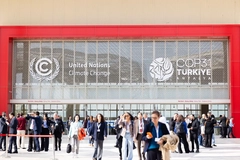
Zero waste and reuse systems could prevent 149 billion metric tons of CO2-equivalent emissions by 2050, according to research presented at the UN Climate Change Conference of the Parties (COP31) by Eunomia Research & Consulting and the Shape Foundation.
The report targets the COP31 presidency’s zero waste economy ambitions by presenting “proven interventions” in food, packaging, textiles, electronics, transport, and construction to reduce new material.
“Packaging falls mainly within the roughly 37 billion metric tons of CO2 equivalent that comes from municipal waste: better waste management, food waste prevention, and reuse, repair, and sharing,” Simon Hann, circular economy consultant at Eunomia, tells Packaging Insights.
“Packaging has a real part to play, but it is one part of a much wider shift in how materials are used.”

Alongside the emissions reduction opportunities, the report points to “a major blind spot in climate policy.” Eunomia, based in Bristol, UK, and the NGO Shape Foundation, based in Ahmedabad, India, say that many emissions savings delivered through reuse and sharing models are not included within national climate reporting frameworks.
Our Zero Waste Future: From the 2035 targets to a fairer, lower-carbon materials economy by 2050 - Eunomia
The organizations call on governments around the world to develop and agree on methods for measuring and accounting for these avoided emissions.
Highlighting the relevance of avoided emissions for the packaging industry, Hann says: “Companies should report the number of trips and the return rate actually achieved, together with life cycle data, instead of assuming that each reusable item fully replaces a single-use one.”
“Recycling claims likewise depend on how far recycled material really replaces virgin material.”
Scaling reusables through policy
Hann discusses how packaging businesses can scale reuse and refill systems to reduce demand for virgin materials.
“Reuse works at scale when it runs as shared infrastructure, not as separate brand schemes,” he notes. “That means standardized formats, pooled containers, and shared reverse logistics, so that volumes are high enough to be efficient.”
“Our analysis shows the GHG emissions benefit depends on containers coming back many times, so systems must make returning easy and keep transport distances short. Pallet pooling and refillable glass bottle systems already show this can work at scale.”
Hann acknowledges that barriers to wider adoption of reusable packaging persist. He points out that shared collection, washing, and redistribution networks are often costly to set up, adding that “nobody can build them alone.”
“Without standard formats, volumes stay too low to be efficient. The biggest barrier is policy,” he asserts.
“Single-use packaging doesn’t pay for its environmental costs, so reuse is competing on unequal terms.”
“Clear policy drivers would create a level playing field, lower the risk for companies that invest in reuse, and give competitors a reason to collaborate on shared systems.”
Avoiding emissions through reuse
At present, there is no standard method for packaging companies to measure and demonstrate emissions avoided through reuse, recycling, and waste prevention, Hann outlines.
“This is the gap that PRISM (Prevention, Reuse, Inclusion, Systems, and Materials), our initiative launched alongside the report, sets out to close by developing agreed ways to measure and credit the GHG emissions saved through reuse, repair, and sharing.”
In particular, Eunomia and the Shape Foundation call for changes to climate policy and national emissions reporting.
“National GHG inventories record emissions where they physically occur, so savings from using less material show up only indirectly in industry figures and are often credited to a different country,” Hann details.
“The report’'s first recommendation is to count what reuse, repair, and sharing save, with agreed methods so these savings can feature in national climate plans.”
Policy should also put a price on virgin material use, for example through EPR fees that reward reuse and recyclability, so that circular options compete on fair terms, according to the consultant.
Cutting material usage
Eunomia and the Shape Foundation say that the most significant reductions in carbon emissions will come from cutting the amount of material used in the first place.
Hann adds that in packaging, reduction can mainly be achieved by replacing single-use formats with reuse systems with high return rates.
“After that come design for high-quality recycling, so that recycled material really does replace virgin material, and pack and portion design that cuts food waste, because the food inside usually carries a much larger footprint than its packaging.”
“Switching from one single-use material to another rarely delivers much on its own, and it can also increase GHG emissions.”
Recently, Packaging Insights spoke to Amcor, Coveris, and SP Group to better understand how their refill solutions aim to reduce packaging weight, introduce recycled content, and push for recyclability.
We also spoke to the Plastic Waste Coalition of Action at the Consumer Goods Forum about scaling reuse initiatives and to Duni Group about the rise of reuse systems in light of the EU Packaging and Packaging Waste Regulation
In the Netherlands, a project explored the “practical realities” of using a smart refillable bottle system in a professional cleaning environment.
Meanwhile, Dutch authorities found McDonald’s Netherlands violated single-use plastics rules by providing disposable cups for dine-in consumption without collecting them for recycling.
This summer, India amended its Plastic Waste Management Rules to facilitate circularity through the mandatory use of recycled plastic and reusable packaging.