


Fenton targets milk waste with bag-in-box packaging for coffee shops

Key takeaways
- Fenton Packaging Solutions highlights bag-in-box pergal as an alternative to rigid plastic milk containers.
- The flexible packaging aims to reduce milk waste, packaging material use, and storage requirements.
- The closed dispensing system can potentially extend milk’s usable life after opening.
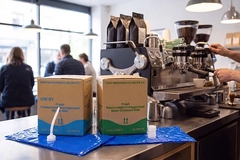 (Image credit: Fenton Packaging Solutions).
Fenton Packaging Solutions highlights its bag-in-box pergal, which aims to offer an alternative to traditional rigid plastic containers.
Fenton says that for coffee shops, milk must be stored safely, kept chilled, and dispensed quickly. Rigid plastic containers can create operational challenges, such as storage requirements, packaging waste, frequent handling, and milk left behind in opened containers.
To tackle the problem, Fenton developed the bag-in-box pergal to improve packaging efficiency. A flexible inner bag is supported by a lightweight outer cardboard box, cutting the amount of packaging material required per liter of milk.
Chris Warren, managing partner at Fenton Packaging Solutions, says: “Milk has a considerably greater environmental footprint than its packaging, making the prevention of food waste particularly important. As the flexible bag collapses during dispensing, pergals can potentially leave less milk behind than rigid containers.”

“The closed dispensing system also limits exposure to air and the surrounding environment. Depending on the system and operating conditions, this may help extend usable life after opening and reduce spoilage.”
Improving efficiency
Pergals connect to a dispensing system, enabling milk to be delivered consistently without repeatedly opening individual containers, according to Fenton. Fewer container changes can lower interruptions for baristas and counter staff, allowing them to focus on customers during peak periods.
Warren shares that the solution can also reduce the number of individual containers that need to be delivered, unpacked, and stored, while more milk can potentially be transported per pallet. Empty packaging also takes up less space before disposal.
“Pergals can improve volume-to-space efficiency, particularly when larger packs replace multiple smaller containers. Reduced packaging can also mean less waste accumulating around the operation, making them especially useful in compact high-street units, kiosks and transport hubs,” says Warren.
Recently, Packaging Insights spoke to SIG and Leibinger about how innovations in the dairy packaging space center around reducing packaging impact while maintaining shelf life, food safety, and affordability.
Meanwhile, experts from Amcor, Elopak, Leibinger, and SIG told us that as sustainability regulations tighten, dairy packagers are turning to recycled content and fiber-based solutions.
This year, SIG and Mengniu Dairy held a sustainability-themed event at Mengniu’s Horinger factory in Hohhot, China, to promote carton recycling.
Mother Dairy, an Indian dairy company, launched a degradable milk pouch for its Cow Milk variant across the Delhi National Capital Region.