


Fiberdom and Kiefel scale dry-molded fiber packaging for mass production

Key takeaways
- Fiberdom and Kiefel have successfully converted Duranova paperboard into 3D molded packaging at full industrial production speed.
- Their trial used electronics inserts, demonstrating a potential output exceeding 80 million units annually per production line.
- The companies say that the results show dry-molded fiber can compete in high-volume packaging applications.
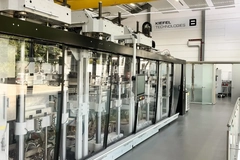
Finnish materials innovator Fiberdom has completed a series of industrial-scale production trials combining Duranova, a material made from FSC-certified wood pulp or paperboard, with technology from packaging machinery and molding technology provider Kiefel.
In the trial, Kiefel converted industrial-scale Duranova paperboard reels into finished 3D molded products at full production speed on its Natureformer KFD 75 dry-forming machine.
Duncan Mayes, chief technology officer at Fiberdom, tells Packaging Insights: “When identifying the commercial opportunities for Duranova’s packaging formats, several high-potential end uses emerge. These include home compostable food trays, lids, and cutlery for single-use occasions and other formed fiber packaging for dry goods.”
“It can also be used in applications where large humidity variations are common and where good strength-to-weight performance is required, along with natural electronic goods infills.”
Replacing plastic solutions
To demonstrate the capability of the solution, Fiberdom and Kiefel chose a packaging insert for consumer electronics used to protect and position products such as mobile devices and other small electronic goods within the pack.
 Duncan Mayes, chief technology officer at Fiberdom (Image credit: Fiberdom).The companies note that conventional plastic inserts are produced in great volumes each year and require tight tolerances, low unit cost, and high-speed manufacturing.
“We didn’t choose this insert because it was easy; we chose it because manufacturing economics matter most in cost-sensitive applications. Based on demonstrated processing speeds, a single KFD 75 production line has the potential to supply over 80 million Duranova-based packaging inserts each year. That is the scale at which dry-molded fiber can be competitive in truly mainstream applications,” says Mayes.
“We have successfully scaled up production, overcoming the challenge of maintaining consistency at industrial speeds exceeding 150 m per minute on industrial-size reels. We developed the tooling in the Kiefel machine to cut and form complex shapes in the shortest possible pressing times with the highest quality surfaces while maintaining uninterrupted flow through the line.”
According to the companies, the trials, built on an ongoing strategic partnership, achieved “optimized cycle times and material efficiency at high speeds.”
The result shows that dry-molded fiber technology can meet the production performance required for mainstream, high-volume applications and regulatory frameworks such as the EU’s Packaging and Packaging Waste Regulation.
Richard Hagenauer, director for R&D Technology at Kiefel, says: “This demonstration shows what becomes possible when innovative materials and advanced manufacturing technology come together. Combining Duranova with our KFD 75 dry-forming technology expands the range of fiber-based packaging applications that can be manufactured efficiently at true industrial scale.”
Earlier this year, Fiberdom completed industrial pilot trials of Duranova using a continuous reel-to-reel pilot line supplied by Vits Technology.