

UN Global Plastics Treaty: INC Chair Cordano addresses accountability concerns ahead of Bangkok meetings


Key takeaways
- INC Chair Julio Cordano says member states, not the Chair or civil society groups, ultimately determine the Global Plastics Treaty’s provisions on production and accountability.
- NGOs argue the latest “Aid to Negotiations” weakens measures targeting plastic production, while Cordano stresses the document remains informal and open to further deliberation.
- September’s Bangkok meetings will give delegations another opportunity to address unresolved issues and shape the next iteration of the treaty negotiating document.
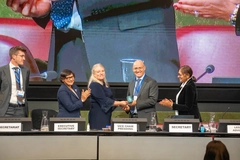 (Image credit: Alejandro Laguna Lopez/ UNEP.))
Julio Cordano, Chair of the UN Intergovernmental Negotiating Committee (INC) on Plastic Pollution, responds to NGO concerns regarding the omission of plastic production and accountability in his Global Plastics Treaty “Aid to Negotiations.”
He highlights that negotiations are between the representatives of the countries members of the UN, as the next phase of informal meetings in Bangkok, Thailand, approaches this September 27-30.
“Discussions are ongoing as there is still significant work ahead, including on issues where views remain divergent,” Cordano tells Packaging Insights. “One of the challenges that the INC is facing is making sure that it remains a coherent document that takes into consideration not only its own provisions, but also the complex processes that are implied in its future implementation.”
Last week, Cordano published an “Aid to Negotiations” document “to help structure” meetings of Heads of Delegations (HODs) in Bangkok. In reaction, Amy Youngman, a legal expert at the Environmental Investigation Agency, told us that the informal document weakens “all of the provisions that would tackle the scale of plastic production.”
“You’ll see the word ‘production’ has been met with brackets or removal in the Aid,” she says.
Discussing if there is a need for the Global Plastics Treaty to tackle plastic production alongside waste management, Cordano states: “I hope that I will be able to help member states in their deliberations, especially as they are trying to find common solutions to the outstanding issues.”
“In this regard, it is not for me to comment on specific elements of the text, as this is completely within the prerogative of members,” he adds.
Decision lies with countries, not NGOs
Yesterday, the Environmental Investigation Agency was joined by other members of the Break Free From Plastic coalition, including Eco Justice Ethiopia, No Plastic in my Sea, OceanCare, and the Center for International Environmental Law, to “denounce” the “Aid to Negotiations” for its “watered down measures.”
Additionally, researchers at the University of California, Santa Barbara and Berkeley, US, and at Tsinghua University, China, recently identified a gap in the draft UN Global Plastics Treaty text, which does not require countries to report how much plastic they produce, how chemicals are used in manufacturing, or how much plastic pollution enters the environment. They proposed a framework to improve transparency in these specific areas.
Speaking to Packaging Insights, Cordano addresses civil society groups’ assessment that the informal document weakens measures addressing plastic production: “The substantive choices remain available for members [nation states members of the UN], as they are the ones driving the process.”
“We are working within a Roadmap to advance our work step-by-step, and the ‘Aid to Negotiations’ is another step in this work. This reference document does not prejudge members’ positions or limit their ability to continue raising issues they consider important and exploring solutions. It is an informal and evolving reference document,” he continues.
Referring to the resolution establishing INC, he comments: “It is crucial to underline that our mission is to deliver on our mandate, contained in the UN Environment Assembly Resolution 5/14 [adopted in 2022], which establishes clear goals, against which we will be measured.”
Reflecting on INC developments
Cordano says his “Aid to Negotiations” text was an effort to reflect the level of progress achieved in the INC process, drawing on previous INC texts and discussions throughout the process.
The text does not incorporate ideas from the previous informal meeting of HODs to the INC in Nairobi, Kenya (30 June–2 July, 2026) “to allow members to continue developing them through their own exchanges,” he explains.
“After the meeting in Nairobi, a summary of the discussions was also published, precisely to help members keep a general record of the exchanges. Two upcoming informal HODs meetings, a virtual and then an in-person in Bangkok, in September, are further opportunities for members to address outstanding issues and explore possible solutions. These discussions are expected to inform the next iteration of the Aid to Negotiations.”
“INC sessions are formal meetings of the Committee where negotiations take place, whereas HOD meetings are informal and seek to facilitate discussions on possible ways forward and are therefore not decision-making negotiating meetings.”
The INC-5.2 sessions held last year in Switzerland failed to deliver an internationally binding UN Global Plastic Treaty.
Cordano says that the HOD meetings in Bangkok will be another opportunity for members to address outstanding issues and explore possible solutions.
“The objective remains clear: to deliver an effective response to end plastic pollution through an international legally binding instrument on plastic pollution, including in the marine environment, in line with the mandate entrusted to the Committee.”