
MM Packaging reinforces fiber tray for meat and produce with double rim


Key takeaways
- MM Packaging Deeside has added a double-rim structure to its GreenPeel fiber-based tray, improving strength and skin-seal integrity.
- Designed for meat, fish, chilled meats, and fresh produce, the tray reportedly uses up to 90% less plastic than conventional plastic alternatives.
- The upgrade responds to customer feedback on durability and will initially serve protein applications before being introduced across the wider GreenPeel range.
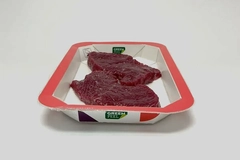 (Image credit: MM Packaging).
MM Packaging Deeside, a UK-based subsidiary of Austrian MM Group, has upgraded its GreenPeel fiber-based tray with a double-rim structure that aims to enhance strength, seal integrity, and retail performance for fresh protein packaging.
The GreenPeel tray reportedly uses up to 90% less plastic than conventional plastic trays, according to the company. It is designed for meat, fish, chilled meats, and fresh produce applications.
“The move to a double-rim structure is a significant step forward for GreenPeel. Customers want a stronger, more robust solution capable of maintaining a reliable skin seal throughout storage, distribution, and retail display,” says Jonathan Craddock, UK business development manager for GreenPeel at MM Packaging Deeside.

“By introducing the double rim, we’ve strengthened the tray without compromising any of the sustainability or branding benefits that GreenPeel already provides. It offers greater durability, particularly in demanding retail environments, while continuing to help food manufacturers reduce their reliance on plastic.”
To understand the latest innovations and trends in the protein packaging category, Packaging Insights previously spoke to industry experts from Yangi and Sealed Air.
Samantha Murphy, strategic marketing manager EMEA at Sealed Air, told us that regulatory requirements and consumer demand for more eco-conscious products are influencing innovation. Meanwhile, Yangi’s Cellera range features dry-formed fiber that combines airlaid fiber technology with 3D thermoforming, eliminating the wet pulp stage of production.
MM Packaging Deeside’s enhanced tray is currently available for protein applications, though the company plans to implement the change across the GreenPeel range.
Responding to feedback
MM Packaging Deeside says that the upgrade was a response to its clients’ feedback regarding strength and robustness when using skin-sealed products. Moreover, it also modified its machinery and tooling to create the double-rim.
Dave Whitworth, managing director at MM Packaging Deeside, says: “Innovation has always been central to our approach, and this latest enhancement demonstrates our commitment to continually improving GreenPeel in response to market requirements.”
Previously, Packaging Insights spoke to an expert at MM Board & Paper to explore how overstated sustainability claims and gaps in consumer understanding of fiber have led to an oversimplified picture of the material’s environmental performance.
Jürgen Kleinrath, chief science officer for Board & Paper, noted that fiber-based packaging is not always recyclable in every paper stream.
He told us: “In reality, coatings, laminates, adhesives, inks, and other components influence how the complete structure behaves during pulping and separation. Some packs can be processed through conventional recycling routes, while others require deinking or specialized systems.”
Meanwhile, at FachPack 2025 in Germany, MM Group showcased its consumer packaging solutions, including cartonboard, folding cartons, kraft papers, uncoated fine papers, leaflets, and labels.