



Metsä pivots from textile fibers to food packaging as market conditions reshape strategy


Key takeaways
- Metsä Group is investing €25 million in a Muoto fiber-based packaging line in Äänekoski, while abandoning plans for its textile fiber mill amid global overcapacity.
- The Muoto line, expected to start operations in 2028, targets the growing demand for plastic alternatives in food packaging.
- Metsä says regulatory pressure and increasing demand for fossil-free foodservice packaging are strengthening the commercial opportunity for Muoto.
 (All Image credits: Metsä Group ).
Metsä Group has invested €25 million (US$28.8 million) in a line for the production of Muoto fiber packaging in Äänekoski, Finland, while canceling plans to invest in its Kuura textile fiber mill. The move reflects an increased consumer interest in fiber-based foodservice packaging and stiff competition in the textiles space, according to the Finnish industry group.
“In the target market for Kuura textile fibers — that is, man-made cellulosic fibers — significant global overproduction has emerged in a short period, which has undermined the competitiveness of high-quality and responsibly manufactured fibers,” says Metsä Group.
“The greatest change has taken place in Asia, where significant new capacity has emerged in recent years. Currently, too few customers are willing to pay a premium for responsibly produced materials.”
The company says it continues to explore options to utilize the “valuable” expertise it has gained in the field of textile fibers.
The fiber expert has further made the decision to invest in its Äänekoski Muoto production site instead of the one in Rauma, Finland, as previously planned. The decision is based on the infrastructure of the mill sites, the existing production lines, and the costs of investment, Metsä Group elaborates.
 Antti Valtonen, VP for Muoto.“Over the coming years, packaging markets will continue to evolve, driven by both customer expectations and regulation such as the EU Packaging and Packaging Waste Regulation (PPWR),” Antti Valtonen, VP for Muoto, tells Packaging Insights.
“Muoto is now entering a new phase. We're expanding capacity, growing our customer collaborations, and preparing for the future. For companies looking to explore new fibre-based packaging solutions, now is a good time to get on board.”
Niklas von Weymarn, CEO at Metsä Spring, the innovation company of Metsä Group, highlights: “We’ve developed a competitive product and production concept for Muoto packaging that responds to the growing demand for fossil-free packaging solutions. Muoto supports Metsä’s ambition to develop new packaging innovations in collaboration with companies in the packaging value chain.”
Metsä’s fiber production
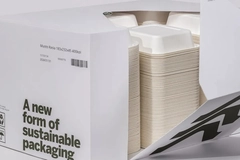
Muoto fiber-based products offer an alternative to plastic for food packaging, including demanding applications, according to the producer. It is produced using Metsä’s own wood fibers and can be shaped to meet a variety of customer needs, the company outlines.
The new Muoto fiber packaging production line will be located at the Metsä mill site in Äänekoski, next to its existing Muoto demo plant. The line will become operational in 2028.
Metsä expects the nominal capacity of the production line to be more than 100 million products per year, and supplied by the technology company Valmet.
The fiber Metsä uses to produce Muoto is made from wet wood pulp, without any intermediate steps. The company argues that Muoto offers stiffness and functionality with a lightweight, which makes it suitable for demanding applications, including foodservice.
 Niklas von Weymarn, CEO at Metsä Spring, the innovation company of Metsä Group.At Interpack 2026, Tarja Heikkilä, product manager at Metsä Spring, discussed the Muoto molded fibers at length with Packaging Insights and presented the new fiber-based tray project, made possible alongside Amcor and G. Mondini.
“There’s a strong market trend to find alternatives to plastic in certain product groups, which opens a significant market niche for the Muoto business. Muoto products also meet the strict requirements of the EU’s recent Packaging and Packaging Waste Regulation. Legislation is expected to give a boost to the product’s chances of success,” Von Weymarn continues.
In an interview with Packaging Insights, the UK’s Foodservice Packaging Association, Huhtamaki, and Siegwerk asserted that fiberization remains a driving force in foodservice packaging, while consumers and regulations are pushing packaging companies to ensure their sustainability claims are substantiated.
Metsä Group asserts that its innovation projects, including the development of the lignin product and carbon capture, are continuing as planned.
Recently, we spoke to the company about its new packaging design studio in Milan, Italy.