



Plastic justice gap exposed as US recycling access favors wealthier communities, study finds


Key takeaways
- A recent study has found that wealthier, more educated US communities recycle more packaging due to better access to nearby recycling infrastructure.
- Plastic waste generation is similar across regions, yet plastic recycling rates differ due to unequal infrastructure distribution, according to researchers.
- Policies in the US, like Bottle Bills, can double recycling rates, highlighting the need for expanded regulatory measures.
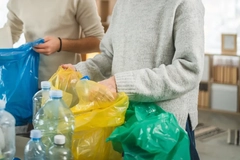
A study from the University at Buffalo (UB), US, found that communities with higher income levels and higher education attainment are more likely to recycle items such as soda bottles, takeout containers, and other plastic packaging.
Meanwhile, less wealthy states report lower recycling rates, despite the similar amount of plastic waste generation.
The study, published in Communications Sustainability, calls out the unequal access to recycling infrastructure, pointing out that communities with less wealth and formal education often have fewer nearby facilities, which leads to more difficult and expensive recycling.
John Atkinson, associate professor in the UB Department of Civil, Structural, and Environmental Engineering, tells Packaging Insights: “Our work shows that there are many underserved areas that should be elevated in priority for recycling infrastructure.”

Atkinson says that, according to the analysis, recycling success is “less shaped by plastic waste generation and more related to whether communities are given fair and equitable access to recycling systems.”
He stresses that there needs to be a mindset shift. “In addition to considering who wants to recycle, we must also prioritize who gets to recycle. That’s a distinctly different approach that goes beyond focusing on how to make recycling easier. Our work supports that this can make a substantial difference in elevating recycling rates.”
Infrastructure inequities
The research team combined maps, census data, state-level recycling rates, and other statistics to create a geographical analysis. The result shows that the consumers across the US generate similar amounts of plastic packaging waste regardless of income, education level, or location.
 Study authors Janet Yang, John Atkinson, Monica Miles, and Aditya Vedantam.Researchers looked into California and states in the Northeast and Mid-Atlantic, such as Massachusetts, Rhode Island, Connecticut, New Jersey, and Maryland, where plastic waste generation and plastic recycling rates are high.
Residents in areas with high recycling rates tend to be 30–55% wealthier and 14–19% more college-educated, with most living within 30 miles of recycling facilities.
On the other hand, states with high plastic waste but low recycling rates, such as Texas, Alabama, Mississippi, Georgia, South Carolina, Louisiana, Oklahoma, and parts of Arkansas, have fewer recycling facilities and lower income and education levels.
Aditya Vedantam, associate professor in the Department of Operations Management and Strategy at UB, says: “Many people in the South and Southeast live in underserved recycling areas. They generate similar amounts of plastic waste, but recovery and processing facilities are far away, which can make recycling much less feasible.”
Policy outcomes
Currently, in the US, ten states and Guam have a DRS, also known as Bottle Bills, requiring a small refundable deposit on recyclable beverage containers.
The UB study shows that states with Bottle Bills have plastic packaging recycling rates that are twice the national average.
Janet Yang, professor in the Department of Communication at UB, says: “Bottle Bills show how public policy, when combined with infrastructure, can help improve recycling infrastructure access.”
Monica Miles, assistant professor in the Department of Engineering Education at UB, adds: “All these data reveal a powerful and unique look into plastic-justice inequities in access to recycling facilities across the contiguous US.”
The research team urges adding recycling infrastructure to high-waste regions that lack material recovery facilities, investing in underserved rural and lower-income areas, and expanding policies to improve plastic recycling access in the US.