



Australian native plant can boost flexibility of seaweed-based pack, study finds
Key takeaways
- Australian researchers have found that adding native pigface plant extracts to seaweed-based films can improve their strength, flexibility, and moisture barrier properties.
- The optimized formulation was 38% stronger, stretched almost twice as far, and reduced water vapor permeability by approximately 57% compared with agar-only films.
- The study is at an early stage, and the material shows potential for water-soluble packaging.

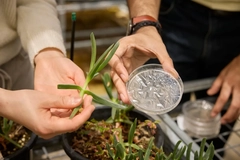 (Image credit: The University of New South Wales).
A research team from the University of New South Wales (UNSW), Australia, has found that adding extracts from the pigface plant, a hardy coastal succulent, to seaweed-based films can increase their strength and flexibility.
Pigface, Carpobrotus glaucescens, is a drought-resistant plant native to the eastern coast of Australia and used by Indigenous communities as food and medicine. Scientists highlight that the plant’s fleshy leaves contain various naturally occurring compounds, including sugars, organic acids, and polyphenols, which the team suggested could influence the properties of biodegradable materials.
The study, published in the Journal of Polymers and the Environment, combined agar, a jelly-like substance extracted from seaweed, with compounds from pigface leaves to create an alternative to conventional plastics.

Dr. Rishi Ravindra Naik from the UNSW School of Chemical Engineering says: “The material could potentially be developed into water-soluble packaging for products such as laundry detergent pods, where the film is designed to dissolve during use. And it won’t leave any traces of microplastic on your clothes or in the grey water.”
“Another possibility is packaging for dry products, although further improvements and safety testing would be needed before the material could be used in contact with food.”
Enhancing biodegradable films
The research team created nine different film formulations from the combination of pigface leaf extracted compounds and agar. They examined each film’s strength, flexibility, moisture resistance, and antioxidant activity.
One formulation was about 38% stronger than the agar-only film and could stretch almost twice as far before breaking.
It also lowered the material’s water vapor permeability by about 57%, improving the material’s moisture barrier compared with films made from agar alone.
“We thought if we added more pigface extract, it would improve our results — but it didn’t. Films containing an intermediate amount performed best overall, while higher concentrations reduced their strength and flexibility,” says Naik.
“The findings suggest that pigface contains compounds that could help improve the performance of biodegradable films, although further research is needed to better understand exactly how they work together.”
Further safety assessments needed
The researchers report that they detected arsenic in the plant material, underlining the need to understand where native plants are sourced and to conduct appropriate safety assessments before developing food-related products.
“It’s really important to understand the source. Higher levels of heavy metals were found in pigface that was sourced from areas with higher contamination,” adds Naik.
The study belongs to a broader project supported by UNSW Societal Impact Seed Funding, in partnership with Indigenous-led plant nursery IndigiGrow.
Peter Cooley, CEO of IndigiGrow, comments, “We were keen to see if there could be other uses for this local plant that can be used and incorporated into modern times, which is why we got involved.”
“There are huge opportunities with our native plants; however, Aboriginal people and communities must be integral to those opportunities and not sucked dry of knowledge and information and then left behind, which in many cases, happens a lot.”