

Tetra Pak taps on-the-go dairy demand with paper-based carton innovation
Key takeaways
- Tetra Pak has launched Tetra Reva, a paper-based packaging solution for yogurt, desserts, and soft cheeses.
- The square-shaped carton features a reclosable lid and pull-ring opening, enhancing consumer convenience and shelf differentiation.
- Tetra Reva supports chilled and high-acid ambient production while addressing growing demand for on-the-go consumption.

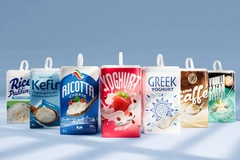 (Image credit: Tetra Pak).
Tetra Pak has launched Tetra Reva, the “world’s first” paper-based package for spoonable foods such as yogurt, puddings, desserts, and soft cheeses. The solution taps into demand for paper-based packaging, on-the-go formats, and responds to the growing soft food category.
Packaging Insights catches up with Tetra Pak to learn more about how the solution could change the segment.
“From yogurts to cottage cheese to desserts, plastic pots have been the go-to for spoonable foods for decades. Tetra Reva gives producers a new option to stand out on shelves, bringing renewable paper fibers into the category,” Marija Pejovic Wallin, VP for the Business Sector Chilled at Tetra Pak, tells us.

Tetra Reva is square-shaped, with a reclosable lid and pull-ring opening that aims to create a more “memorable interaction” with the package, as well as offer ease of use. The packaging giant says that conventional foil lids can be difficult to grip and may tear during opening.
“The carton uses paper from Forest Stewardship Council-certified forests and other controlled sources. It can be recycled where collection and recycling infrastructure exists at scale.”
Moreover, she details that its square shape makes transport and storage more efficient, pointing to a Tetra Pak case study in which a pallet held 57% more Tetra Reva packs than similarly sized plastic pots and 47% more than paper cups.
On-the-go consumption
Pejovic Wallin says that the solution’s full-top opening allows consumers to eat directly from the carton, tapping into demand for on-the-go formats. But she highlights that the innovation came with its own challenges.
 Tetra Pak's new square shaped carton for spoonable foods aim to stand out on crowded dairy shelves.“Packaging (spoonable) yogurt is very different from packaging a drink. Spoonable foods can be thick or contain pieces of fruit, which makes filling and sealing the carton more challenging,” she explains.
“We also needed to rethink how consumers interact with the carton,” says Pejovic Wallin. “Unlike a beverage, which can be poured through a cap, spoonable foods need a full-top opening that allows consumers to eat directly from the package.”
Snack packagers are increasingly responding to consumers looking for on-the-go products and appropriately packaged healthy treats.
At Pack Expo 2026, Pedro Gonçalves, Tetra Pak’s VP of Marketing for the US and Canada, told us that, although Tetra Reva is designed for refrigerated products, it can be carried in a backpack without the risk of spillage. “That is a significant advantage for the market,” he says.
A growing category
Tetra Reva’s filling system can also support chilled or high-acid ambient products. The packaging giant says that the spoonable foods category is growing, with new varieties of spreadable and flavored cheeses reaching the market, and plant-based products also expanding.
“The way people consume spoonable foods is changing,” underscores Pejovic Wallin. “Yet the packaging formats available to producers have remained largely unchanged.”
She positions Tetra Reva as an opportunity to shape the segment, giving producers a “distinctive” way to bring new products onto the market.
“We see this as an exciting step forward for the category, opening up new possibilities for product innovation, packaging differentiation, and the wider use of paper-based materials,” she concludes.
Recently, Tetra Pak also entered the ice cream packaging market with the launch of its Ice Cream Wrap made from up to 85% paper.