

US PET recycling stalls as “record” recycled imports fuel competition
Key takeaways
- The US PET bottle recycling rate fell from 30.2% to 29% in 2025, while post-consumer PET bottle collection dropped by 3.6%.
- Imported rPET reached a record 39.1% of US and Canadian market use, intensifying competition and threatening domestic recycling operations.
- NAPCOR warns that cheap imports, facility closures, and insufficient infrastructure investment are limiting domestic recycling growth.

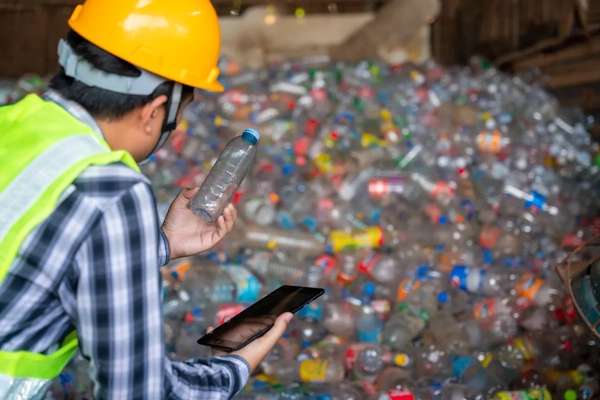
A report by the National Association for PET Container Resources (NAPCOR) has revealed a mixed picture of PET recycling, collection, and demand in the US and Canada, with imported recycled PET (rPET) changing the landscape for recyclers.
NAPCOR is an industry association for PET packaging in the US, Canada, and Mexico.
Its latest report finds that the US PET bottle recycling rate fell from 30.2% in 2024 to 29% in 2025, even as the volume of PET bottles available for recycling rose 0.6%.
Meanwhile, total post-consumer PET bottles collected for recycling in the US declined for the second straight year, down 3.6% from 2024, with imported rPET accounting for a record 39.1% of total rPET use across US and Canadian markets.

The annual report evaluates PET collection and recycling rates, recovery and rPET end-markets, as well as industry demand in the US and Canada.
Packaging Insights speaks to Lauren Laibach, director of data services at NAPCOR, about how the findings reflect changes in the economics of domestic PET recycling, as well as how rPET imports are causing “unprecedented competition” for domestic PET reclaimers.
Lightweighting and EPR impact
One factor driving declining PET recycling rates, says Laibach, is that major beverage brands continued rolling out lighter-weight soda bottles in 2025.
 The continued rollout of lightweight soda bottles by major beverage brands in 2025 contributed to declining PET recycling rates, says Laibach.“This means the same number of bottles recycled weighs less, assuming no change in recycling behavior. While this would affect both the weight of bottles available and bottles collected for recycling, impacts may be skewed on the recycling side because lighter bottles can lead to more sortation and processing losses.”
She also points out that EPR implementation is still in its early stages, with investments in recycling infrastructure not yet able to improve recycling rates.
“Recycling rates have largely stagnated without large-scale shifts in policy or infrastructure, and we can’t expect improvement until those change.”
Additionally, Laibach suggests that consumer participation in recycling could also be a factor contributing to declining recycling rates, as “debates about whether US recycling works are unfortunately a popular topic in our current culture.”
The report finds that US and Canadian recyclers processed 226 million pounds of post-consumer PET thermoforms in 2025, despite total thermoform collection, including exports for recovery, declining from 2024.
Are facility closures lowering recycling rates?
Earlier this year, The Recycling Partnership reported that seven of the 30 major US PET recycling facilities had fully or partially closed within a year, and NAPCOR estimated that closures since January 2025 had cut US PET recycling capacity by about 24.5%.
 Laibach underscores that stable demand remains essential to keep domestic recyclers viable.The Recycling Partnership cited cheaper virgin plastic and rPET imports, as well as high operating costs, as reasons why the facilities closed.
“PET reclaimer shutdowns in 2025 happened quite suddenly, at least temporarily disrupting regional recycling markets,” says Laibach.
However, she adds that the percentage change in pounds processed by reclaimers from 2024 to 2025 was “far lower” compared to the net loss in US reclamation capacity between the end of each year.
“This means reclaimers operating in 2025 were able to absorb additional material, and there remains enough domestic capacity to process the post-consumer PET collected in the US. In fact, post-consumer PET exports were lower in 2025, and a higher fraction of PET bottles collected in the US was also recycled here compared to 2024.”
However, Laibach underscores that stable demand remains essential to keep domestic recyclers viable. “Without predictable markets, reclaimers can struggle to sustain operations or justify investment.”
rPET imports “cap” US recycling growth
The report finds that rPET sales, including imports, to US and Canadian end markets increased 5.6% compared with 2024, with imports accounting for all the growth. Laibach explains that sales to all end markets from US and Canadian reclaimers peaked in 2021, with the pounds sold in 2025 12% lower.
Imported rPET’s share of the US and Canadian markets rose by 3.6% in 2025, according to NAPCOR, intensifying competition for domestic recyclers.
 Imported rPET to the US increased in 2025, intensifying competition for domestic recyclers, outlines Laibach.“Record amounts of imported rPET are being brought into the US market largely to meet additional demand for rPET use in bottle applications,” she explains.
While there has been expansion of rPET flake-to-pellet capacity to help meet market demand, Laibach explains that reliance on imported rPET “essentially caps” US reclaimers’ capacity to sell into end markets and “stifles further growth.”
The report also finds that 69% of PET recycled in the US and Canada was used to make new PET bottles in 2025, the highest share NAPCOR has recorded.
“The upstream impacts of this disconnect between demand growth and regional rPET supply chains are certainly a part of the strain that has led to facility closures,” highlights Laibach.
“In short, post-consumer material that crosses an ocean to be made into new products does nothing to drive additional recovery of material in the region where it’s used.”
Recently, SIG and Mondi told Packaging Insights that the US market lacks mechanically recycled post-consumer recycled plastics suitable for food-contact applications.