

Pack Expo 2026: Yangi targets US packaging demand with dry-formed fiber

Key takeaways
- Yangi will launch its Cellera dry-formed fiber packaging range in the US at Pack Expo 2026.
- The company sees an opportunity to expand domestic production as US duties and tariffs increase the cost of imported molded fiber products.
- Cellera reportedly uses up to 99% less process water and 55–75% less electricity than wet molding, while reducing cycle times to 4.3 seconds.
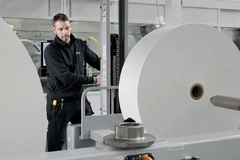 (Image credit: Yangi).
Yangi is expanding its dry-forming molded fiber into the US market as part of its “international expansion effort” following a Swedish Energy Agency grant announced earlier this year.
The Cellera range features plates, bowls, hot-and-cold beverage lids, and takeaway trays for quick-serve restaurants (QSR). Yangi will officially launch the product in the US at Pack Expo 2026 in Chicago (October 18-21).
The Swedish company says that with the expansion, it is tapping into the “widening gap” between fiber-based packaging demand and domestic production capacity — especially as current US anti-dumping duties and tariffs on imported molded fiber products are putting pressure on US brands to find domestic alternatives.
Carlo Semeraro, head of Commercial Partnerships at Yangi, tells Packaging Insights: “The anti-dumping and countervailing duties are significantly changing the economics of imported molded fiber products, particularly from China.”
The impact of these measures expands beyond fiber-based packaging. Earlier this year, the US Department of Commerce officially issued anti-dumping and countervailing duty orders on PP corrugated boxes from China. Industry associations expect the measures to increase overhead costs for Chinese plastic product exporters.
Semeraro notes that, according to the US International Trade Commission, US shipments of thermoformed molded fiber products subject to the investigation from China and Vietnam totaled approximately 259 million pounds in 2024.
 Yangi says that the expansion taps into demand for fiber-based packaging and domestic production capacity (Image credit: Yangi).“If even a portion of that volume shifts to domestic sourcing, US converters will need to add meaningful production capacity. For brands and converters, that creates an opportunity to replace imported volumes with locally manufactured fiber packaging,” shares Semeraro.
Dry-forming molded fiber technology can scale to that capacity without the water-intensive forming and drying stages of conventional wet-molding, says the company.
Dry-formed fiber benefits?
The Cellera range boasts up to 90-99% less process water than conventional wet molding, 4.3-second cycle times versus wet molding’s 30-60 second cycle times, and roughly 55–75% less electricity consumption than the wet-molding process.
“Yangi has built the supply chain and partnerships needed to deliver Cellera to North America, working with technological partners like GDM, a Coesia company, and AP&T,” says Johann Kaiser, CEO of Yangi. “That gives us a strong North American footprint, and the proven industrial capabilities converters expect from an equipment supplier.”
Semeraro tells us about Yangi’s strategy to expand into the US with its turnkey dry-forming solution.
He says: “Yangi designs, engineers, builds, commissions, and supports the complete production system, giving converters a clear path from investment decision to industrial production. We are focusing on converters that already have the customer relationships, market opportunities, and manufacturing capabilities to bring new domestic capacity online.”
Semeraro underlines that the pace of Cellera adoption will depend on customer commitments, product qualifications, site readiness, and investment timing.
Targeting QSR
QSR companies are a “clear” target packaging format for Cellera technology as it combines high volumes with repeatable formats such as plates, trays, bowls, and lids, says Semeraro.
Moreover, he explains that import dependence is “particularly visible” in these categories. According to the US International Trade Commission, imports from China and Vietnam supplied more bowls to the US market than domestic producers did in 2024.
“The opportunity is therefore not simply to produce more molded fiber in the US, but to build competitive domestic capacity in the right formats,” underscores Semeraro.
“For QSR applications, where throughput, consistent quality, and cost competitiveness are critical, dry forming offers a particularly relevant manufacturing route. By eliminating the drying-step bottleneck of conventional wet molding, Cellera can support much faster production cycles and help converters compete at an industrial scale.”
In July 2025, the US Government and the EU announced an import tariff deal, imposing a 15% tariff on most goods entering the US from Europe, with the exception of steel, which is still taxed at 50%. But while the agreement may have diffused a trade war, it risks sidelining shared priorities such as climate targets, circularity, and harmonized safety standards.
Xinnan Li, senior analyst for Packaging and Logistics at RaboResearch, told Packaging Insights that US tariffs on paper and pulp may trigger a zero-sum dynamic, with rising prices and costs pushing trade flows toward cheaper, lower-tariff partners like Canada and Brazil.