



Aliplast opens €48.8M rigid plastics recycling plant in Italy

Key takeaways
- Aliplast has opened a €48.8 million (US$55 million) rigid plastics recycling facility in Modena, Italy, with annual capacity of up to 30,000 metric tons.
- The R3GID plant uses Nextchem’s NX Replast technology to produce high-quality recycled polymers for packaging and other applications.
- Hera Group says the facility can strengthen Italy’s recycled plastics supply, cut import dependence and support compliance with new EU packaging rules.
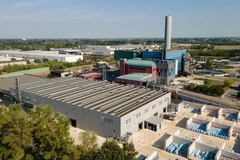 (Image credit: Aliplast).
Aliplast, a Hera Group subsidy, has inaugurated a €48.8 million (US$55 million) rigid plastic recycling facility in Modena, Italy, to meet growing demand for recycled plastics under new EU regulations, such as the Packaging and Packaging Waste Regulation.
According to Hera Group, the R3GID facility can process up to 30,000 metric tons of recycled polymers annually. It processes rigid plastic waste from cosmetics, home and personal care, and consumer electronics packaging.
“Europe faces a structural gap in recycling: capacity is stagnant or declining, while new regulations will increase demand for recycled plastics with quality equivalent to virgin polymers,” says Orazio Iacono, CEO at Hera Group.
“R3GID is our response as a first mover. It provides Italian manufacturers with high-quality, locally produced materials, reducing import costs and ensuring security of supply.”
Construction of the facility began in 2024. Nextchem, Maire Group’s sustainable technology company, provided its proprietary NX Replast plastic upcycling technology.
The new site is located at Hera Group’s industrial hub on Via Cavazza in Modena, which already houses a waste-to-energy plant and a wastewater treatment facility.
Strengthening Italy’s supply
Iacono says that the facility is also a benefit to Italy’s circular economy, suggesting that it could save the country approximately €24 million (US$27 million) in Plastic Tax, “if its entire output were used for packaging.”
Italy’s Minister of the Environment and Energy Security, Gilberto Pichetto Fratin, says that the facility is a “clear example” of how Italy can anticipate the challenges posed by new European regulations and “turn them into opportunities for industrial growth.”
“This plant combines Italian technology, an entirely Italian supply chain, and a certified, traceable product with quality comparable to virgin raw materials. Producing secondary raw materials locally means strengthening the country’s competitiveness, reducing dependence on foreign markets, and making our supply chains more secure, even in the face of geopolitical tensions and price volatility.”
The inauguration comes amid a series of strategic moves from Hera Group. Recently, Aliplast expanded its low-density PE recycling facility in Borgolavezzaro, Novara, and acquired a 70% stake in Kronos Polymer Polska.
The company anticipates that its latest facility to double its recycling capacity while increasing its overall operational flexibility.
Europe’s recycled plastic demand
As regulations like the PPWR require products to incorporate minimum levels of post-consumer recycled content from 2030, packaging producers are under growing pressure to reduce virgin material use.
Aliplast says that the EU End-of-Life Vehicles Regulation, approved in June 2026, will also contribute to recycled plastic demand.
Yet, brands must also ensure material efficacy and packaging performance. Earlier this year, François Thibeau, strategic business manager for Flexibles, E&E, and Sustainability at Ampacet, told Packaging Insights there are significant opportunities as well as challenges in the rigid plastic packaging space.
“On one hand, there is growing demand from regulators, brands, and consumers for more sustainable packaging solutions with higher recycled content,” he pointed out.
“On the other hand, challenges remain in managing the effects of thermal degradation, such as yellowing and loss of mechanical properties, especially as recycling loops increase.”