


Amcor partners with Kelpi to test seaweed coating for recyclable fiber packaging


Key takeaways
- Amcor is partnering with UK start-up Kelpi to assess seaweed-based barrier coatings for fiber-based packaging.
- The companies will evaluate the material’s commercial viability, scalability, performance, and compatibility with paper recycling streams.
- The collaboration reflects growing investment in bio-based coatings as brands seek alternatives to fossil-derived polymers.
Amcor has partnered with UK-based bio-based barrier coating start-up Kelpi to evaluate the viability of its seaweed material, which is designed to offer protection and compatibility with recycling streams, for fiber-based packaging.
The collaboration aims to expand Amcor’s AmFiber solutions with a coating said to be more sustainable, while maintaining its high running speed and circularity.
“This collaboration reflects how we are advancing our material innovation pipeline, and it supports the Ellen MacArthur Foundation’s call for accelerated innovation in paper-based flexible packaging,” says Peter Ettridge, director of R&D, AmFiber, at Amcor.
“Kelpi’s technology combines processability, gas and moisture barrier performance, and paper recyclability.”
The global packaging provider outlines that the potential benefits of integrating Kelpi’s bio-based coating include reduced reliance on fossil-derived polymers and greater use of renewable resources, which could contribute to a lower carbon footprint.
Scaling bio-based coatings
In the partnership, the companies will evaluate the commercial viability, scalability, and performance of the seaweed-based coating on Amcor’s products.
In recent years, many bio-based solutions have emerged in the packaging space that aim to replace conventional polymer-based barrier coatings, which are chemically complex and hard to recycle.
Frank Lehmann, VP Corporate Venturing and Open Innovation, Amcor, says: “Partnering with companies like Kelpi is a key part of how we bring new technologies into our innovation ecosystem.”
“Its innovative approach to leveraging nature-sourced materials that won’t compromise packaging performance is promising, and we’ll explore opportunities to scale the technology within our global packaging portfolio.”
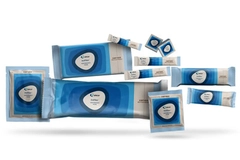
Kelpi recently joined forces with Mondi and Guardpack, a UK manufacturer of wet wipes and liquid-filled sachets, to conduct early-stage trials of seaweed and paper-based materials for sachet packaging.
Many bio-based alternatives often fail to be commercially adopted due to poorer protection quality and cheaper polymer-based options. But as consumers and regulations demand more stringent circularity efforts, bio-based options are increasingly receiving more funding.
At Empack 2026, Xampla showcased its pea protein-based coating, featured in Huhtamaki’s corrugated paper box with JustEat Takeaway. At the show, Packaging Insights spoke to Sam Walker, head of sales and business development at Xampla, about ambiguous definitions of “bio-based” amid rising consumer demand for renewable solutions.
Earlier this year, Notpla secured €4 million (US$4.66 million) in Horizon Europe funding to advance its plastic-free coffee cup range. It also partnered with Dutch quick-service restaurant Kwalitaria to advance its seaweed-based coating, suitable for trays and containers, with logistics provided by packaging distributor Conpax.