

Bacardi expands reusable spirits packaging on cruise ships

Key takeaways
- Bacardi has renewed its agreement with ecoSpirits to expand reusable and refillable spirits packaging across cruise ship operations.
- The collaboration has reportedly eliminated more than 130,000 single-use glass bottles and removed over 82,000 kg of packaging waste since 2023.
- The companies will further develop dispensing systems and explore circular packaging applications across additional brands and hospitality channels.
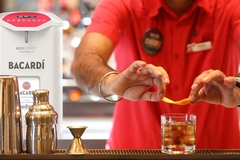 (Image credit: Bacardi).
Bacardi has signed a renewed agreement with ecoSpirits, a packaging technology company, to extend access to its reusable and refillable packaging for alcoholic spirits on cruise ships.
Under the new agreement, Bacardi will adopt ecoSpirits’s reusable ecoTote containers, SmartPour dispensing systems, ecoPlant processing technology, and CircularOne software for cruise ship applications.
“Our collaboration with ecoSpirits has demonstrated the potential of circular packaging in a complex, high-volume operating environment,” Rodolfo Nervi, VP Corporate Sustainability at Bacardi, tells Packaging Insights.
“Since launching the pilot with Carnival Cruise Line in 2023, more than 130,000 single-use glass bottles have been eliminated and more than 82,000 kg of packaging waste removed.”
The agreement also sees the companies foster a closer collaboration on the alcoholic dispensing systems together.
Previously, Bacardi aided the development of the ecoTote 3.0SC Cruise Edition, an alcoholic beverage drink solution engineered for cruise ships with corrosion resistance and enhanced compliance with US Public Health hygiene regulations.
Nervi adds: “We’re excited about the opportunities this expanded agreement creates and will continue evaluating how circular solutions can support our broader sustainability ambitions.”
Reuse in challenging environments
Bacardi’s portfolio includes Bacardi rum, Grey Goose vodka, Patron tequila, Martini vermouth, and Dewar’s Blended Scotch whisky. On cruise ships, these drinks are popular with passengers. Nervi says that each operating environment comes with its own challenges — and this was no different for the cruise ship industry.
However, due to Bacardi and ecoSpirits previous collaboration, he is confident the technology functions effectively in “one of the most complex and demanding hospitality environments.”
Reusable and refillable packaging options are fast becoming one example of effective circular packaging. However, reuse system companies Borealis, Tomra, and Eco-Products told Packaging Insights that reusable packaging is subject to mechanical stress and can be challenging to scale.
“Working with ecoSpirits and Carnival Cruise Line, we’ve demonstrated that circular packaging can operate effectively at scale without compromising quality or operational performance,” attests Nervi.
“The experience gained through that collaboration has provided valuable insights that can help inform future opportunities across other hospitality settings.”
Recently, Borealis and FSG Returnables launched a reusable cup and container system at the Northamptonshire Healthcare NHS Foundation Trust in the UK, while the South Korean government pushed for major F&B chains to adopt reusables.
Alcoholic sectors ambitions
Bacardi aims for all of its product packaging to be recyclable, reusable, or biodegradable by 2030, and include no single-use plastic in in-shelf secondary packaging and point-of-sales materials.
“The ecoSpirits collaboration is one example of how we’re exploring practical, scalable solutions that support a more circular approach to packaging,” underscores Nervi.
He hopes that the new agreement creates a framework to explore potential future applications across additional brands, channels, and sectors over time. Nervi adds that future opportunities must be measured by operational feasibility, customer demand, and support Bacardi’s ambitions.
The alcoholic beverage sector is increasingly innovating to reduce the environmental impact of certain packaging types. We recently spoke to Frugalpac, PulPac, and UPM Adhesive Materials about how the sector is rethinking materials, transportation, and energy use.
Innovations in the space have included paper wine bottles, aluminum cans, and lightweighting.