


Ecosurety and UWE Bristol trial reusable cup scheme without deposit or app


Key takeaways
- Ecosurety has launched a year-long reusable cup trial at UWE Bristol using a deposit- and app-free return system designed to simplify participation.
- The Lendable scheme uses dedicated purple collection bins and incentives such as cash prizes to encourage cup returns across the university campus.
- Partners including Suez, Re-uz UK, and Hubbub will assess return rates, operational efficiency, and the potential to scale low-complexity reuse systems.
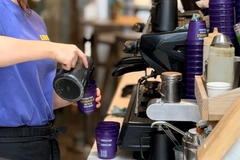 (Image credit: Ecosurety).
Ecosurety is trialing Lendable, a reusable cups scheme that does not rely on a deposit or a phone application, at the University of the West of England (UWE) Bristol, UK. The trial sets out to determine if removing such additional steps typically associated with deposit systems would result in higher participation.
Users can return the 80 purple reusable cups to dedicated purple collection bins at UWE Bristol’s Frenchay Campus. Participating locations include Costa Coffee, Subway, and the Students’ Union bar.
“Success will be principally measured by two things: operational simplicity and return rates,” Richard Marriott, head of Reuse at Ecosurety, tells Packaging Insights. “We want Lendable to run with minimal intervention from café staff, while achieving good return rates, giving us confidence that reusable cups can work at scale without relying on deposits.”

The producer responsibility compliance organization is partnering with Suez recycling and recovery UK, reusable packaging service provider Re-uz UK, and the environmental organization Hubbub for the year-long trial.
Jo Dainton, head of Circular Economy at UWE Bristol, comments: “Lendable gives us the opportunity to test and evaluate circular economy solutions in a real-world environment while creating valuable learning, research, and skills-development opportunities for our students and staff.”
“It demonstrates how universities can play a leading role in accelerating the transition to a more sustainable future.”
Return target
Marriott expects the trial participation and return rates to be “very high,” adding that all takeaway drinks on campus are to be served in Lendable cups, unless customers choose to bring their own reusable cup.
“Achieving strong return rates is critical to delivering the environmental and economic benefits of the scheme, but this is the first trial of its kind at this scale on an open campus,” he continues.
“Rather than setting a fixed target from day one, we’ll use the first few months to measure behavior, identify opportunities for improvement, and optimize the system. That’s one of the key reasons we’ve committed to a year-long trial: it gives us the time needed to test, learn, and improve.”
To encourage people to return the cups, Marriott explains that Lendable was designed to be as intuitive as possible. “Return bins sit alongside existing waste bins, making cup returns no more effort than disposal. The simple ‘purple cup, purple bin’ approach removes ambiguity, while our Lendable Lotto initiative provides an added incentive by linking return rates to cash prizes.”
According to Ecosurety, users can win up to £250 (US$336) per month in prizes linked to cup return rates across campus as part of efforts to encourage participation.
A recent study conducted at Matej Bel University, Slovakia, found that rewards can boost food purchases in reusable packaging in a university cafeteria setting. Customers received every fifth salad for free when using reusable dishware or bringing their own reusable container.
Designing for reuse
Ecosurety outlines that the purple cups rolled out as part of the scheme have also been designed to reduce environmental impact, as they use up to 50% less material than conventional reusable cups.
The organization highlights that closed-loop systems like Lendable can reduce carbon emissions by 20-30% after just two uses when compared with single-use paper cups.
Dr. Sarah Hills, senior lecturer in Geography and Environmental Management at UWE Bristol, comments: “Recycling alone cannot solve our resource challenges. Reuse systems like Lendable are essential if we are serious about creating a truly circular economy. By connecting the scheme with teaching and research, we’re helping equip the next generation with the knowledge needed to drive change.”
As part of the collaboration, Suez gathers data and insights and provides logistics throughout the trial, and collects the cups from campus to deliver them to Re-uz UK for professional washing and sanitization. The cleaned cups are then returned to UWE Bristol for reuse.
Marriott points to cost and convenience as the biggest barriers to scaling reusable cups in the UK. “For businesses, that means minimizing operational disruption, staff time, and packaging costs. For consumers, it means creating a system that is convenient enough to fit seamlessly into existing habits.”
The partners aim to use the evidence on consumer behavior from the trial to improve operational performance and environmental outcomes to achieve wider adoption across Bristol and beyond.
“We plan to test Lendable in other locations to understand where this type of system can work best,” adds Marriott.
“A university campus works well because it has a high footfall and density of outlets, making high bin coverage cost-effective, but other locations, such as shopping malls, could work well. The goal is to demonstrate that low-cost, low-complexity reuse systems can help scale reuse in on-the-go settings.”
At Packaging Innovations 2026 in Birmingham, Packaging Insights spoke to Ecosurety about the UK’s plans to launch a national Deposit Return Scheme (DRS) in 2027. Alison Appleby, packaging sustainability specialist at Ecosurety, called for clearer guidance on labeling, reporting, and costs ahead of the deadline.
More recently, we spoke to the Quebec Beverage Container Recycling Association about its efforts to modernize and expand the Canadian province’s DRS, which it said is witnessing “steady growth.”