
Greenpeace warns of microplastics in baby food sold in plastic pouches


Key takeaways
- Testing commissioned by Greenpeace finds microplastics in infant food pouches, with up to 495 particles per teaspoon.
- Packaging experts note plastic pouches help preserve food, ensure safety, and extend shelf life despite contamination concerns.
- Plastic pouches are the fastest-growing baby food format globally, raising concerns about infant exposure to microplastics and associated chemicals.
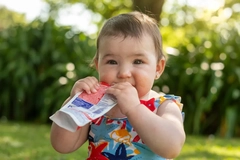
New research commissioned by Greenpeace has discovered microplastics in baby food sold in plastic pouches by Nestlé and Danone. At the same time, packaging experts remind that plastic packaging is important to achieving longer shelf life and food security.
The researchers behind the report Tiny Plastics, Big Problem: The Hidden Risk of Plastic Pouches for Baby Food conducted laboratory testing on Nestlé’s Gerber and Danone’s Happy Baby Organics infant nutrition.
In response, Nestlé states: “Plastic food-grade packaging plays an essential role in protecting food and beverages, ensuring the food safety and quality of the product, and helping to prevent food waste.”
“We take care when selecting our packaging materials based on our rigorous quality and safety standards and all applicable regulatory requirements.”
In a recent conversation with Packaging Insights, Nerida Kelton, the VP of sustainability and safe food at the World Packaging Organisation, explained that packaging needs to be functional first, especially in the case of sensitive food products.
“Even though we’re material agnostic, it’s important to understand that some polymers are, at this moment in time, the best solution for food safety, human health, protecting, containing, preserving, and extending shelf life,” she says.
The report by Greenpeace notes the presence of microplastic particles, and “a range of chemicals” were found in every sample of packaging and food analyzed. According to the report, this suggests that the plastic packaging may be the source of contamination.
Graham Forbes, global plastics campaign lead at Greenpeace USA, comments: “This study is a wake-up call for parents everywhere, who trust these brands to put their kids first. Plastic-dependent companies like Nestlé and Danone owe families a clear answer: what are they doing to eliminate microplastics and chemicals from the products they sell to babies?”
Microplastic exposure
Greenpeace highlights that a key finding of the report is that for every gram of baby food tested, researchers found up to 54 microplastic particles in Gerber pouches and up to 99 particles in those by Happy Baby Organics pouches.
This is said to be equivalent to as many as 270 (Gerber) and 495 (Happy Baby Organics) microplastics per teaspoon.
The study further estimates a total of more than 5,000 particles in a single Gerber pouch and more than 11,000 particles in a Happy Baby Organics pouch. The plastic-associated chemicals present in the packaging and food include a potential endocrine disruptor in the Gerber samples tested.
The findings are said to suggest a link between the PE used to line the plastic pouches and some of the microplastics found in the baby food.
Greenpeace points out that plastic squeeze pouches have become the dominant packaging format for infant food worldwide, which it says is the result of marketing, alongside a lack of options. According to the global organization, this baby food packaging format is the fastest-growing globally, at 8.18% year on year, and making up 37.15% of the 2025 global market by volume.
Plastic pouches now exceed all other forms of baby food packaging, including traditional glass jars. The organization adds that infants and toddlers may be more vulnerable to microplastic exposures as their organs are developing and their higher consumption of food, relative to body weight.
A recent study by the research consultancy Earth Action has revealed that, annually, around 1,000 metric tons of microplastics migrate from packaging into food, including particles small enough to enter human cell barriers and potentially interact with biological systems.