
Kirin and JSW advance PET chemical recycling with 95% depolymerization breakthrough

Key takeaways
- Kirin and JSW demonstrate alkaline depolymerization technology, achieving over 95% PET breakdown using production-scale equipment.
- The companies aim to overcome chemical recycling barriers by reducing reaction time, energy use, and commercialization challenges.
- The partners will further develop an integrated PET recycling process covering collection, depolymerization, and resource recovery.
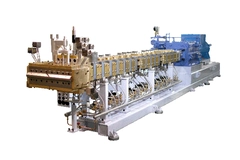 (Image credit: JSW).
Kirin Holdings’ Packaging Innovation Institute and The Japan Steel Works (JSW) have successfully developed and tested a PET chemical recycling technology, achieving over 95% depolymerization.
The demonstration test highlighted the alkaline depolymerization technology that rapidly depolymerized PET using production-scale equipment. The companies say that the process takes commercialization into consideration.
Kirin developed the alkaline depolymerization technology, which used JSW’s Twin Screw Extruder TEX αⅢ series, a co-rotating processing system for advanced polymer compounding, reactive extrusion, and recycling.
The solution addresses chemical recycling issues linked to high temperature and long reaction time requirements, according to the companies.
The partners’ solution is to depolymerize over 95% of the PET and establish operating conditions that allow stable PET depolymerization at a throughput of 250 kg/h or greater.
They say that their depolymerization achievement provided “valuable knowledge” on equipment specifications and operating conditions for the design of commercial-scale processes, while establishing a foundation for commercialization.
Kirin and JSW will present more detailed results of their test at the 57th Autumn Meeting of the Society of Chemical Engineers in Japan later this month.
Confronting PET bottle waste
As a major beverage producer, Kirin acknowledges that the use of PET bottles continues to increase globally, making resource circularity ever more vital. The company points out that the dominant method to recycle PET bottles remains mechanical recycling, which it argues is limited.
“Chemical recycling depolymerizes and purifies PET feedstocks, creating the potential to recycle a broader range of PET materials into high-quality PET, not limited to beverage bottles,” Kirin says. “However, conventional technologies have faced challenges related to energy efficiency and cost due to the need for high-temperature and long-duration reaction conditions.”
Kirin adds that the solution it developed alongside JSW is also low-energy and highly efficient.
For the test, Kirin did not rely only on heating to accelerate chemical reactions. It further used mechanical forces such as strong mixing and friction generated by machinery, the company describes.
“This technology is attracting attention as it can enable the reaction to proceed in a shorter time with less energy, thereby helping to reduce environmental impact.”
Kirin and JSW aim to continue building on the technology by developing an integrated recycling process to cover the entire value chain from PET collection and depolymerization to resource recovery.
The companies say that they will also evaluate if their solution is suitable for a wide range of PET packaging feedstocks, including non-food contact material grade PET materials.
Through collaborations with other corporations, local governments, research institutions, and other partners, the companies intend to promote the development of their technology and its practical implementation and commercialization.
In the past, Kirin adopted Avantium’s Releaf polymer to boost recycling.
While some plastic manufacturers and F&B companies see chemical recycling as a solution that facilitates the processing of hard-to-recycle packaging materials and contributes to a circular economy, environmental groups warn that the process could pose a risk to human health and the environment.
Packaging Insights recently highlighted this debate in a conversation with Dow and Global Alliance for Incinerator Alternatives.