


SIG boosts aseptic filling capacity with compact Neo machines


Key takeaways
- SIG has added two compact aseptic filling machines to its Neo platform, targeting single-serve and multi-serve carton filling.
- The systems can fill up to 32,000 and 15,000 packs per hour, with format changes in under 15 minutes and no machine-part changes.
- SIG says the machines increase output per square meter by around one-third, keep waste below 0.5%, and integrate digital and sterile-airflow technologies.
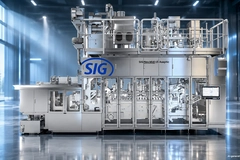 (All image credits: SIG).
SIG has developed two new filling machines for aseptic cartons as part of its SIG Neo platform. SIG Neo XSlim 32 Aseptic is suitable for single-serve cartons and SIG Neo Midi 15 Aseptic for multi-serve offerings.
The company says that the two “compact” machine models respond to the F&B industry’s increasing demand for high output and flexible production without requiring facility expansion.
“Many F&B producers have reached the physical limits of their existing plants,” comments Christoph Wegener, chief markets officer at SIG. “SIG Neo filling machines deliver the highest output per square meter in the industry and therefore add capacity to our customers’ factories and not buildings.”
SIG Neo XSlim 32 Aseptic is able to fill 32,000 SIG XSlimBloc single-serve cartons per hour in nine different pack sizes. Meanwhile, SIG Neo Midi 15 Aseptic fills 15,000 SIG MidiBloc or SIG MidiFit squarish multi-serve cartons per hour — both types of carton come in three different pack sizes.
Gavin Steiner, chief technology officer at SIG, adds: “The latest additions to our SIG Neo platform demonstrate how innovation can translate directly into operational value. By combining speed, flexibility, advanced digital capabilities, and aseptic excellence, we have created filling solutions that increase productivity and simplify day-to-day operations.”
Filling capacity and digitalization
The 32,000 SIG XSlimBloc can handle nine different carton sizes by leveraging SIG’s sleeve-based carton technology and open-sleeve filling process, outlines the aseptic packaging and machinery provider.
The filling technology further allows operators to switch between packaging sizes and formats in less than 15 minutes without changing any machine parts, despite the compact size of the machine, the company continues.
“This enables rapid SKU changes, reduced downtime, lower investment costs, and greater responsiveness to market demand,” says SIG.
The company states that the upgraded filling machines can improve the total output and output per square meter by one-third, compared to previous models. At the same time, they offer the same flexibility in terms of packaging size and format changes, the company adds.
SIG Neo XSlim 32 Aseptic and SIG Neo Midi 15 Aseptic are said to have a waste rate of less than 0.5%. Additionally, they reduce the total filling costs in comparison to SIG’s standard filling machines, the company adds.
SIG spotlights the smart operations offered by the machines, as they include the SIG Neo human-machine interface for intuitive operation and performance insights. They also feature SIG’s Neo Shield for improved sterile airflow and shielding during bottom sealing and pre-folding. This process is said to remove up to 95% of particles from the air.
Packaging Insights recently interviewed Steiner about SIG’s material science efforts, which are pushing aseptic packaging forward. He elaborated on the importance of developing materials that are compatible with SIG’s machinery, as well as on how packing machines are evolving to meet future demands.
We also explored the solutions that packaging machinery manufacturers are developing to reduce material waste, energy, and water consumption while supporting recyclable packaging formats.