
Material Week Tokyo 2026 live: Berndorf taps film demand across Asia with steel belts


Key takeaways
- Berndorf showcases casting and drying systems as packaging film producers adapt to monomaterials, green solvents, and rising energy costs.
- Its steel belts support thinner films while thermal transfer and temperature control help optimize drying for different solvents.
- The company serves laboratory and mass production needs, targeting Asian demand with systems for edible, biodegradable, and water-soluble films.
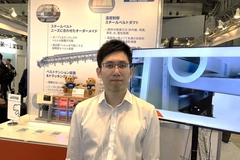
Berndorf Band Group, a global machinery company for flexible films, is showcasing steel belts and casting and drying systems for films and foils used in packaging at the Highly-Functional Material Week Tokyo 2026 (September 30 – October 2), in Japan.
Packaging Insights speaks to Christopher Yuen, business development and sales manager for machinery at Berndorf, about how it adapts to current market pressures and caters to a growing Asian market.
“As stricter environmental regulations come into force in Europe, we see the industry shifting toward the use of monomaterials and green solvents. As a result, the demands placed on the casting process have increased accordingly.”
He adds that amid rising energy prices globally, maximizing efficiency and reducing operating expenditure through process optimization have become key differentiators in the industry.
According to the company, its casting and drying solutions deliver maximum output with the same drying length as conventional market alternatives. Meanwhile, the technology boasts a cost-efficient operation despite requiring high energy and heat demands.
Adapting to market demand
Yuen explains that Berndorf’s goal is to respond flexibly to changing market demands. In the last year, packaging developers have advanced bio-based, water-soluble films, while equipment suppliers have prioritized production efficiency amid regulatory and supply chain pressures.
For example, as industry shifts to monomaterials, reduced materials, and green solvents, Berndorf says its high-quality steel brings balance between efficacy and sustainability demands.
Yuen says: “The use of high-quality steel belts ensures thickness uniformity in the transverse direction, enabling the casting of ever-thinner films while reducing overheating at the edges. Efficient thermal transfer and precise control of the oven temperature also allow for customized casting processes tailored to each solvent’s unique drying profile.”
.webp) Berndorf offers a standardized EcoLine system for a pilot scale of water-based polymer solutions and a Performance Line for mass production.He adds that Berndorf also offers a standardized EcoLine system for a pilot scale of water-based polymer solutions and a Performance Line for mass production.
Berndorf offers a standardized EcoLine system for a pilot scale of water-based polymer solutions and a Performance Line for mass production.He adds that Berndorf also offers a standardized EcoLine system for a pilot scale of water-based polymer solutions and a Performance Line for mass production.
“Whether it comes from our long-established partners, or new players in the industry, we would not be in this business if our steel-belt systems were not solving real-world problems,” Yuen continues.
Last month, Packaging Insights spoke to Markem-Imaje, Multivac, Sidel, Syntegon, and UFlex about the packaging machinery factors they see as most impactful to the industry’s sustainability efforts.
From lab to production
Yuen argues that Asia is the “dominant production region” for packaging films and its biggest consumer.
Berndorf’s technology and steel belts can create films for food and packaging, such as edible and biodegradable packaging films, water-soluble films, such as polyvinyl alcohol films, single-dose detergent delivery products, and other “sustainable” materials, such as algae protein.
However, Yuen explains that “the needs of a commodity film producer are very different from those of an R&D laboratory, and we have offerings at both ends of the spectrum.”
“For sophisticated development applications, we offer film drying simulations and casting systems with in-line sensors to monitor relative humidity and thickness as the film dries.”
He underscores that, for mass production development, Berndorf’s production systems prioritize stability and cost effectiveness to ensure consistent product quality annually.
Also at the show, Packaging Insights caught up with Oji Holdings, one of Japan’s largest paper, pulp, and packaging companies, which is presenting an array of paper-based materials and food containers. Meanwhile, we also spoke to Cargill Bioindustrial, which is presenting its bio-based Incroflo P50 additive for polymers.
With live reporting from Sichong Wang at Material Week Tokyo 2026