

Sealed Air banner promoting CRYOVAC Darfresh packaging with fresh meat cuts in vacuum trays on a rustic surface
Home
Videos
Packaging Innovation...

Packaging Innovations 2025: Colpac on lightweighting and fiberization

26 Feb 2025 | Colpac

Colpac showcased its Stagione Light products, for foodservice and retail markets at Packaging Innovations 2025, UK. We speak to Andrew Grimbaldeston, Colpac’s managing director about the portfolio’s weight reduction to comply with the UK’s EPR regulation. We also talk to Talia Goldman, the company’s ESG director, about the food packaging industry’s fiberization and the opportunities and challenges within this space.
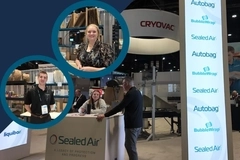

This is Packaging Insights reporting from Packaging Innovations 2025 in the UK.

I'm at the Coppa booth with Andrew Brimbaldiston, the managing director.

Andrew, what solutions are you highlighting at packaging innovations?

Thank you, Natalie.

First of all, we are showcasing our new Stagioni light product.

This builds on the success that we've had with our standard Stagioni product, but it's a slightly different format.

It lightweights so that it fits in with the new EPR legislation looking to reduce the amount of packaging weight.

It also provides a better platform with having a flatter base than the traditional product, enables it to be labeled more easily, so that really fits in with the market that hopefully is here today from the retail packer processor world where people are trying to communicate allergens and so forth.

So that's one good example.

We've got a range of 3 different products in that range, and that's a start and we hope to build from that.

We also are looking at platters again, the first one I'd like to show you is a brand new design that we've just in the throes of launching and testing.

This product allows for a slightly different platter style than the one that's the norm in the food service world where you can take the lid off.

We have had consumer feedback that basically says that feels like it's.

More of a luxury type product because it gives that reveal moment, but we've also simplified the base construction so it's very easy to pull together and again we've lightweighted it to fit in with the regulations and to make it easier for the teams within the packer or the bakery or the store.

Create and and and fill the platter.

So that's that's the next one.

The other thing that we're really showcasing as is is on the back of a project that we've we've done with with one of our favorite customers is showcasing an innovation that we've worked really hard on over a number of years which is Direct Food Contact Incs now.

Historically if you wanted to have food contact over a printed area, you needed to put a functional barrier which was typically plastic, so in this case this is a prep platter that historically would have had a printed area and then it would have a very, very fine thin laminated plastic in order to make it wipeable for ease of use in store.

What we've been able to do with the new technology is remove that plastic.

Take that plastic completely away from the product, so you just then have a printed finish that is also wipable.

It's hugely functional.

It works really.

It's taken an awfully long time for us to be able to make that work in the factory to meet the high standards that we have with our rating, and we're really proud of it and we look forward to seeing how we can take that technology forward with other customers at the show.

Now I'm also speaking to Talia Goldman, the ESG director at Calak.

Talia, the fiberization trend continues to go the pace.

What are the main challenges and opportunities for packages in the space?

So.

Every material has its place in the packaging ecosystem, but there is a real power to paperboard, and we are seeing this growing wave of fiberization.

It's been happening for a very long time, but it's, it's definitely, you know, really in the, the zeitgeist for the moment.

But there's sort of three main elements that I think are really great opportunities for fibrization.

One, it's the traceability to source.

It's a renewable resource.

We can do fantastic due diligence and traceability right down to the tree of origin.

We know where that paperboard is coming from, it can be certified sustainability, and we have that really excellent chain of custody, full transparency and traceability when it comes to this material type.

And that also that renewability, is really important when we think about the longevity of our of our materials and its efficiency.

It's also highly recyclable, so when the right infrastructure is in place, we can get some really, really excellent results in terms of keeping the value in that material and recycling it over.

Over again.

Of course that does mean we do have some challenges, infrastructure being one of those main challenges, and also contamination, so that food contamination, really that consumer education piece about taking food out of your packaging before you recycle it to really increase the chance of it being recycled.

But it doesn't mean that that's, those are challenges that can't be overcome.

It's just a lot of work that we have to do across the supply chain to make sure that the power of paper board is truly realized as we move through this fiberization process.

Perfect.

Now what impacts do you expect new legislation to have on fiber-based packaging?

This would be legislation such as the EU's PPWR and the UK's EPR.

So this is really one of the key issues that I've been exploring through the newly founded Alliance for Fiber Based Packaging, which I'm currently a co-chair of and through PAC UK through the scheme administrator, and I'm actually taking part in a panel discussion on day two packaging innovations.

Talking through some of the supply chain collaboration that's really needed with this new legislation, of course, it's fantastic that we're getting this reform, but there is a lot of work that still needs to be done to make sure that it is reform that drives recyclability, that really incentivizes recyclability and brings that collaboration right across the supply chain.

As a designer and innovator and manufacturer in food packaging, we've been designing and redesigning our packs to adapt to legislation.

And to really develop and to move forward and to be ambitious, we need to make sure that we can that we can keep pace with policy, but that policy can also keep pace with us.

And so there's a lot of challenges here but also some really good opportunities.

And then of course in Europe we're really still seeing how that is developing.

Now you've already mentioned that tomorrow you will give a talk about packaging.

Can you ahead of the talks share some of the key insights that you will be discussing?

Yes, so I'm very excited to be taking part in day two of the launch of PAC UK, which is the PEPR scheme administrator, and really thrilled that Minister Crey will be chairing that event.

We're going to really be talking about how we can achieve true supply chain collaboration when it comes to raising ambition and moving forward on on EPR.

For me it's about really making clear that it's really important that as we move.

Forward in this process with this new policy, that we do have that full industry engagement, both in width and breadth, but also in depth as , that we have good transparency and communication, and that we bring everyone along the supply chain on board at the same time, listening to voices, really bringing in robust data, bringing in expertise and making sure that decisions are being made in a sound and effective manner.

Perfect, thanks for speaking to Packaging.

More videos

Image