

EU-funded Aimplas project converts brewery waste into bioplastics for packaging

Key takeaways
- Aimplas uses brewery waste to create high-performance bioplastics for bi-based packaging, including bottles and coatings for cups and trays.
- The BioSupPack project, funded by the EU, has developed PHA and PHB materials, said to offer an alternative to fossil-based plastics and support regulatory compliance.
- The material can be used for packaging solutions, such as ice cream cups, condiment bottles, and cosmetic containers, which are recyclable and biodegradable.
 All image credits: Aimplas.
Aimplas has transformed spent grains from brewery waste into high-performance bioplastics for packaging applications, including bottles and coatings for cups and trays.
As part of the EU-funded BioSupPack project involving 18 partners, Aimplas has developed polyhydroxyalkanoate (PHA and PHB) materials that can serve as alternatives to fossil-based plastic and facilitate regulatory compliance.
The project has received €7.6 million euros (US$8.9 million) from the EU Horizon 2020 research and innovation program.
“Brewers’ spent grains contain sugars that can be used as a feedstock to produce PHB through fermentation,” Rosa González Leyba, project coordinator and leading researcher on Packaging at Aimplas, tells Packaging Insights. “The PHB obtained was then formulated into materials suitable for injection molding and extrusion blow molding.”
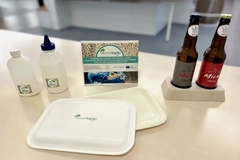
“This process allowed the production of different rigid packaging prototypes, such as a beer bottle display for bars and restaurants, and several bottle designs for food, home care, and cosmetic products. In addition, PHB was also formulated into coatings for fiber-based packaging, resulting in ice-cream cups and trays for multi-portion ice cream cakes.”
Industry applications
The biorefinery process for PHB production from brewery waste has reached a Technology Readiness Level (TRL) of six out of nine, which Aimplas says demonstrates feasibility in industrially relevant environments.
.webp) Aimplas uses spent grains from brewery waste to create bioplastics for packaging.“Within the BioSupPack project, the PHB formulations and the packaging prototypes were produced at a demonstration scale together with industrial partners,” says González Leyba.
Aimplas uses spent grains from brewery waste to create bioplastics for packaging.“Within the BioSupPack project, the PHB formulations and the packaging prototypes were produced at a demonstration scale together with industrial partners,” says González Leyba.
“The project delivered packaging solutions across multiple sectors. In F&B, this includes bottles for dressings such as mustard and ketchup, coated cups and trays for ice cream, and a bottle display for Horeca. In cosmetics, applications include bottles for body-peeling products, while home care solutions feature bottles for liquid detergents,” she outlines.
The PHB rigid packaging solutions developed as part of BioSupPack are said to be mechanically and enzymatically recyclable. These have reached a TRL of seven.
The PHA plastisol coatings are 99% bio-based, fully biodegradable, and at TRL six, according to the Spanish research institute. The coatings can be applied to paperboard, textiles, and PVC, as alternatives to PE coatings. The innovation is protected by a Centexbel patent and is ready for licensing to coating manufacturers.
Aimplas is also leading the Biovalsa project to convert rice straw and citrus pruning into bio-based plastics for packaging and the Bioprocess project to enhance the mechanical and barrier properties of bioplastics. The institute joined industry stakeholders to launch the Upcycle project to convert non-recyclable plastics into circular packaging solutions.