
TotalEnergies Corbion commercializes bio-based polystyrene alternative


Key takeaways
- TotalEnergies Corbion has commercialized Luminy Foam 50F, a high melt strength PLA material designed for extrusion foamed packaging applications.
- The bio-based material is positioned as a drop-in alternative to XPS for fresh food trays, clamshells, and bowls, with minimal changes needed on existing lines.
- The company says the sugarcane-based PLA can reduce carbon footprint by at least 70% compared to XPS foam.
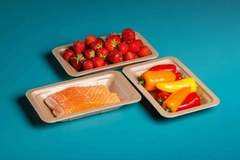 (Image credit: TotalEnergies Corbion).
TotalEnergies Corbion has launched Luminy Foam 50F, a high melt strength polylactic acid (PLA) solution for extrusion foamed packaging applications. The material is developed for use in trays for fresh food products, including fish and meat, as well as for foodservice packaging formats, such as clamshells and bowls.
The material is designed to replicate the performance of conventional extruded polystyrene (XPS), while offering a reduced carbon footprint, according to the PLA production company.
Luminy Foam 50F is available for commercial orders globally. The material is approved for food contact applications by the US Food and Drug Administration and in South Korea. While in other countries it can be used for non-food applications, says TotalEnergies Corbion.
“With polystyrene (PS) bans accelerating, this is one of the first solutions positioned as an industrial-scale replacement, not a niche material,” says Laurent Daligault, global packaging segment leader at TotalEnergies Corbion.
“Luminy Foam 50F enables converters and brand owners to adopt a drop-in [alternative] to XPS, in terms of processing and product functionality. The sugarcane-based PLA delivers at least a 70% reduction in carbon footprint compared to XPS foam parts. We look forward to supporting our customers globally, commercially, and technically, as they advance their sustainability ambitions.”
Stable foam production
TotalEnergies Corbion says that its Luminy Foam 50F’s high melt strength facilitates stable foam production without requiring additives, chain extenders, or reactive processing.
Stability in foam production supports the production of low-density foam structures with uniform cell morphology to match the performance needed for demanding applications, including fresh protein packaging.
Hao Ding, global marketing director at TotalEnergies Corbion, outlines: “This development reflects our commitment to sustainable innovation. We continue to focus on creating high-performance materials that are better for people and the planet.”
TotalEnergies Corbion describes Luminy Foam 50F as engineered to be a drop-in replacement of PS to allow converters to run it on existing XPS extrusion lines with a similar throughput and minimal modification.
Luminy Foam 50F is also an industrially compostable, recyclable, and PFAS-free material, according to the company.
Previously, TotalEnergies Corbion introduced Luminy PLA bags featuring 30% post-industrial recycled content in the outer layer. Last year, it reached a strategic agreement to distribute its Luminy PLA in the Middle East, including in the United Arab Emirates and Saudi Arabia.
During last year’s UN Global Plastic Treaty negotiations, Thomas Philipon, CEO of TotalEnergies Corbion, spoke to us live from the talks about the company’s objectives, the need to promote bioplastics, and greenwashing.