


Material Week Tokyo 2026 review: Japan’s plastics policies drive innovation

Key takeaways
- Japan’s packaging sector is responding to tighter plastics policies and international rules, such as the EU PPWR, with eco-friendly and PFAS-free solutions.
- Toyota Tsusho and Oji Holdings highlighted alternatives to plastic packaging.
- Sankei Giken Kogyo showcased a vacuum-insulated stainless steel tumbler designed to replace single-use cups.
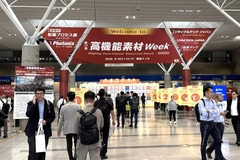
At Highly Functional Material Week Tokyo 2026, Japan, 1,016 exhibitors spanning corporations, industry organizations, and research institutions, presented packaging innovations across films, plastics, metals, ceramics, and sustainable materials to approximately 35,811 visitors.
Driven by the expansion of the regional packaging market, businesses are aligning their strategies with Japan’s accelerating plastics policies, as well as international regulations such as the EU’s Packaging and Packaging Waste Regulation (PPWR).
“Japan’s plastics policy has stepped up since the government formulated its Resource Circulation Strategy for Plastics in 2019. This was followed by the introduction of a charging scheme for plastic bags in 2020 and the Roadmap for Bioplastics Introduction in 2021,” a spokesperson from Toyota Tsusho Corporation told Packaging Insights.
“In 2022, Japan started implementing the Act on the Promotion of Resource Circulation for Plastics, which promotes measures such as reducing single-use packaging and cutlery and encouraging the use of recycled and bio-based materials. Looking ahead to 2030, Japan is targeting the introduction of around two million metric tons of additional bioplastics under its broader resource-circulation strategy.”
Advancing eco-friendly materials
According to data from the New Energy and Industrial Technology Development Organization (NEDO), a national agency that supports technology development to address energy and global environmental problems, four million metric tons of plastic packaging are generated annually in Japan, with waste arising from households and businesses.
On the show floor, Yoshii Hiroto, technical researcher for the Administrative Affairs Section under the Biotechnology and Materials Department at NEDO, told us: “In Japan, plastic packaging has a short useful life and is discarded in large quantities every year.”
“Food packaging, in particular, is difficult to recycle because it often consists of multiple materials and may contain food residues, additives, and other substances. Effective recycling can simultaneously reduce resource consumption, CO2 emissions, and waste generation.”.webp)
Toyota Tsusho is expanding bio-based PE in East Asia in collaboration with Braskem.
In response, Toyota Tsusho has collaborated with South American chemicals manufacturer Braskem to sell its bio-based PE product to the East Asian market.
“By using it as an alternative to petroleum-based PE, manufacturers can help reduce GHG emissions while maintaining comparable performance and processability. As it enables environmental benefits and consistent product quality, adoption is expanding across a wide range of applications, including shopping bags, food packaging, and household products,” said Toyota Tsusho.
At the tradeshow, Cargill Bioindustrial presented its Incroflo P50 additive for polymers. The 86% bio-based Incroflo P50 can be added to polymers for food-contact film packaging to aid processing.
Avery Dennison showcased its Ecotach portfolio, which replaces virgin plastics with recycled materials, like recycled PET from recycled water bottles, and recycled PP from containers.
Paper-based alternatives
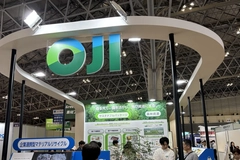
Also at the show, Oji Holdings presented its paper-based solutions that aim to replace traditional plastic packaging. The company showcased Flatskin, a vacuum-sealed packaging solution using a high-barrier skin film to keep food fresh for longer.
“This is a packaging that is separable into cardboard and film. Compared with conventional plastic packaging, plastic use can be reduced by up to 90%,” a spokesperson at the company told us.
“The solution features an easy-open peel tab. The vacuum packaging of meat and fish can suppress drip, and the printing on the cardboard offers an attractive presentation of foods.”
The EU’s PPWR requires the packaging industry to demonstrate that the materials it uses do not exceed PFAS‑related limits. To ensure compliance with the EU standard, Japanese packaging manufacturers are also turning to fluorine-free alternatives.
Demonstrating this shift, Oji highlighted O-hajiki, its environmentally friendly non-fluorine greaseproof paper designed without PFAS..webp) According to Oji, using highly rigid paper-based material prevents the board from warping when products are displayed on shelves.
According to Oji, using highly rigid paper-based material prevents the board from warping when products are displayed on shelves.
“O-hajiki can be used as packaging and lining paper for oil-containing food products. Used as a replacement for PE laminated paper, this product contributes to the elimination and reduction of plastic materials,” said Oji.
At the event, we also spoke to Oji Paper, a subsidiary of Oji Holdings, about its range of nonwoven fabric packaging materials.
Metal boosts sensory quality
Sankei Giken Kogyo showcased Ginoe, a brand of heat- and cold-retention beverage packaging products, designed to replace single-use plastic cups in food services.
The tumbler features a double-wall stainless steel structure. The product uses vacuum insulation technology, using a vacuum layer containing almost no air molecules to prevent heat transfer.
Kenta Takaoka, researcher from the R&D department at Sankei Giken Kogyo, said: “Stainless steel is a practical, cost-effective material choice for the technology. Using two walls instead of one, and a vacuum layer instead of an air layer, improves the insulation effect.”
The company indicated that Ginoe can provide an alternative to plastic solutions while enhancing the drinking experience by maintaining the temperature. In this way, it can preserve aroma release and mouthfeel for the beverage.
On the showfloor, Packaging Insights spoke to Hindalco Industries about its high-performance alumina products and ceramic solutions.