

Nefab completes global shift to fully recycled HDPE cushioning

Key takeaways
- Nefab has finished its global transition to fully recycled HDPE for Reflex Cushioning production across eight facilities in the Americas, EMEA, and APAC.
- The thermoformed cushioning offers a recyclable alternative to conventional foam packaging, protecting sensitive products.
- Nefab is advancing circular packaging through reusable designs, take-back programs, and recycling partnerships.
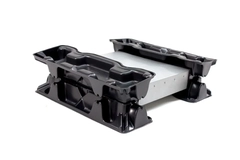 (Image credit: Nefab).
Nefab has completed the transition of all eight thermoformed Reflex Cushioning production facilities to fully recycled high-density PE (rHDPE) as standard, unifying its global production volume under one recycled material specification.
Nefab says it has adopted the material across facilities in the Americas, EMEA, and APAC. The final facility completed the transition in August 2026.
Olivier de Guitaut, executive VP of Sustainability, Innovation, and Portfolio at Nefab Group, says: “Packaging requirements are placing greater scrutiny on material composition, recycled content, and recyclability.”
“By using the same documented recycled material across our global Reflex Cushioning network, we make it easier for customers to understand what is in their packaging and prepare for changing legal requirements.”

Preparing for regulatory requirements
Reflex Cushioning is a thermoformed solution that can replace conventional fabricated foam for shock-sensitive and high-value products across datacom and cloud, semiconductor, MedTech, and other demanding industries.
Nefab highlights that the rHDPE solution can be developed around restricted contact zones, supporting equipment at approved points while maintaining clearance around fragile surfaces, screens, and protruding components.
Blair Vance, global product sales director at Nefab, comments: “Using recycled material only works if the packaging continues to provide the protection the product requires. By combining 100% rHDPE with application-specific engineering and testing, we can validate performance for demanding products while supporting more circular material flows.”
According to Nefab, the designs can be validated through its six International Safe Transit Association-certified testing facilities. “Testing often includes repeated drops at different orientations and G-force measurements to confirm that the packaging meets the customer’s specified protection requirements,” shares the company.
Reflex Cushioning is also said to be able to assist circularity programs, lowering the cost per part through repeated use. At the end of its life, whether used as a one-way solution or reused within a circularity program, the cushioning can be recycled via HDPE recycling streams if the local recycling program accepts it.
Nefab says that it can collect used cushioning through a take-back program and connect customers with a local recycling partner depending on the market.
The company is set to focus on post-consumer recycled content, recyclability, and responsible material sourcing to support customers in preparing for the EU Packaging and Packaging Waste Regulation.
Last year, Nefab Group, through Nefab Spain, acquired Embalajes Echeberria Soluciones de Embalaje, specializing in complete packaging solutions and heavy-duty corrugated products.
Meanwhile, the company unveiled an updated version of its EdgePak Collar, a fiber-based alternative to wooden pallet collars developed for one-way shipments. The packaging design aims to offer a practical solution for industries where return logistics are not feasible.