

Sun Chemical positions inks and coatings as the invisible PPWR enabler

Key takeaways
- Sun Chemical points to its NC-free, direct-food-contact, and non-bleeding portfolios that are built for PPWR recyclability.
- The company’s SunColorBox color management platform matches brand color across substrates, regions, and converters for global SKUs.
- Sun Chemical’s DFC inks can replace PE layers, help meet plastic reduction commitments, and lower EPR fees.
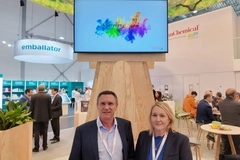
Sun Chemical is spotlighting its portfolio of nitrocellulose (NC)-free‚ direct-food-contact (DFC)‚ and non-bleeding ink systems, which are engineered to meet recyclability requirements under the EU Packaging and Packaging Waste Regulation (PPWR) across flexible packaging‚ paperboard‚ sleeves‚ labels‚ and digital printing.
Packaging Insights sits down with Rebecca Wilcock‚ the company’s marketing director for Packaging Solutions‚ EMEA, and its director of Product Strategy EMEA‚ Packaging Solutions‚ and global sustainability business leader, Nicolas Bétin, to discuss the future of packaging and packaging recyclability.
Sun Chemical’s PPWR compliant solutions land as the regulation’s August 12 implementation date approaches.
The 4Elements
Wilcock reveals that the company has built a value methodology called the 4Elements‚ structured around brand evolution‚ efficiency‚ risk mitigation‚ and sustainability.
“The reality is‚ if we look at packaging these days‚ it’s so complex — whether it’s compliance‚ regulatory‚ recyclability‚ or people just wanting more from their packaging from a differentiation point of view‚” Wilcock says. “We recognize that‚ and what we’re trying to do is reference the fact that we are a high-quality‚ very capable producer‚ but we are also a full solutions provider.”
Bétin says the framework organizes the company’s broader offering across inks‚ primers‚ coatings‚ lamination adhesives‚ heat-seal and cold-seal adhesives‚ and barrier materials in water-based‚ solvent-based‚ offset‚ digital‚ and metal-packaging formats. Customer conversations now begin with the full packaging solution rather than ink selection alone‚ he explains.
“When we go and see a partner today‚ we’re not talking about inks‚” Bétin says. “If you put this ink with this primer and this adhesive and maybe this top coat‚ you’re going to have these possibilities. It’s modular‚ of course.”
He frames the modular portfolio as something the company brings to customers as a single solution.
“We’re future-thinking,” Wilcock asserts. “We’re using a lot of insight to look at what’s coming down the line‚ and we’re really trying to make sure that we drive that into our innovation pipeline.”
NC-free for recycling
The clearest technical message from the Sun Chemical stand was the industry shift toward NC-free flexible packaging inks. Bétin says the company has developed proprietary polyurethane and electron beam (EB) solvent-based systems‚ alongside water-based flexo and gravure inks‚ that meet recyclability requirements without NC.
“For decades we do not sell NC inks for retort because the temperature is too high — it degrades the NC‚” Bétin says. “When the recycling started‚ they made tests with NC‚ and they saw that at 200 degrees Celsius it was degrading‚ which makes it difficult to recycle. So we’ve developed and pushed our polyurethane inks and EB systems that can withstand this temperature.”
Sun Chemical reports that its NC-free alternatives have undergone recycling testing and received certification‚ with the portfolio offering brand owners options across solvent-based and water-based platforms.
Multi-technology supply
Bétin states that Sun Chemical’s broad technology portfolio as a competitive advantage in a constrained supply environment.
“By the fact that we have multi-technologies‚ we are probably in a better seat than other companies because we can help a customer to go from one technology to another‚” he says.
He attributes part of that resilience to scale, noting that Sun Chemical is a member of Japan’s DIC Group (DIC Corporation‚ formerly Dainippon Ink and Chemicals)‚ which Bétin describes as the largest packaging and graphics group globally. He says this gives the company a broader base of qualified suppliers and long-term purchasing relationships.
The company is partly vertically integrated and produces its own polyurethane resins for ink synthesis and its own pigments for part of its color range.
“We are partly integrated in terms of packaging‚ which gives us the comfort to tell our customers that‚ except for major [disruptions]‚ we will support supply‚ I will say‚ at any price — we do what we need to do to buy the product‚ and make sure that we can supply it‚” Bétin says.
DFC safety
Sun Chemical’s paperboard portfolio focuses on DFC inks and coatings that replace PE barrier layers on folding cartons and corrugated trays. Bétin says the technology enables brand owners to print directly on the food-contact surface of items such as bakery trays and ready-to-eat formats‚ which eliminates the plastic co-extrusion layer.
“We’ve been able to develop inks and coatings that are compliant with European regulations for DFC‚” Bétin says. “And you can put cakes‚ muffins‚ sushis — whatever.”
The commercial logic for brand owners is twofold. Eliminating the PE barrier layer reduces total plastic content under voluntary brand commitments‚ while simultaneously lowering EPR fees by removing the plastic layer from the recycling stream calculation.
“It’s very important for brand owners who have decided to reduce‚ committed to reduce‚ the amount of plastic they use per package‚” Bétin says. “It’s a plate with carton‚ a little bit of PE — doesn’t look like a lot‚ but when you multiply by the number of items‚ and you’ve replaced the layer of PE with just an ink and a coating that can go easier in the paper recycling stream‚ it’s a lot of plastic saved and it reduces the EPR.”
The technology also opens experiential print options for brand owners.
“The fact that you can print inside really gives an experience‚” Bétin says.
Innovative label streams
For label applications‚ Sun Chemical presented two non-bleeding ink technologies engineered for bottle recycling streams. The first retains ink on the label substrate during washing‚ while the second is designed to release as crystallized flakes that can be filtered out of the wash solution.
“We have non-bleeding inks retentive — so it stays fully to the label — or we have non-bleeding washable — it’s de-crystallized‚ you have crystals‚ flakes of inks that go out that can be filtered without staining the washing solution‚” Bétin says.
The choice between approaches is dictated by local regulatory frameworks‚ with different stream specifications across European markets.
“In all cases they are non-bleeding to avoid staining the wash solutions during the recycling,” he says.
Color at global scale
Sun Chemical also emphasized color management as a strategic capability for global brand owners producing the same packaging across multiple regions and substrates. The company reports its SunColorBox software workflow supports color consistency from metal cans to cartons to labels‚ integrating with original equipment manufacturers’ (OEM) ink-dispensing systems.
“When you print in metal‚ when you put it on a label‚ or when you put it on a carton; if we use the same ink, it doesn’t make the same color,” Bétin explains. “We have a strong color management support and workflow to make sure that whatever the country‚ whatever the converter‚ or whatever the type of substrate‚ we can offer colors that match their logos and their marketing.”
Wilcock adds that the capability is critical for retail shelf presentation. “You go into the supermarket‚ you can see that you’ve got a retail-ready packaging and you’ve got the primary packaging‚ and they should harmonize — unless the marketer wants it to look different. You need something like SunColorBox to bring it all together to make it look right on the shelf.”
“We know we can talk to each other,” Bétin concludes. “We share a formula‚ we know how to adapt, and we know we can share the standard.”