
Vetropack discusses Rezon scale-up and reusable glass market growth
Key takeaways
- Vetropack is seeing growing interest in its Rezon lightweight glass bottles from beer and soft drinks producers.
- Rezon industrialization director discusses the technical challenges of transferring the thermal strengthening process from pilot to large-scale production.
- The company expects further growth across the European beverage market, with a second large-scale production machine planned for 2027.

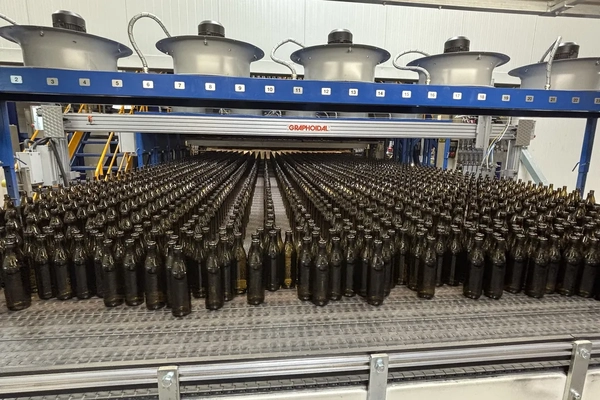
Vetropack Group is bolstering the large-scale production of its Rezon lightweight bottle. Packaging Insights catches up with Dubravko Stuhne, Rezon industrialization director, to find out more about the main technical challenges in scaling.
Stuhne also discusses Vetropack’s capacity to meet growing market demands, the properties that make Rezon stand out from conventional glass bottles, and the growing interest in the lightweight bottle in the beer and soft drink segments.
“Scaling up Rezon involved transferring a highly specialized thermal strengthening process from pilot production to an industrial environment while maintaining consistent product quality at significantly higher output volumes,” he tells us.
“Optimized process steps, automation, and digitalization were essential to overcoming the technical challenges involved. The scale-up phase was intensive: the new industrial machine began operating in spring and ran alongside the pilot machine for several months.”

From pilot to industrialization
Stuhne explains that during the Rezon scale-up period, Vetropack commissioned a new machine, trained around 30 employees, and produced more than 300,000 test bottles.
“Since then, the production line has been operating reliably, producing bottles at around twice the speed of the pilot machine with the same workforce,” he outlines.
“We have shown that we can produce Rezon reliably on an industrial scale, in larger volumes, and at a level of quality we had not achieved before.”
“By expanding our production capacity in Pöchlarn, Austria, we make Rezon available to a much broader customer base across the European beverage market,” Stuhne notes. “With the new machine, annual production capacity will double in comparison with the old machine.”
“However, we see this as the first step in expanding production. As market demand continues to grow, the new machine alone will not be sufficient. A second large-scale machine is scheduled to begin operating in 2027.”
Thermal strengthening
Rezon’s thermal strengthening process produces lighter and more durable bottles than conventional reusable glass options, Stuhne points out.
“Over the last decade, research at our Innovation Centre in Pöchlarn focused on developing a process for strengthening lightweight glass bottles. The result is Rezon technology.”
“For the first time, this technology uses a specially developed thermal strengthening process for glass bottles and makes their production economically viable. Rezon bottles are up to 30% lighter than conventional reusable glass bottles while offering higher resistance to internal pressure and impact than conventional bottles.”
Stuhne adds that the process also improves resistance to scuffing, helping bottles maintain their appearance over many reuse cycles. “This combination of reduced weight and improved durability makes Rezon particularly suitable for demanding reusable packaging systems.”
Use cycles and pallet capacity
At the end of 2024, the Research and Teaching Institute for Brewing in Berlin, Germany, tested a reusable 0.33 L lightweight glass bottle that is already available on the market and a reusable lightweight glass bottle developed by Vetropack specifically for the thermal strengthening process, highlights Stuhne.
“The comparison showed that even after 60 use cycles, the thermally strengthened bottles exhibited far greater internal pressure and impact resistance than standard bottles. This improved durability means that bottles can remain in circulation for longer before they need to be replaced, reducing replacement costs and the demand for new bottles.”
The reduced weight saves beverage manufacturers raw material, while also lowering transport costs and CO2 emissions, according to the expert. “Combined with the bottle’s higher number of use cycles, this substantially decreases resource consumption per use.”
“As a result, beverage producers benefit from both improved sustainability and economic efficiency — reducing the total cost of ownership across the entire life cycle of the bottle.”
He argues that the “logistics benefits” go beyond the bottle. “We also consider reusable packaging as a system. This means that the designs of the bottles and crates, as well as the pallets and the logistics, are all coordinated with one another.”
“As a result, more crates can be transported on each pallet, making more efficient use of transport and storage capacity.”
Market interest by segment
Vetropack is seeing a growing interest in Rezon in the beer and soft drinks segments, according to Stuhne. He says that the main driver is the trend toward more sustainable packaging, with Rezon technology offering significant benefits for reusable packaging systems.
“In the beer market, Rezon is already well established. In Austria, a 0.33 L reusable bottle based on Rezon has been available to the brewing industry as a standard solution since early 2024.”
“Brands such as Gösser and Rieder have already introduced the bottle successfully,” he points out. “We are now seeing the technology gain traction in the soft drinks segment as well. One of the first customers is Austrian drinks distributor Del Fabro Kolarik, which adopted the technology for its traditional Altwiener Kracherl brand.” “
Looking ahead to Vetropak’s plans for expanding Rezon production, Stuhne says that the next step is to further expand production capacity at the Pöchlarn site.
“With significant market growth expected over the next two years, a second large-scale machine is scheduled to go into operation there in 2027.”
“In the years that follow, we intend to extend Rezon production to other Vetropack sites over the following years. This will allow us to scale up the technology further and support growing demand across the European beverage market.”
Recently, Stoelzle Glass Group, another major Austrian glass packaging producer, spoke to Packaging Insights about its newly expanded pharmaceutical glass packaging production facility in Hermanova Hut, Czechia.
Libor Kraft, plant manager at Stoelzle Hermanova Hut, said that the investment aims to increase production capacity, improve process stability, and enable the company to respond more flexibly to changing production volumes.