


Yangi unveils dry-formed fiber tray for food packaging


Key takeaways
- Yangi has introduced a cost-competitive, high-volume dry-formed fiber tray for meat, fish, deli, and ready meals.
- The tray is PFAS-free, made of renewable fibers, and offers customizable designs for product-specific applications.
- Yangi’s Cellera technology enables scalable production, simplifying the process and reducing CO2 impact by ~80% compared to plastics.
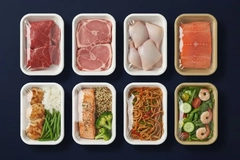
Yangi, a Sweden-based packaging provider, has launched a production-ready dry-formed fiber tray for meat, fish, deli, and ready meals. Behind the innovation is Cellera, the company’s dry-forming machine, which, according to Yangi, offers cost-competitive, and high-volume output with repeatable precision.
The tray is made of renewable fibers and is PFAS-free, featuring a functional laminate applied selectively to high-demand applications. Recyclability depends on the selected laminate, while integrated fiber chemistry ensures the tray's desired outer properties.
Hanna Rudel, chief commercial officer at Yangi, says: “The tray can be designed or customized to meet specific product, barrier, and design requirements. It gives brands and converters the flexibility to adopt fiber-based packaging that is intentional, premium, and high-performing without compromising on design, functionality, or cost.”

Fiber-based innovations
The solution enables manufacturers to “move beyond the limitations” of wet-mold fiber. Yangi’s Cellera is a dry-forming machine that combines dual-drum airlaid formation, in-line custom pad formation, and precision transfer technology to create fibers.
Anna Altner, founder at Yangi, says: “With renewable materials, a PFAS-free composition, ~80% lower CO2 impact compared to plastic alternatives, and scalable industrial reliability, Yangi’s dry-formed tray represents more than just a product launch.”
“For packaging producers and brands seeking alternatives to wet-molded fiber, it signals the arrival of dry forming as the new benchmark in fiber-based packaging.”
Yangi explains how by eliminating the wet stage of conventional dry forming, Cellera simplifies production, reduces process complexity, and enables industrial-scale dry forming with 4–6-second cycle times.
Fiber-based food packs
The fiber tray is available in bleached and unbleached options and comes in customizable sizes. It also supports debossing, high-resolution digital printing across the full surface, and a label-ready finish.
The tray meets the requirements for food applications and, when tested for consumer use in chilled, frozen, microwave, and oven settings, maintains its shape, strength, and stability, according to Yangi.
The solution also has sealing capabilities and is compatible with modified atmosphere packaging.
Recently, ProAmpac expanded its ProActive Recyclable RP-2000 High Barrier Series to include a curbside recyclable, fiber-based packaging solution, supporting the trend toward fiberization.
Meanwhile, Mondi and Pacapime Hungary are bringing corrugated packaging for fruit and vegetables to Central and Western European markets.
DS Smith Tecnicarton developed corrugated cardboard packaging for Zicla’s smart bike-lane separators, a street-safety company.