

Solidus launches fiber-based ready meal packaging with less plastic

Key takeaways
- Solidus develops Futurline Heat&Eat fiber-based MAP trays for microwaves, ovens, and air fryers.
- The packaging uses up to 90% less plastic than conventional plastic MAP trays and supports separate material recycling.
- The moisture-resistant trays preserve food freshness and are compatible with existing tray-sealing equipment.
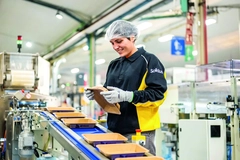 (Image credit: Solidus).
Solidus has introduced the Futurline Heat&Eat, a range of fiber-based modified atmosphere packaging (MAP) for ready meals that can be heated in microwaves, ovens, and air fryers.
The solution taps into consumer demand for convenient meal options that fit into busy lifestyles, as well as regulatory pressure for reduced plastic and recyclable packaging.
“A key feature of Futurline Heat&Eat is its material composition. Compared with conventional plastic MAP trays, the solution uses up to 90% less plastic while maintaining the functionality required for MAP applications,” says the packaging company.
Additionally, the solution aims to preserve freshness and extend the shelf life of chilled and frozen meals by maintaining the protective atmosphere inside the pack.

Packaging Insights recently explored convenience and sustainability in food packaging with SIG, Tetra Pak, and TNA at Pack Expo 2026. The experts highlighted how busy lifestyles and growing interest in portion control are prompting companies to develop smaller formats.
Regulation drives paper pack innovation
Solidus’ Futurline Heat&Eat trays are made from recovered fiber solid boards that are available in FSC- and PEFC-certified grades. According to the company, after use, consumers can separate the barrier film from the tray, which goes into the plastic recycling stream, while the tray is recyclable in existing paper streams.
“The combination of product protection and recyclability positions the solution as an attractive option for brands seeking to reduce plastic usage and prepare for future packaging requirements,” says the company.
Increasingly, packagers are innovating to reduce plastic use, especially as EPR legislation and the EU’s Packaging and Packaging Waste Regulation (PPWR) come into effect.
“Beyond regulatory compliance, the industry is trending toward packaging with reduced plastic content, with many consumers indicating a preference for recyclable and fiber‑based formats, while cost and convenience remain decisive factors,” Uwe Schulze, executive VP of product and development at Elopak, previously told us.
Earlier this year, we spoke to suppliers at Interpack 2026 about how the PPWR is driving paper innovation, with investment in functional barrier papers and converting compatibility reaching a tipping point.
Supply chain durability
Futurline Heat&Eat trays are also compatible with standard tray-sealing equipment for minimal integration into existing packaging lines, says Solidus.
The tray range is said to be moisture-resistant and maintains strength and stability during transport and storage. It also boasts offset printing to facilitate shelf appeal and has retail and foodservice applications.
As concern over food waste grows and supply routes face volatility, packaging producers are optimizing supply chains through material innovation and regional production.
Packaging Insights previously spoke to Sealed Air, Coveris, and Dole about how innovative materials, optimized engineering, and circular supply chain strategies are transforming food preservation without compromising product quality or sustainability goals.