

Paperization scales up: How PPWR is driving flexible paper packaging innovation


Key takeaways
- Koehler, Sappi, Paptic, and Metsä Board push fiber-based barrier papers as PPWR reshapes flexible packaging.
- Sappi reports paper reaches cost parity or preference over plastic on the total cost of ownership.
- WPO calls for rigorous life-cycle analysis before brand owners substitute plastic with fiber-based packaging alternatives.

According to suppliers at Interpack 2026, investment in functional barrier papers and converting compatibility has reached a tipping point as the paperization trend continues to rise. The shift is being driven by brand owners seeking Packaging and Packaging Waste Regulation (PPWR)-compliant alternatives to multi-layer plastic laminates in the EU. Manufacturers maintain that the established European paper recycling stream offers a credible end-of-life pathway.
Koehler, Sappi, Paptic, and Metsä Board tout fiber-based barrier solutions that are engineered to match plastic on performance and total cost, while the World Packaging Organisation (WPO) warns that fitness-for-purpose must still guide every substitution decision.
Packaging Insights sits down with leading suppliers, who point to a fundamental change in commercial framing. Paper is no longer evaluated against plastic on substrate cost alone but on total cost of ownership, regulatory exposure, and consumer trust; a shift several executives describe as the moment paperization stopped being aspirational.

Barrier on demand
Koehler Paper spotlights its NexPlus and NexPlus Advanced grades — papers engineered with water-based barrier dispersions applied to the reverse side of the substrate. The coatings target grease, aroma, and oxygen barrier requirements while remaining compatible with the paper recycling waste stream.
“The biggest trends in flexible packaging are to replace materials that are not recyclable, not sustainable, with materials that are bio-based from renewable resources, but also have an end-of-life means to be recyclable in the paper waste stream,” says Alexander Rauer, head of business development for flexible packaging paper at Koehler Paper.
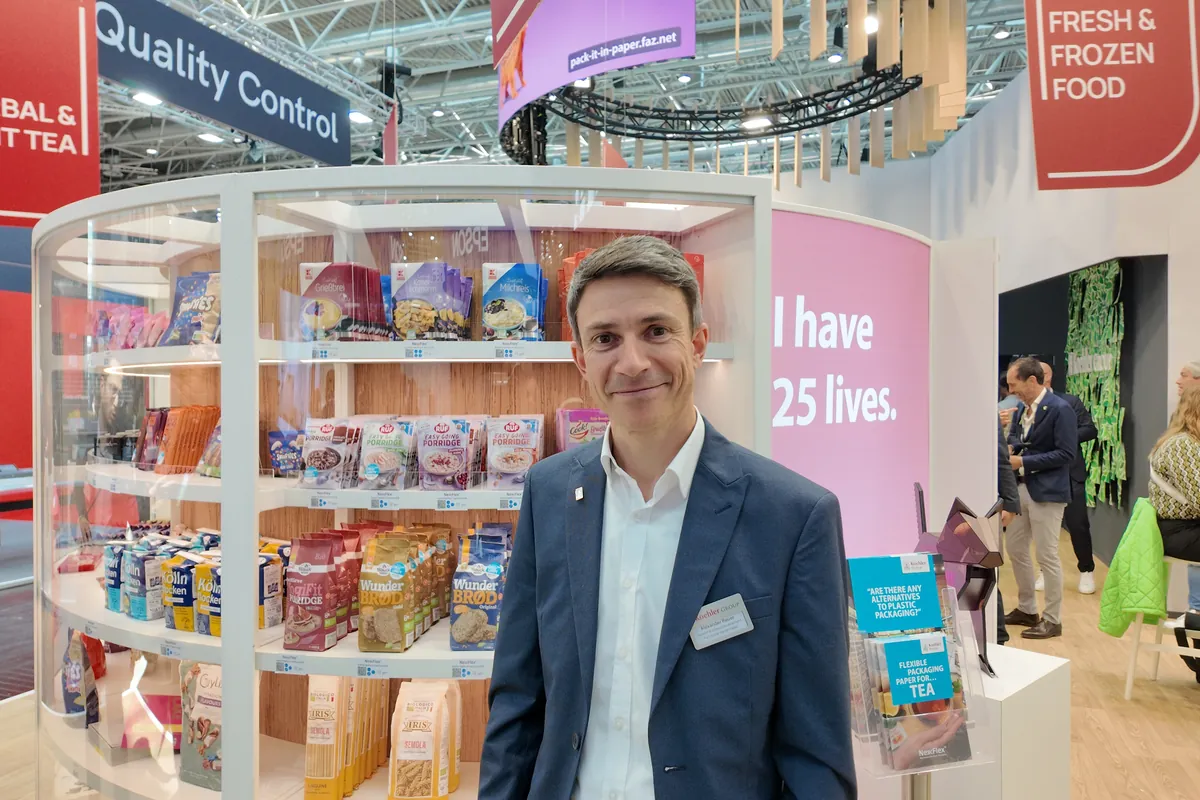 Koehler’s Alexander Rauer says NexPlus papers deliver on-demand barrier protection for flexible packaging.Rauer says the company has a robust portfolio, with paper qualities ranging from heat-sealable grades for greasy dry foods such as spices to more sophisticated multi-barrier formats.
“We have basically an on-demand paper, depending on the product and the product demands,” Rauer proclaims.
He adds that Koehler’s papers run on standard form-fill-seal machinery across flow packs, block-bottom bags, three-side seal bags, and standard pouches. He describes converter compatibility as a non-negotiable requirement for any new development.
Looking forward, Rauer says Koehler’s barrier sophistication will define the next competitive cycle.
“Barrier functions will evolve dramatically,” Rauer predicts. “The level of the barriers will improve, the combination of barriers will be more detailed, more sophisticated, and the use of non-recyclable material will be less and less.”
He also notes that Koehler is investing in bio-based coatings to replace polymer coatings, which are still common in functional papers. Rauer frames this as important for long-term recycling-stream compatibility.
The paperization moment
Sappi described Interpack 2026 as the moment paperization shifted from concept to mass scaling. The company’s VP of marketing and sales, Flavio Froehli, says the industry has reached a maturity point where functional papers can compete on existing converting equipment without performance compromise.
“We’re not talking about innovation pilots anymore, we’re talking about mass scaling, and that’s where Sappi comes in,” he explains.
He adds that the PPWR has accelerated decision-making across brand owners, even where momentum had previously stalled on regulatory uncertainty.
“The urgency has increased, and certain decision-making is being accelerated,” says Froehli. “What slowed down decision-making was the uncertainty; is it going to happen or not, and in what form or fashion?”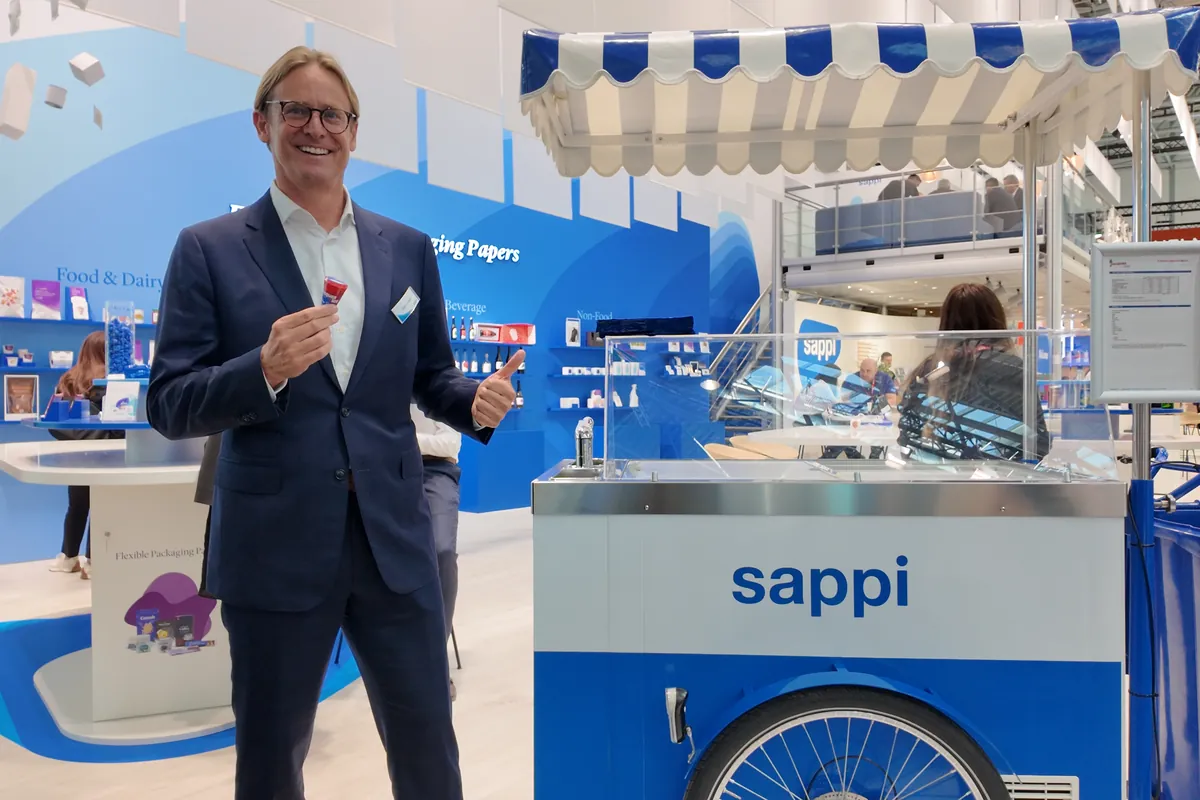 Sappi’s Flavio Froehli says paper now competes with plastic on the total cost of ownership.
“Now at least it’s clear it’s going to come into effect.”
The company also challenged the long-standing assumption that paper is more expensive than plastic. Citing internal research, Froehli spotlights that on a total-cost-of-ownership basis — including extended producer responsibility fees, brand value, and consumer trust premiums — paper reaches parity or preference in more than half of the cases evaluated.
“If you just compare substrate cost, plastic versus paper, you have no chance,” Froehli emphasizes. “Plastic is the cheapest form out there.”
“However, if you look at the total cost of ownership, and you start adding all the fees and premiums and brand costing attached, in more than 50% of cases, people see actually even keel, if not a preference for paper. That stigma that paper per se is more expensive is only true for the substrate, but not for the total cost of ownership.”
Froehli also highlights Sappi’s Guard Duo barrier paper for confectionery applications requiring grease and aroma protection on both internal and external surfaces. At Interpack 2026, the company demonstrated this solution with an ice-cream-cone application that displayed a visible demonstration of moisture and grease resistance under stress.
Sappi also reframes the brand-owner conversation around value rather than cost.
“It’s no longer how much does a package cost us, but what is the package bringing value to us?” he asks.
“The value has a lot to do with trust, and the modern consumer has a certain trust issue. Greenwashing is a big topic, so they’re looking for signals, for signs that boost their confidence in a certain brand.”
Froehli also points to the existing paper recycling stream. By his account, 87% of paper in Europe is currently recycled, which he sees as a critical consumer-behavior advantage.
“It’s tough to change consumer behavior, but consumers are already used to recycling paper,” he underscores. “If they know that paper or fiber-based packaging can go into the same waste bin, that is the booster people need, and that's the value-added that the brand owner sees.”
Froehli adds that Sappi has invested in expanding functional paper production at its Alfeld site in Germany, which he says hosts the world’s largest coating unit capable of applying multiple functional layers.
“Brand owners and converters are not going to make the change just because it's sustainable; that’s just the added value,” Froehli explains. “It’s got to work on their lines with existing equipment.”
“If you have that ecosystem — machine manufacturers, brand owners, and converters working together — that’s what brings the right solution to the application.”
Plug and play
Paptic positions its fiber-based material as a drop-in replacement for plastic on existing converting lines. The company’s segment director, Alexandros Skouras, PhD., tells us that the material has been validated for retail carrier bags, electronics, luxury packaging, and hygiene-sensitive non-food applications.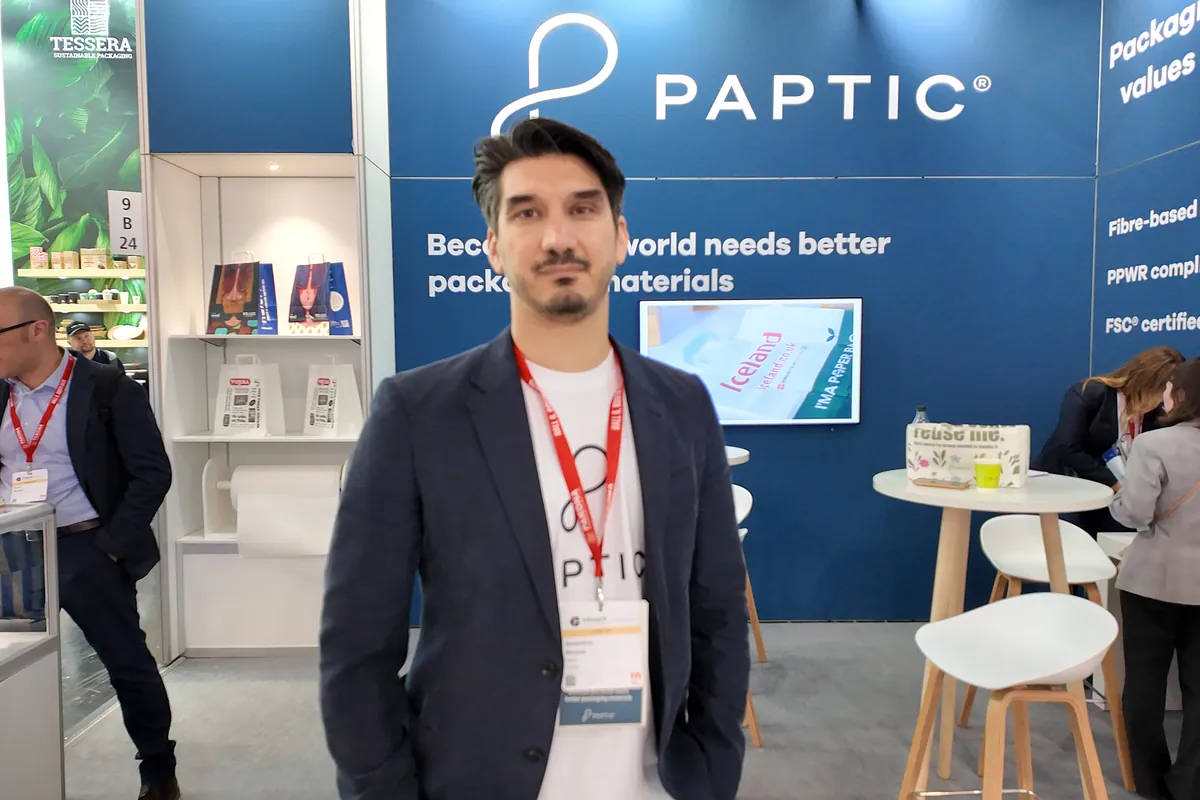 Paptic’s Alexandros Skouras says the fiber material replaces plastic rolls on existing converting lines.
“We’ve designed a fiber-based material that combines the recyclability and sustainability of paper with the characteristics, properties, and functional performance of plastics,” Skouras notes.
He further reveals that brand-owner conversations now center on a clear set of converting requirements that fiber alternatives have historically failed to meet.
“They don’t want to compromise, they don’t want to see their converting lines running at slower speeds, and they don’t want to have to substantially redesign their packaging,” says Skouras. “They want the same properties in terms of puncture resistance and weight.”
“They don’t want scratches on their products, and they don’t want dust. They want all the big advantages that plastic has always carried inherently, but in a format that’s recyclable at scale and fully compliant with PPWR.”
Moreover, Skouras highlights that Paptic’s central advantage lies in converting compatibility.
“You don't need to change your lines or your equipment. You just replace your plastic roll with a fiber roll from Paptic, and it works straightforwardly. Right away, off the bat.”
Skouras also identifies inherent heat-sealability as the company’s next development priority, as fiber-based materials currently require coating processes to achieve sealability, adding material and complexity.
“Our main focus would be to design a fiber solution that’s sealable right from the production,” he reveals. “You’re able to seal it straight away, and it resembles plastic without going through the extent of using coatings, so you reduce the amount of materials needed.”
Skouras adds that electronics and appliances packaging is the company’s next target segment, where non-plastic packaging is increasingly demanded, but historical fiber solutions have failed on dust, scratch resistance, and electrostatic performance.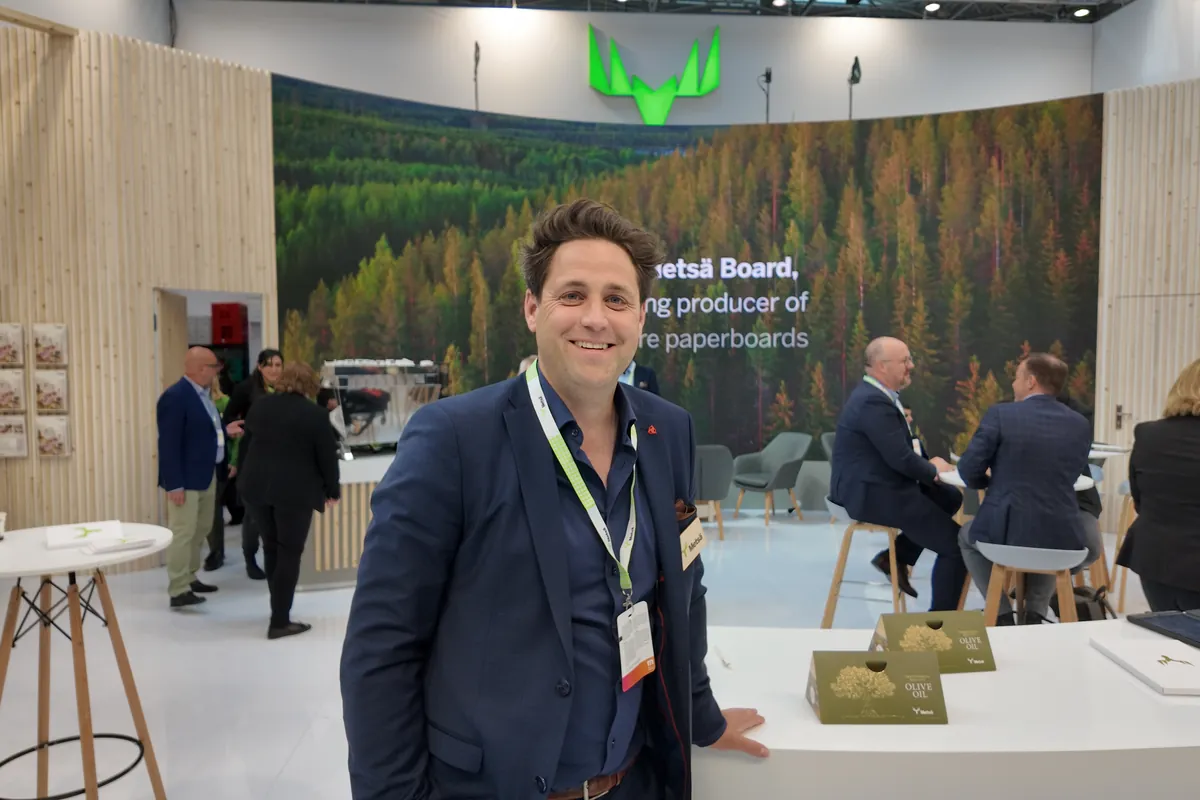 Metsä Board’s Tom Symons says circular forest ownership underpins long-term fiber packaging supply security.
Circular by design
Metsä Board, a Finnish paperboard producer, says it specializes in supply security and circular forest ownership. The company’s sales director for pharma and healthcare Benelux, Tom Symons, explains how the company is targeting fully fossil-free production by 2030, with several sites already operating at 98% fossil-free and some mills self-sufficient in electricity.
He notes that the company has invested heavily over the past five years in mill modernization, which he says is essential for long-term supply chain security.
“It’s important to know that we are here for the future and for the long term, no matter what crisis comes up,” Symons says. “We are self-sufficient; we have the trees.”
Metsä Board’s ownership structure, which consists of 90,000 forest owners across its parent group, who plant 33 million trees annually, is framed by Symons as a circular-economy proof point.
“We don’t want to run out of forests by 2050,” he attests. “We want to maintain them, because that’s our source of bread-winning.”
Symons further explains that brand-owner conversations have increasingly focused on supply security alongside sustainability targets.
“Circular economy is the most important one,” he adds. “The crisis we have today is making people aware that, at some stage, it’s about capacity, and it’s about solutions.”
The company recently introduced a new GC2, a type of premium and multi-layered folding box board, that is paperboard grade and produced in Sweden, expanding its mill footprint beyond its Finnish base. Symons highlights combination applications, such as trays with healthcare boxes, and primary and secondary packaging in unified fiber solutions, as the company’s broader competitive position.
“We are not only a paperboard company; we are a solution company,” Symons concludes.
A note of caution
WPO’s VP of sustainability and safe food, Nerida Kelton, offers a word of caution in the paperization conversation and urges brand owners and converters not to substitute fiber for plastic without rigorous life-cycle analysis.
“We have seen a significant shift from plastic to fiber alternatives, but the question always is — have they undertaken LCA?” Kelton asks. “Have they looked at the research to ensure it still maintains the flavor, the integrity, the safety aspect, and the extension of shelf life?”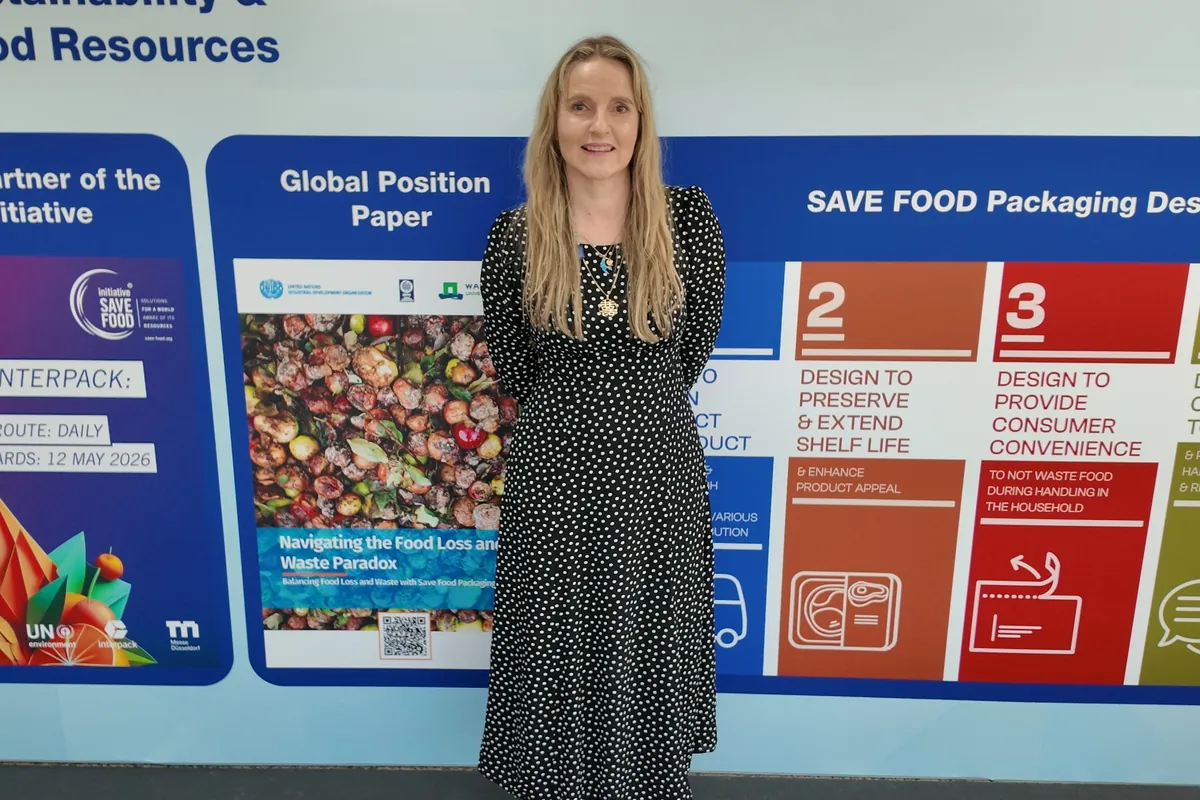 WPO’s Nerida Kelton urges life-cycle analysis before brand owners swap plastic for fiber alternatives.
She offers fresh produce as a worked example.
“Can you move a punnet of tomatoes or strawberries to a paper alternative? Yes, you can,” she admits. “But the questions you must ask are: is it an export or a domestic product, how far does it have to travel, and how long is that shelf life?”
“These are the areas we need to train and educate people on,” she emphasizes.
Kelton frames the organization’s position as material-agnostic but realistic about current polymer performance in food-safety applications.
“Even though we’re material agnostic, it’s important to understand that polymers at this moment in time are the best solution for food safety, human health, protecting, containing, preserving, and extending shelf life.”
“The whole point is trade-offs. We must look at how we find the balance between optimum packaging design, where we’re not wasting food but also not wasting packaging materials.”