
Mondi replaces wooden crates for furniture shipments

Key takeaways
- Mondi developed bespoke corrugated packaging for Büromodel’s acoustic office cabins, replacing traditional wooden and plywood crates.
- The stackable, wood-free solution reduces packing costs by around 20% while improving storage, assembly speed, and logistics efficiency.
- The recyclable packaging also addresses mold risks during sea freight and integrates into Büromodel’s operations without additional investment.
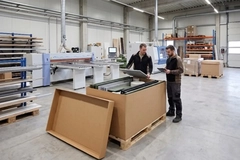 (Image credit: Mondi).
Mondi has partnered with the Turkish furniture manufacturer Büromodel to design a corrugated packaging solution that enables the shipping of acoustic office cabins and targets operational efficiency.
The wood-free solution aims to tackle mold issues usually associated with traditional wooden and plywood crates during sea freight transportation. These are falling in popularity among key export markets such as Germany and the UK, according to Mondi.
"The main challenge was designing a corrugated packaging solution tailored to the specific requirements of such large and heavy products. Through close collaboration, multiple design iterations, on-site visits, and packaging trials, the optimal solution was developed. Mondi's team provided continuous technical support and responded quickly throughout the project, ensuring a smooth transition and successful implementation," a Mondi spokesperson tells Packaging Insights.
"The transition from wooden crates to corrugated packaging resulted in an average cost reduction of around 20%, driven by lower material and operational costs," the spokesperson adds.
Sinan Müsellim, procurement manager at Büromodel, comments: “Moving away from wooden packaging was a strategic decision for us. Mondi’s team understood our operational requirements and worked with us to find a solution we could trust across different markets. That confidence in the packaging is just as important as the efficiency gains.”
Metin Morhayim, sales and marketing director at Mondi Corrugated Turkey, adds: “This project shows what is possible when packaging is treated as part of the customer’s operation, not just a protective layer. By working closely with Büromodel, we were able to design a solution that fits their processes and supports their business needs.”
Boosting efficiency
Mondi worked with Büromodel to switch to a bespoke corrugated packaging solution that ensures safe transportation and improved product protection, according to the corrugated packaging company.
“The transition has delivered multiple operational improvements, including more efficient use of storage space and enhanced logistics performance through a stackable design. Compared to Büromodel’s former in-house wood-based crate production process, the corrugated solution is easier and faster to assemble and pack, reducing the assembly time and labor intensity,” says Mondi.
The corrugated packaging can integrate into Büromodel’s existing production and logistics processes without requiring additional investment, the companies add. It is also said to reduce packing costs by around 20%, largely as a result of lower material and operational costs compared to the wooden alternative.
Mondi says that the packaging can contribute to end-user satisfaction and to Büromodel’s brand perception. “The use of recyclable corrugated packaging supports Büromodel’s environmentally responsible positioning and has generated positive feedback from customers.”
Last year, Mondi also partnered with Özler Tarım, a Turkish fresh fruit and vegetable exporter, to co-create a customized packaging solution.
Recently, the packager provided recyclable and digitally printed packaging for Riedel Glas and Prymat, a Polish dried seasoning manufacturer, with paper-based packaging that protects its aromatic spices. It developed corrugated packaging for fruit and vegetables for the Hungarian market and powder detergent packaging with 50% recycled content