

Compostable packaging goes mainstream: How technology, regulation & market demand drive innovation


Key takeaways
- The EU’s February 2028 home compostable label mandate accelerates demand for fruit and vegetable label adhesives.
- Tipa, TotalEnergies Corbion, and Taghleef expand home compostable packaging across child-resistant, foam, and high-barrier laminate categories.
- The PPWR positions compostability and recyclability as parallel end-of-life paths rather than competing packaging strategies.
The compostable packaging category recently received a regulatory boost from the EU’s mandate requiring home compostable adhesive labels on fruit and vegetables by February 2028. At the same time, compostable packaging technology is reshaping conversations about regional end-of-life strategy.
Packaging Insights speaks to experts from Tipa, TotalEnergies Corbion, Brückner Maschinenbau, and Taghleef Industries, to discuss the latest compostable innovations.
Compostable and child-resistant
According to Gary Tee, Tipa’s VP of global converting, the company recently created a home compostable child-resistant zipper for packaging, developed with its US partner, Presto. Tee says the company delivered its first commercial order earlier this year.
The zipper is paired with a compostable child-resistant base material, with both components engineered to meet child-resistant performance requirements together. The development opens compostable packaging to nutraceutical, cannabis-adjacent, and pharmaceutical-style packaging categories where child-resistant performance is a regulatory requirement.

“The material and the zipper have to work together to ensure we meet that child-resistant requirement,” Tee explains.
He also notes that adhesive development has been a parallel workstream for the company.
“Often it’s the adhesive that dictates whether it’s home or industrial compostable,” Tee adds. “We’ve been doing a lot of work looking at different adhesives in the market and optimizing those with our materials to allow us to develop more home compostable structures.”
He also frames home compostability not as a universal solution but as a meaningful option for specific consumer and market conditions.
“It also ultimately means if these materials go into an industrial facility, they’ll break down even quicker, which is a bonus,” Tee says.
At the same time, Tee highlights that Tipa also recently invested in SealPap, a paper-recyclable technology platform he says the company plans to develop into a dual-pathway material: compostable and paper-recyclable, with added barrier capability.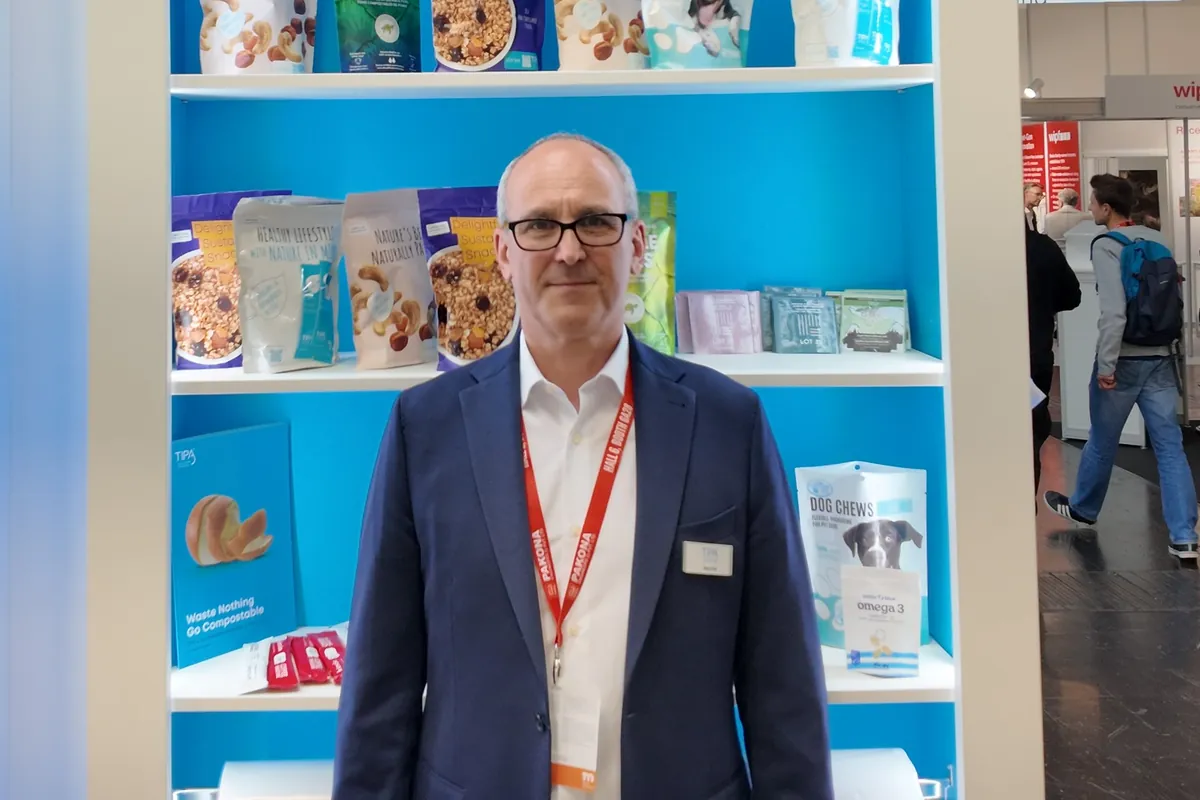 Tipa’s VP of global converting spotlights its home compostable child-resistant zipper for nutraceutical and pharmaceutical packaging.
“We’ll have barrier papers with compostability and recyclability, opening that whole market for us,” Tee underscores.
Closing the coffee capsule loop
At Interpack 2026, TotalEnergies Corbion presented expandable Luminy polylactic acid (PLA), a bio-based foam material developed in cooperation with Chinese machinery manufacturer Useon. The technology converts compact PLA granules into pre-expanded beads, which the company says are suitable for protective packaging applications historically served by expanded polystyrene (EPS).
Alberto Fornaro, business development consultant at TotalEnergies Corbion, tells us that the material combines the protective lightweight properties of EPS with sugarcane-derived feedstock and industrial-compostable end-of-life.
“It comes from sugarcane, of natural origin, and offers a very low carbon footprint,” says Fornaro. “It is biodegradable, or even more specifically, it is industrially compostable.”
“This offers help when the packaging is born, by decreasing the environmental impact.”
Fornaro emphasizes that the development relied on close collaboration between the polymer and machinery sides.
“The nature of our polymers, and having fine-tuned its characteristics in cooperation with the machine manufacturer, has allowed us to achieve something that indeed was not possible before,” he stresses.
Fornaro also reveals that the company sees its strongest near-term opportunity in single-serve coffee capsules, where the mixed-material problem — organic coffee grounds inside a plastic shell — creates a recycling dilemma most consumers ignore in practice.
“Nobody does it,” he attests. “The advantage of having a compostable capsule is that as a whole, once you've had your beautiful, possibly Italian coffee, you just throw the whole capsule into the organic bin, and then it will be converted by nature into fertilizer, closing the loop.”
“This is a nice example of a circular economy.”
Fornaro adds that TotalEnergies Corbion is engaging with both legislators and consumers on the case for compostable coffee capsules as a system-level solution to a mixed-material recycling problem.
High-barrier compostable laminates
Tipa also recently introduced T-LAM-428 and T-LAM-418, two metalized high-barrier laminate structures that Tee says unlock applications previously inaccessible to compostable substrates.
He also reveals that T-LAM-428 is the company’s highest-barrier laminate, and achieves oxygen transmission rates and water vapor transmission rates of one. The T-LAM-418 grade, a two-ply structure with slightly lower barrier, targets the chips and crisps sector with thinner construction.
“It’s all great having the barrier, but if you don’t have the seal performance, you lose the barrier very quickly,” Tee explains. “Our two-ply version, T-LAM-418, is suited really well for the crisp industry.”
Tee also spotlights Tipa’s product evolution.
“Over that time, we’ve moved from one monomaterial to metalized layers,” he says. “We’ve got materials to emulate PE as well as PP, which are chemically very different, but are certified compostable using our own patented formulation.”
Tee says the company’s regional strategy reflects different market realities on each side of the Atlantic.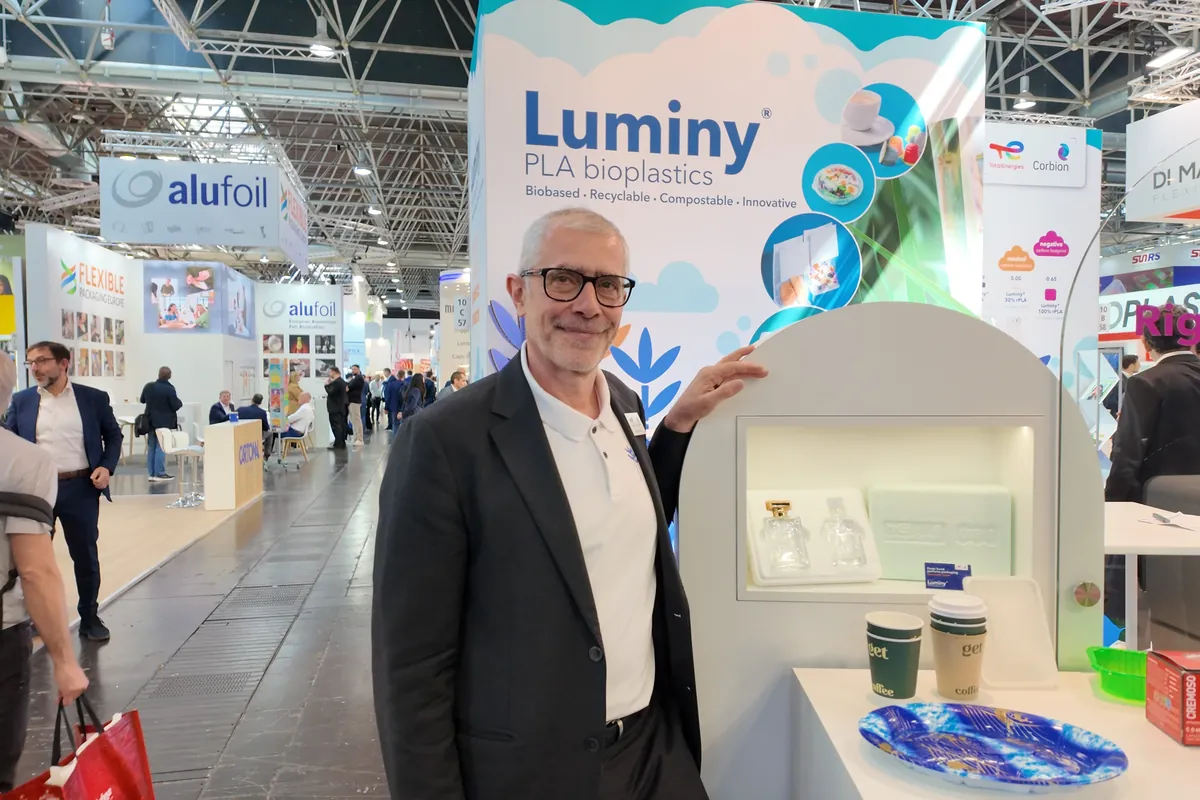 TotalEnergies Corbion’s business development consultant highlights Luminy PLA foam as a sugarcane-derived alternative to EPS.
“Europe has, I would say, more of an appetite currently for recyclability, but compostability certainly has a place in Europe,” he underscores. “The US is very different; it’s very much more progressive, looking at different solutions.”
“Different states have different opinions. Some are very pro-compostable, and others not so much.”
In Europe, Tee says Tipa is targeting tea, coffee, and condiment sachets. He notes these are small flat formats that may be food-contaminated and, therefore, lend themselves to the compostable category rather than recyclable when it comes to the material’s end-of-life.
He also says that the company’s portfolio is broader in the US, and spans ambient, frozen, and chilled categories, including tea, coffee, nutraceuticals, and gummies.
The 2028 label mandate
At the same time, Tee identifies the EU’s February 2028 mandate on home compostable fruit and vegetable labels as the regulatory milestone reshaping near-term development priorities.
He says that Tipa’s 312 MET face-stock has been certified in combination with a home compostable adhesive developed by Bio4Pack. He adds that there are currently significant trials underway in both Europe and the US.
“In the UK, it’s a recommendation; in Europe, it’s legislation,” says Tee. “We’ve been working hard on this development.”
“The adhesive is unique to them, and we had to develop our own face-stock to work with that, and then we had to certify the combination as well.”
Tee is also clear about the development timelines compostability requires.
“Nothing in compost moves particularly quickly because the compost testing can take up to 12 months,” Tee asserts. “We have to be patient, we have to do the work up front, and then we have to apply for certification.”
Unlocking home compostability
In North America, the compostability story is being driven by different pressures than Europe’s. Sebastian Ruhland, the director of product management at Brückner Maschinenbau, whose machinery supports PLA and polyhydroxyalkanoates (PHA) blends for home compostable films, identifies PepsiCo as a leading driver of home-compostable formats in the US.
However, Ruhland also notes that this can be a defense against potential litigation over packaging litter, as well as an end-of-life optimization.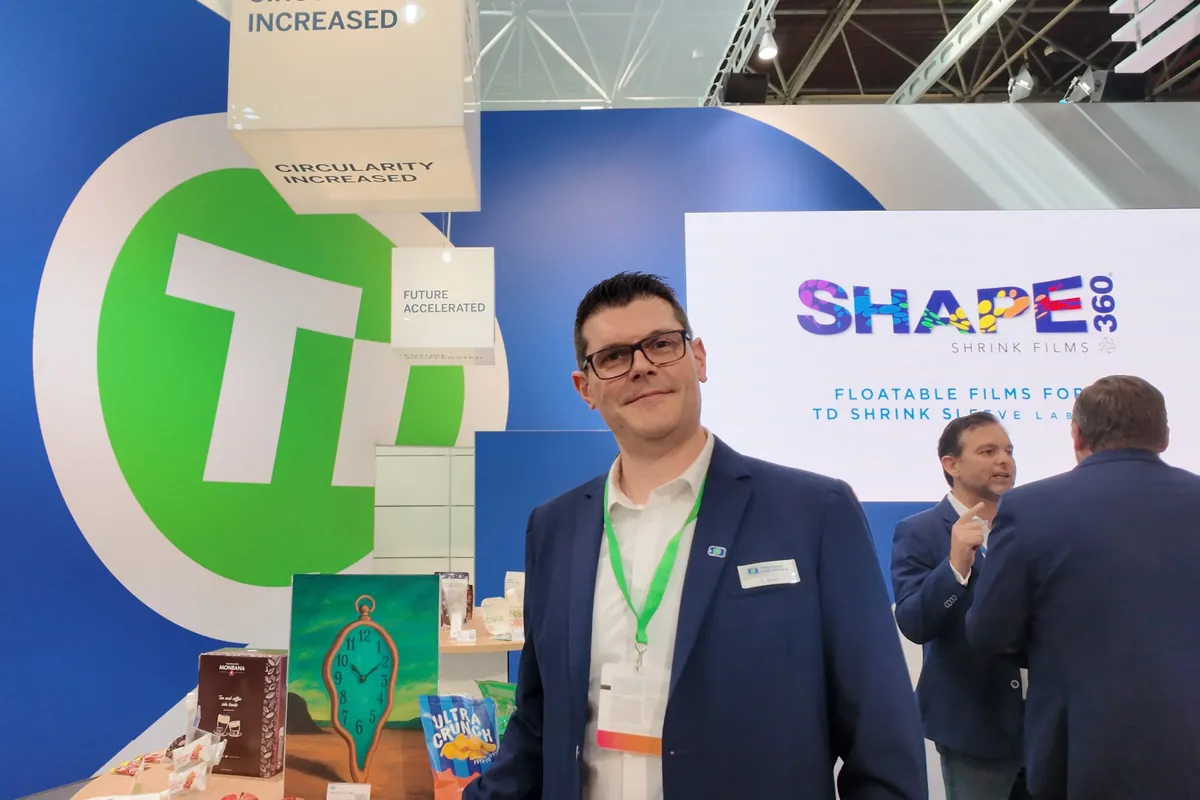 Taghleef's senior product manager for flexible packaging EU positions compostability and recyclability as parallel end-of-life paths under PPWR.
“PepsiCo is driving this more for the North American region, where a recycling stream is not yet really visible,” he reveals. “In order to avoid any court cases for littering the environment, they are thinking of going into home compostable solutions.”
Ruhland adds that current home compostable formulations typically combine PLA with PHA, with the PHA component enabling true home compost performance.
He notes that the combination also addresses earlier-generation PLA limitations, including industrial-only compostability and the loud, brittle packaging behavior that initially limited PLA adoption in snack applications.
“PHA combined with 30% to 40% PLA makes it home compostable,” Ruhland stresses. “The supply chain is established.”
“Of course, there’s still a cost issue and, therefore, you see very limited adoption. In packaging, cost is still the dominant driving force, even if you have sustainability targets and other motivations.”
Taghleef Industries also expanded its compostable offering at Interpack 2026, launching home compostable grades within its Nativia product family. Daniel Borin, Taghleef’s senior product manager for flexible packaging EU, tells us that the launch positions compostability and recyclability as parallel rather than competing end-of-life paths under the EU Packaging and Packaging Waste Regulation (PPWR).
“Recyclability, from one side, includes monomaterials, simplifying structures to make them thinner and less complex, and to improve recyclability,” Borin concludes.