



October in review: Pack Expo & Material Week Tokyo reflect changing industry priorities

Key takeaways
- Pack Expo 2026 and Material Week Tokyo 2026 highlighted developments in packaging automation, convenience, material innovation, and recyclability.
- EU regulatory developments included proposed changes to packaging EPR requirements for SMEs and a draft list of countries eligible to import waste.
- Major brands and packaging companies explored recycling claims, food waste reduction, material optimization, and the transition to 2D barcodes.
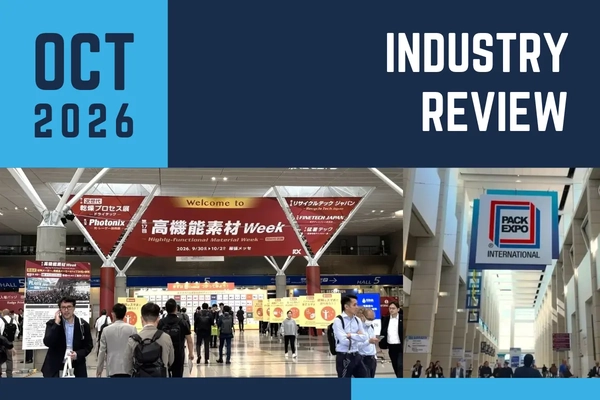
This month, Packaging Insights attended two major industry trade shows: Pack Expo 2026 in Chicago, US (Oct 18–21), and Highly-Functional Material Week Tokyo 2026 in Japan (Sep 30–Oct 2).
While automation and convenient formats emerged as significant topics at Pack Expo 2026, and plastic innovation stood out as a key development at Material Week Tokyo 2026, both events highlighted how global packaging regulations are impacting the industry and driving material optimization.
Regulatory developments impacting the industry this month included the EU’s draft list of countries that could be allowed to import packaging waste under the Waste Shipment Regulation. At the same time, the EU Parliament voted to temporarily suspend some requirements for micro, small, and medium enterprises under its packaging EPR rules.
Meanwhile, Coca-Cola, Nestlé, and Danone committed to changing the recycling claims advertised on their plastic bottles after a dialogue with the European Commission (EC) and the Consumer Protection Cooperation network.
We look back at these and other major industry developments from October.
Pack Expo 2026 review: Industry balances material optimization, shelf life and recyclability
Over 72,000 total packaging and processing professionals attended Pack Expo 2026. Conversations with companies on the show floor highlighted growing industry demand for material optimization and recyclable packaging structures amid evolving regulatory requirements.
We spoke to Peak Nano, ProAmpac, Uflex, and SIG about the packaging industry’s efforts to reduce material use without compromising performance, increase the availability of post-consumer recycled materials, and simplify structures to support recyclability.
Pack Expo 2026: Tetra Pak, SIG & TNA on innovating for on-the-go packaging formats
Also at Pack Expo 2026, packaging companies highlighted convenience and portability as key drivers of snack packaging innovation in North America.
Busy lifestyles and growing interest in portion control are prompting companies to develop smaller formats designed for on-the-go consumption, experts from SIG, Tetra Pak, and TNA told us at the show.
Pack Expo 2026: Siemens showcases AI-powered digital twin for flexible filling
Siemens presented its digital twin robotic solution, made in collaboration with PepsiCo and Nvidia, that uses AI to improve the speed and efficiency of packaging and bottling lines, at Pack Expo 2026.
On the show floor, we spoke with Andrea Sassetti, digital enterprise innovation manager at Siemens, about how the solution helps brands respond to emerging beverage trends and growing US EPR pressures.
Material Week Tokyo 2026 review: Japan’s plastics policies drive innovation
At Material Week Tokyo 2026, 1,016 exhibitors spanning corporations, industry organizations, and research institutions, presented packaging innovations across films, plastics, metals, ceramics, and sustainable materials to approximately 35,811 visitors.
Driven by the expansion of the regional packaging market, businesses are aligning their strategies with Japan’s accelerating plastics policies, as well as international regulations, exhibitors told us.
Material Week Tokyo 2026: Oji showcases bio-based materials to replace plastic cushioning
Oji Holdings, one of Japan's largest paper, pulp, and packaging companies, presented an array of solutions at Material Week Tokyo 2026.
On the show floor, we caught up with Vipavan Sae Gang, manager at Oji Paper, a subsidiary of Oji Holdings, to discuss the company’'s material innovations, which span food containers for fresh food products and fabrics aimed at replacing conventional bubble wrap.
EU drafts waste export list as Tomra urges recycling investment
The EC published a draft list of countries outside the OECD that could be allowed to import non-hazardous waste from the EU after May 2027, under the Waste Shipment Regulation.
Non-hazardous waste includes recovered paper and cardboard, metal scrap, glass, and certain textiles and rubber, depending on composition and contamination levels.
EU Parliament committee backs EPR reprieve for SME packaging
The European Parliament voted in favor of a proposal to temporarily suspend authorized representative requirements for micro, small, and medium enterprises (SMEs) under packaging EPR rules.
We spoke to the EU-wide industry organizations EuroCommerce, the European National Registers for Packaging, and Thuiswinkel.org, representing the Dutch e-commerce sector, to better understand what the move means for compliance with the EU’s Packaging and Packaging Waste Regulation for SMEs based in the EU and beyond.
Coca-Cola, Nestlé & Danone to revise plastic bottle recycling claims after EU dialogue
Coca-Cola, Nestlé, and Danone committed to changing recycling claims advertised on their plastic bottles after a dialogue with the EC and the Consumer Protection Cooperation network.
The changes aim to provide consumers with “fair and clear information” about the recycling characteristics of the bottles, in line with the requirements under EU consumer law. We spoke to Danone and the EC to find out more.
Sealed Air, Coveris & Dole rethink food packaging to cut waste and carbon
Global supply chains are seeking to reduce waste and carbon emissions as regulations aim to tackle rising GHG emissions. Increasingly, the packaging industry is combining developments in material science with smarter logistics to improve how food is protected, preserved, and transported.
We spoke to Sealed Air, Coveris, and Dole about how innovative materials, optimized engineering, and circular supply chain strategies are transforming food preservation without compromising product quality or sustainability goals.
FSSC warns packaging reduction can drive food waste if protection fails
Material reduction innovations are growing across the F&B industry as regulations and sustainability targets attempt to reduce packaging waste. However, Antoinette Maake, technical officer at Foundation Food Safety System Certification (FSSC), warned that only when essential food-protection and usability functions remain “fully effective,” can material reduction contribute to environmental benefits.
EU and Canada move faster than US on GS1 Sunrise 2027
The GS1 Sunrise 2027 transition from traditional 1D codes to new 2D codes, like QR and GS1 DataMatrix, is set to come into global fruition next year. However, according to Leibinger Group and Markem-Imaje, the changeover is taking place faster in the EU and Canada than in the US, where industry interest remains low.
Syndigo: Brands risk overlooking data challenges behind Sunrise 2027
Brands risk underestimating the data challenge behind the global project Sunrise 2027 by focusing on the barcode rather than the information it delivers, according to Tarun Chandrasekhar, president and chief product officer at Syndigo, a software and product data services company.